El-Zaytoon Neighborhood also lies in the center of the ancient
overhill city. It occupies its southern part and has been so called due to the fact that
part of the town was densely planted by olive trees, some of them still cover the southern
part of this neighborhood. El-Zaytoon was an integral part of the city center representing
together with El-Daraj the commercial center before World War I. During the first war, the
two parts were separated by Jamal Basha Street, later to be called Omar El-Mokhtar Street
in the thirties. As described by Jabaly 1644, the area used to be a complex of brisky
markets such as Surojeia, El-Najareen Markets etc.
El-Zaytoon
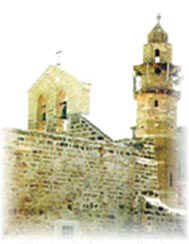
Neighborhood was distinguished for its holy and antique places. These include
El-Shama’a, El-Ajamy and Kateb Wellaia mosque. The latter still boasts the survival
of its ancient minaret. The inscription which goes back to the year 735 Hijri appears on a
marble stone at the bottom of this minaret can be translated as follows:
"IN THE NAME OF GOD, THE MOST
COMPASSIONATE, EVER MERCIFUL. AT THE REQUEST OF OUR MASTER, ELASHRAFI LESEIFY AFNAN ELANY,
DEPUTY SULTAN IN SAFE GUARDED GAZA, THE CONSTRUCTION OF THE MINARET WAS ORDERED WITH THE
HOPE OF OBTAINING GOD’S SATISFACION AT THE BEGINNING OF MOHARAM IN THE YEAR
735".
This
inscription surrounds a circle composed of a pen case with a cup in the middle and a lily
beneath. The mosque was renovated by Ahmed Beik, a province clerk during the reign of the
Ottoman Sultan Murad 925 Hijri. This is clearly shown on the marble door still.
There was a
cemetery just at the southern outskirts of El-Zaitoun. This cemetery with marble columns
in the middle used to be called Martyrs cemetery. The names of some of the martyrs who
died in defense of the city against invaders. Were written on those columns. For this
reason, this part is still called the Columns Suburb "Haret El-Awameed". One of
the Most important Christian buildings is Porphyrius Church built in 5th century, Bishop
Prophyrius was buried in that church. |