El Daraj Neighborhood occupies the city center. It was so
called with reference to the various steps leading up to El-Refa’ee waterwheel which
is located in the southern part. Some, however, say that the name refers to a distance
view of the place which appears to the onlooker as stairs made up of many steps. The
former, however is more accurate. This name goes back to the Ottoman era. The ancient name
of El-Daraj neighborhood was Bani Amer given after an Arabian tribe that inhabited Gaza at
the outset of the Islamic Conquest. During the Mameluk era, El-Daraj was called
El-Barjalia, this is a direct reference to the defenders of the surveillance towers
located near the eastern wall of the city. Until now, El-Daraj has been an architectural
and commercial center. It is distinguished for its antique markets such as El-Kesaria
Market which is still there, the disappearing Khan El-Katen, Khan Zeith and Grains Market
of which some reminiscent but in need of amelioration.
The
old quarters of El-Daraj used to have ceilings and were called Sobats, an example was
Sobat El-mufti which was removed in the sixties of the present century. To the East of
El-Daraj, there has been and, is still there, the pottery quarter which has been known for
pottery making. In this area, the Moslems had constructed several mosques, prayer rooms,
general baths, schools and libraries. Of these, the most important is El-Omary Mosque
which is located in the city center. This place has been sanctified by the Gazans for
three thousand years, since the heathen and until it was converted into a mosque by Omar
Ibn El-Assi in response to Moslems’ demand. The Moslems had restored and ameliorated
the mosque several times and this can be demonstrated by the inscriptions found on some
stones of the door steps and the thresholds and window stills. The inscriptions on the
Eastern door read as "By the will of Sultan Mansour Hussam El-Dein Abu El-Fateh
Lajeen El-Mansouri 1297 AD." In 730 Hijri Sultan Mohammed Guallown ordered an
extension of the mosque. A portico was constructed with a door leading up to El-Kesaria.
In 1788 AD the minaret of the mosque war restored and in 1875 AD during the time of
Ra’oof Basha, the commander of El-Quds, the whole mosque was renovated. The final
restoration had been in 1345 Hijri when the mosque was devastated by the allies’ navy
in the First World War.
There are other
ancient mosques in El-Daraj neighborhood. In this respect, it is important to mention
mosques like El-Sheikh Zakaryia, El-Wazeeri, El-Sayed Hashem and El-Ahmadia prayer room.
El-Sayed Hashem, prophet Mohammad’s grandfather, (peace upon him), is strongly
believed to have been buried in that mosque which was first constructed by the Mameluk.
In 1266, the
Ottoman Sultan Abed El-Majeed ordered the renovation of the mosque. During the First World
War, the mosque was hit by a shell and was greatly damaged, yet, the High Islamic Council
restored it. In this part of the city, there used to be some public baths such as the
Market and the Soldiers’ baths.
One of the most
important antique buildings at El-Daraj, has been the palace of Al-Redwan family which is
still present and mistaken for Napoelon castle, El-Zahra Secondary School at present. The
Construction style of this building does not indicate a military function as it is a two
storey building with Windows. The palace was built during the reign of Al-Redwan princes
who ruled the city at the outset of Ottoman era and remained in power until the
seventeenth century. The inscriptions, the Islamic drawings and decorations shows on the
stones, in addition to certain stones carrying the lion logo of Elzaher Peipers 1260-1277
AD, substantiate the fact that the building’s history goes back to Al-Redwan reign.
However, it is noteworthy to mention that Napoleon took the palace as a temporary
headquarters during his invasion to Ako in 1799. |
|
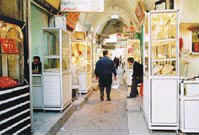
Gold Market |
|
|
|
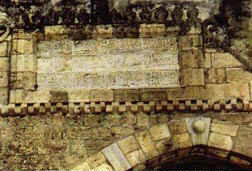
One of the Grand Omari Mosque's sketches |
|
|
|
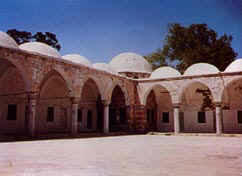
Al-Sayyed Hashem Mosque
|
|