El-Montar Hill is situated in the east of Gaza 85 meters above
the sea level. This has made El-Montar Hill acquire a strategic military stronghold in the
past. As a key access to Gaza, the hill was a camping place for Napoleon's army. During
World War I, thousands of allies soldiers were killed in front of El-Montar Hill. All of
them were buried in Gaza's First World War Cemetery.
Moslems, during
their conquests, made use of El-Montar’s strategic location. They used it as a
surveillance point, thus following the example of their ancestors the revered Caliphs by
choosing hills and high positions as surveillance towers. In case of an assault against
the city, the men at these points would ignite fire at night or release smoke in the day
time. Then the city inhabitants would quickly learn about the coming enemy. Consequently,
the name El-Montar was exclusive to the functional implication of the Hill. This
contradicts with the assumption of some Orientalists who claimed that El-Montar was
derived from Montarious or Porphyries the priest who introduced Christianity to Gaza at
the outset of the fifth century AD. Another claim is that, during the funeral of one the
righteous men, the corpse flew then descended. All these claims are unfounded and the best
evidence is the application of the name to various hills and high positions in Palestine
and Jordan. The tomb of one of the righteous men (Sheikh Mohammed El-Batahi) on the hill
reinforced the importance of the hill where annual festivals used to be held on the hill.
The above mentioned Sheikh is strongly related to Sheikh Radwan and Sheikh Ejleen, the
former refers to a Northern suburb of Gaza, while the latter refers to a Southern one. The
three Sheikhs are said to be the sons of Shekh Arkoub Zein Hamada, the son of Sheikh Ali
Iben Aleem, buried in Arsouf near Jaffa. The latter is directly related to Omar Iben
El-Kattab (God bless him) one of the four Caliphs.
El-Montar Hill
will remain a place rich in its antiquity but in need for more research and investigation. |
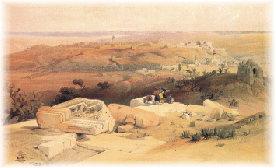
Montar Hill, 1839
|