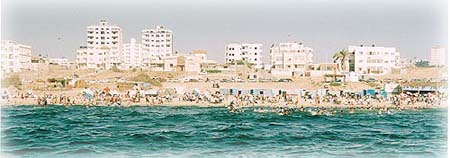
Tourism in Gaza
depends mainly on the sea whose shores are famous for their golden bright sand; several
precautionary measures have been taken to protect the shores from pollution. Tourism also
depends on the archeological and historical sites, which are wide spread in Gaza; more
archeological sites are under exploration. Gaza is famous for its moderate weather in the
summer and winter, which encourages the people, to go to the beaches, parks and gardens.
People also spend their leisure time on farms, orchards, and at touristic facilities.
The Sea:
The most
beautiful sights in Gaza are the sea, the beaches, the coast, the sky, the golden bright
sand, the sun and warmth, and the soft breeze. Gaza is the beautiful mermaid, which
attracts tourists to its sea and beaches. Gaza depends on tourism. It is expected that the
number of tourists and tourist trade would increase after the declaration of the
independent Palestinian State.
Several
fantastic tourist projects were implemented on the sea beach; they provide the visitors of
the city and the sea with the services they need. Gaza municipality has given the beaches
special concern because of their important role in attracting tourists and residents. The
municipality cleans the beaches and works on developing them. It also provides beach
observers and lifeguards in the summer, the busiest tourist season. The municipality has
taken several preventive measures to protect the waters and beaches from pollution. It
implemented several projects for sewage and treatment.
Archeological
Sites:
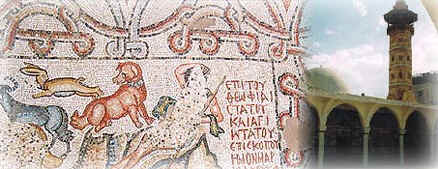
Gaza and its
surroundings are considered a historical museum and a painting on which history carved a
valuable and glorious heritage. It is one of the cities in the world, which has a large
historical and archeological heritage; many events took place in the city. A large number
of ruins were discovered after excavations started in the nineteenth century.
Gaza City,
which is now full of houses, streets and fields, hides magnificent historical treasures
under its sand. They should be excavated in order to manifest our deep-rooted Arab
identity at the time when we face a foreign enemy, which has no history. The enclosed
areas, from the northern to the southern end are like an integrated historical painting.
Thus, it is not surprising that Herodos, "Father of History", called it 'the
great city' or "Beilini", the Roman historian, praised its greatness.
Unfortunately, many of the wonderful pieces of ruins were stolen, destroyed, smuggled, or
buried by time or because of negligence.
The ruins in
Gaza did not get the attention they deserve during the past decades; they remained
neglected without any research, documentation or maintenance. The Israeli occupation
period had witnessed what we might call "the ruins massacre" because important
pieces were stolen in a planned and systematic method. High Israeli officials including
Moshe Dayan have done this. When the National Palestinian Authority took over, there were
serious efforts paid by the concerned parties to restore the ruins; Gaza municipality has
an important role in that. As a result, these places have regained their beauty and their
historical and Islamic importance so as to be a window through which the world can look at
our culture and which encourage tourists to visit our great ruins.
The most
important historical sites in Gaza:
The mosque
contains the tomb of Hashem Ben Abd Manaf, the Grandfather of the Prophet Mohammed. It was
built by the Memlukes and renovated by the Sultan Abdul Hamid in the year 1850 AD (1268
Hijra). Gaza was called Hashem's Gaza, after him.
It contains the tomb of the holy
man, Sheikh Ali Ben Marwan.
It was built during the first
Islamic era, the Omary conquest.
This mosque is
adjacent to the Roman Orthodox church known as "Saint Perforius Church". It was
built in 735 Hijra during the Memluke period. After the mosque was destroyed, Ahmad Beik,
the clerk of the district, during the reign of Salim II, the Ottoman Sultan, rebuilt it in
the year 995 Hijra. There are 23 historical mosques in Gaza City.
Dabboya is the
only fortress whose ruins still exist. It was located in the place where the Zahra' School
is situated. It was a Crusaders fortress built on the remains of an Arab fortress. The
fortress was renovated in the your 1149 AD during the reign of Baldwin III and during the
Crusade Wars. There are other ruins from the times of the Pharaohs and the following
historical periods.
Saint Perforius
was born in Salonika, Greece. He came to Gaza on 21st March 395 AD accompanied
by "Deacon Murqus" who wrote the biography of this saint. The building of the
church continued for a period of 5 years and it was opened on 14th April 407
AD. |