

Birzeit University is proud to present Our Voice, an online collection of research,comment and analysis from Birzeit University staff and students. Our Voice is a first for Palestine, an opportunity for the Birzeit community to promote the high quality work of the university. Choose a category on the right , or see the latest additions below.

[About the Background Image]
What's New

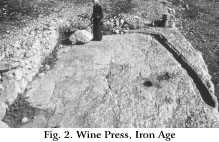
- Taken from the new Journal of Palestinian Archaeology, we reprint an articleKhirbet Birzeit 1996, 1998-1999: Preliminary Results Khirbet Birzeit is a multi- period site with an occupation
extending from the Iron Age to the Ottoman period. The
evidence from the excavations indicates that, after the
early phase of the Ottoman period, the site was exploited
by the inhabitants of Birzeit mainly for agricultural
purposes.This article details results from 3 seasons of excavation. Added 26/4/2000.
- Samia A. Halaby, a free lance artist from New York contributed
an article titled: THE LANDSCAPE OF PALESTINE IN ARABIC ART published in Birzeit University publication The Landscape of Palestine: Equivocal Poetry (pp. 175-190), a volume that sums The Fifth International Conference convened by Birzeit University under the theme Landscape Perspectives on Palestine, which took place during November 12-15, 1998. Added 15/02/2000.
- Albert Aghazarian head of the Public Relations Office in Birzeit
University writes an article: Would
Jerusalem soften its heart of stone? for a publication called "Christian
Voices From The Holy Land Bethlehem 2000 Palestine Year One?" published
by the Bethlehem 2000. Added 16/12/99.
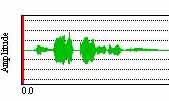
- Palestinian Arabic has a rich variation depending on location. In
this article, Kimary Shahin from Birzeit University and the the University
of British Columbia analyses different
speech samples from Gaza, Rafat, Nablus and Hebron. With Audio.
Added 16/10/99.

- A new article by Professor Roger Heacock entitled Between
Systems and Salami: US Policy Towards the Palestinians and the Middle
East in the Late Twentieth Century. The article traces the successive
policies of US administrations towards the Middle East and proposes
that sovereign states tend to range in their foreign policies between
two strong alternative poles, and that this pendulum-like movement often
occurs between successive administrations. Added 9/10/99.
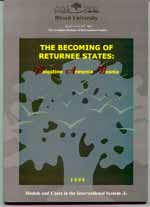
- Professor Roger Heacock examines the evolution of the Palestinian
national movement with a particular focus on the "inside" and the "outside"
or locals and returnees, in his article "Locals
and Returnees in the Palestinian National Authority (PNA): A Historical
Perspective". The article is taken from the book (pictured right)
"The Becoming of Returnee States: Palestine, Armenia, Bosnia" published
by the Graduate Insititute of International Studies, Birzeit University
1999 Added 4/10/99.

- George Giacaman, Dean of Graduate Studies at Birzeit University, discusses
the features of the Algerian situation that might be relevant to the
Palestinian context in his article Order
and Disorder After Oslo: Some Parallels Between Algeria and Palestine
Added 27/9/99.
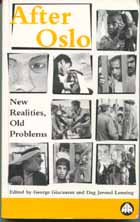
- George Giacaman, Dean of Graduate Studies at Birzeit University, discusses
the Oslo Accords and their affects on Palestinian society, the PLO and
civil society in his article "In
the Throes of Oslo: Palestinian Society, Civil Society and the Future".
The article is taken from a book edited by Giacaman, entitled "After
Oslo". To order the book, click here.
Added 27/4/99.
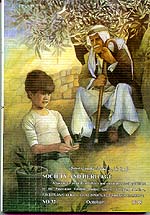
- Palestinian humor has passed through several stages since the beginning
of the negotiations with the Israeli government. Sharif Kanaana examines
these different stages and what they reveal about Palestinian attitudes
towards the "Peace Process" in this article, "Palestinian
Humor and the Peace Process". Added 30/1/99.
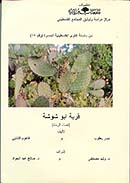
- The village of Abu Shusha was one of the over 400 Palestinian villages destroyed in 1948. We publish an excerpt of a detailed monograph about the village based on oral history interviews with survivors and historical research. The monograph is one of 22 published by the Center for Research and Documentation at Birzeit University. Details also available on how you can order these publications and if you can translate from Arabic to English we are looking for your help! Added 13/1/99.
to Birzeit University


Journal of Palestinian Archaeology (JPA) is a new journal, published by the Palestinian Institute of Archaeology of Birzeit University.
Editor: Khaled Nashef.
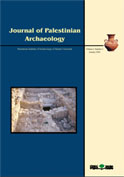 JPA
will appear in two issues per year (January and July), between 96 and
128 pages each. The first issue (112 pages) is scheduled for January 2000,
and will appear in February.
JPA
will appear in two issues per year (January and July), between 96 and
128 pages each. The first issue (112 pages) is scheduled for January 2000,
and will appear in February.
JPA focuses on the archaeology of historical Palestine, its geographical horizon, however, encompasses countries of the Eastern Mediterranean, including the Arabian Peninsula. It includes articles in archaeology, ancient writings, ethnography, Old and New Testament. JPA prefers studies exhibiting new primary material, such as fieldwork reports, collections of artifacts, inscriptions, or individual finds or texts. JPA also seeks articles furnishing innovative concepts, interpretations, and new directives in the archaeology of Palestine and the Arab World.
In addition to the specialists, JPA also addresses readers who view their interest in archaeology and history as a crucial step towards shaping Palestinian historical consciousness. It encourages participation of non-specialist or graduate students, when their contributions enrich the substance of the Journal.
JPA is the platform of the Palestinian Institute of Archaeology (PIA) of Birzeit University. It expresses the ambition of the Institute to enhance among Palestinians an interest in archaeology as an integral part of their history. JPA is the concrete outcome of a policy aimed at promoting fieldwork, research, publication and the development of a graduate program. Click here for more information. Also available in Arabic.
 Palestinian Journal for Historical Studies. This journal, published by the Palestinian Society for Historical Studies in cooperation with Al Aswar-Acre, is a bi-lingual research journal. The first issue contains an article by Roger Heacock entitled Saying No: The role of rejection in national identity formation - the case of Palestine. For more information, visit this link.