

SERIES ON PALESTINIAN DESTROYED VILLAGES
The Center for Research and Documentation of Palestinian Society at Birzeit University has published 22 monographs on Palestinian villages destroyed during 1948. The idea for this visionary project was articulated in 1979 by Professor Sharif Kanaana and Dr. Kamal Abdulfattah and is continued today by the Centre. This series aims to document and preserve Palestinian history and culture for future generations, in particular in relation to the over 400 villages destroyed during the 1948-49 war which according to British Mandate statistics were home to 340,000 Palestinians.
The series combines oral history interviews with survivors from 1948 and available written historical sources. Currently, monographs are available on the following villages:
| 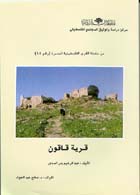 No 14. in the series - Qaquun 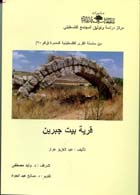 No 20. in the series - Beit Jabreen 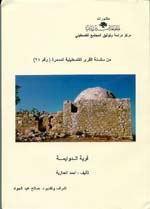 No 21. in the series - Ad Dawaymeh |
We Need Your Help!
The publications above are currently only available in Arabic. We believe it is extremely important that this material is made available in English in order to explain and inform the world about Palestinian history. Due to limited resources, the Centre for Research and Documentation is unable to translate the works above and so we are appealing for your assistance. If anyone is able to volunteer translation services for one of the publications above we would be extremely grateful. Volunteers will receive complimentary copies of all of the monographs above and will be acknowledged on the Birzeit website and the publication of the translated version. Please contact the Birzeit webmaster if you can help at webmaster@birzeit.edu
Each of the publications above costs US$6 (includes postage and handling). If you would like to receive copies please contact the Birzeit webmaster at webmaster@birzeit.edu
Below we publish the introduction to the Abu Shusha monologue by Dr. Saleh Abdel Jawad former-Director of Centre for Research and Documentation, Birzeit University.
Abu Shusha - The Massacre
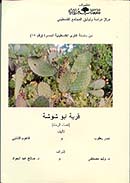 No 18. in the series - Abu Shusha |
At the dawn of 14 May 1948, when the first light of day began to reveal itself and replace the darkness of night, while the muezzin called 'Prayer is better than sleep' and while through the plains and valleys the echo of the call 'Allahu Akbar' rang out, the units of the Zionist Givati brigade began their final assault on the village of Abu Shusha east of the Palestinian town of Ramleh. The object of the military operation was to occupy the village and deport its Palestinian inhabitants.
This was the beginning of the unknown massacre in which around sixty Palestinian men, women, and children were killed. The luckiest of them were shot dead individually during combat. Others, however, were rounded up and shot together, and some were killed by axe-wielding soldiers. The last thing that these victims saw was the grim demeanour of their murderers. The massacre was beyond the imagination of these villagers.
The residents of Abu Shusha witnessed the arrival of Jewish reinforcements at the neighbouring settlement of Kibbutz Gezer the day before the massacre. Everyone in the village realised with fear that their 'midnight hour' was upon them, and that the final assault on their village was near. The assault was to follow months of minor skirmishes between the Jewish settlers of Kibbutz Gezer and other Zionist communities in the area and the Palestinian villagers. The village had thus already experienced the psychological warfare of the Zionists. The settlers had previously suggested a non-aggression pact between them and the villagers(2). However, the main purpose of such proposals was to play for time, giving the leaders of the Haganah the space to concentrate their military forces on other fronts in the early stages of the war. The other purpose of such agreements was also to create tensions and fissures in Palestinian villages known for their factionalism and to create deeper divisions among them concerning the agreements. The villagers of Abu Shusha had rejected such proposals.
At the height of the massacre, the scene in Abu Shusha was a bleak one, mirroring the general picture in Palestine at that time. On the same day 13 May 1948 two days before the announcement of the independence of the State of Israel end before the decision of the Arab governments to send their armies to Palestine Palestinian society was on the point of collapse.
As British soldiers prepared to evacuate the country the administrative structures of the mandate government crumbled. The Palestinian leadership had never been allowed by the British to prepare themselves to inherit the mantle of government. While the Zionists had created a 'state in waiting' the Palestinians had been excluded from the decision-making process and positions of power by the Mandate authorities. This situation led to a sense of anarchy in Palestinian circles, uncertainty about the future and a vacuum in the political leadership and organisation. All this contributed to a growing sense of panic.
On the military front the Palestinians were unable to mount their own defence. They did not possess substantial stocks of arms and ammunition. The level of military organization and preparedness was almost nil. The only exception to this was a couple of thousand armed men led by Abdul Qadr al-Hussein gathered together under the banner of 'jihad muqadis' (holy struggle).
The war situation, after the Deir Yassin massacre on 10 April 1948 entered a new phase. This phase was heralded by a change in Zionist military strategy - the threat or act of massacre - as a means of forcing many thousands of Palestinians to flee their villages and homes in fear of their lives. These villagers followed on the heels of thousands of middle-class and wealthy Palestinians who had already left their homes and moved to more 'secure' Palestinian neighbourhoods in other parts of the country.
One defeat after another one massacre after another fear and panic characterised the whole of Palestine. Thousands fled trying to protect their own lives as well as those of their children and loved ones. On April 17 1948 the town of Tiberias fell amidst similar scenes of panic and all the Palestinians were compelled to flee. Within days of this happening a similar course of events took place in Haifa. Thousands of Palestinian inhabitants left and within a week only a few thousand remained. They were moved to a single neighbourhood in the city. When on 13 May 1948 the Zionist forces prepared to occupy Abu Shu'sha the defeated leading citizens of Jaffa signed an unconditional surrender with the forces of the Haganah. The situation was increasingly alarming.
Although the picture was bleak and the consequence of the events forced the choice of either death or exile the residents of Abu Shusha who then knew the fate that awaited them arranged a meeting. They decided to stay in the village and defend their homes and lands and to protect the tombs and burial places of their forefathers.
It was not an easy decision for the village to reach. It followed a short but passionate debate with the spectre of Deir Yassin present throughout the discussions. Some argued for an evacuation of the village believing that their exile would be short-lived. The majority however argued for remaining in the village and protecting it. The villagers then had to decide how to protect their loved ones in the forthcoming conflict. The debate centred on two options: the first was to evacuate the women children and the aged and let the fighters remain. The second option was to let the women children and aged remain but to hide them in the village caves. The latter option was chosen.
The villagers then set about organising themselves for the forthcoming battle. There were about seventy rifles in the village, 20 of which were old-fashioned muskets. The villagers also had in their possession one old machine gun sent by the famous Arab reader Hassan Salameh' as well as some mines. The fighters positioned themselves around the village and its borders. They began their wait filled with fear and trepidation' and some families even attempted to flee under the cover of darkness rather than face the imminent conflict. However these families were discovered by other villagers and returned to the village.
The assault itself began with heavy bombardment by mortar shells from the Jewish artillery. Many houses and streets were damaged in the onslaught. By 09:00 hrs the Zionist soldiers marched on the village. The fighters of Abu Shusha tried to repel the attack, and some were killed in the defence. Their lines however were easily broken as their arms were no match for the efficiency of the Zionist forces. Some of the fighters stationed on the village boundary line were disarmed and executed by the Jewish fighters as they took the village. Other unarmed villagers fleeing to the east were captured and killed unable to defend themselves. Once the village had been occupied, the Zionist forces began the process of cleansing the village of its Palestinian inhabitants. Villagers were killed on the street or in their homes. Some were axed to death and others were shot dead. In one of the houses the Jewish fighters found a group of men and killed them with axes. In front of another house some men were lined up against a wall and executed. This apocalyptic scene was repeated throughout the village and continued until a deathly silence prevailed announcing the victory of the Zionist forces.
However this was not the end of the tragedy. Further chapters remained as the soldiers were unaware that some villagers had hidden themselves in nearby caves. They discovered the caves two or three days later when they found a woman foraging for food in her house. The frightened woman led the soldiers to the caves where the inhabitants were ordered to leave. A few men hid in the far recesses of the cave in order to escape detection making their escape later. With blind fear in their eyes the sun bright on their faces after days in the caves the remaining villagers came out of hiding. The women who remained both saw and smelt the death and decay of their loved ones. The bodies of the slain fighters had been left unburied in the hot May sun. Their bodies were swollen and decomposing the maggots and flies ate their flesh. The women saw the bodies of their relatives their husbands sons brothers and uncles.
In this terrible moment the brave and lonely women faced an uncertain future. The only man among them was too old to help and ironically the soldiers made him raise a white flag of surrender over the village. These women who in the past had risen early to feed their family worked in the fields returned to their homes to launder clothes and bake bread and raise their families, were then forced to cope on their own and to organise the burial of the dead.
The women formed a committee and asked for permission to bury the dead. They undertook the grisly task with tears in their eyes. They found it impossible to dig the ground that had baked hard under the hot May sun. They were also unable to organise a decent burial as there was no-one available to conduct the burial service or recite the prayers. Thus the men were buried where they had fallen rather than in the village graveyard. The women threw the bodies in ditches or covered the corpses with soil and stones. The most shocking scene for them - and they still remember this - was when they reached the house where the men had been butchered with axes. It was a horrifying sight.
The tragedy continued. One soldier spotted a woman and her thirteen year old son trying to escape. The boy was axed to death as the woman's cries for mercy rang out through the air. The soldiers also killed an old woman and stole the only things she owned - two cows. Two mines exploded, blowing the feet off two of the women.
In the midst of this terrible situation the women realised that they couldn't live alone and that they needed each other for protection. They gathered together end brought their families under one roof. In certain houses their shared their lives and their household duties, and tried to look after their children. The women remained in the village. During this period one villager who had escaped returned on several occasions. Each time he took away a group of women and reunited them with their male relatives who had escaped. Their husbands,fathers and brothers awaited them in the neighbouring villages of Qubab and Ni'ana.
The Jewish soldiers who occupied the village during this period were unaware of the secret escapes facilitated by the villager. They soon ordered the remaining women and families to come to their headquarters in the occupied village. There the officer in charge commanded the villagers to leave, travel to the east and go to King Abduallah', he ordered. There was no time for the villagers to pack their meagre possessions. The soldiers prepared a 'suitable farewell' for the defeated villagers. The soldiers stood in lines and made the villagers run the gauntlet of their blows and beatings. The whole experience planted untold fear into the hearts of the dejected villagers of Abu Shusha. Some women were injured and three even miscarried their babies during this terrible ordeal. The inhabitants of the village were forced into exile and scattered, while their collective heritage, some six thousand years old, was lost.
Ironically, four hours after the massacre, the Jewish People's Council was meeting in Tel Aviv. Those present were there to draft the Declaration of Independence for the new State of Israel. In this declaration the Arab citizens of the state were promised full and equal citizenship and representation in all state structures. However, the villagers of Abu Shusha -themselves now citizens of the new state - were denied any rights, and their forceful expulsion meant they had no place in the state-in-making. The were forced from lands which belonged to them by right. They became homeless and penniless refugees compelled by Zionist policy to quit their homes and settle elsewhere.
Our research contradicts accepted testimony about the fate of Abu Shusha after its inhabitants were forced to flee. The Israeli historian Benny Morris wrote that the village was completely destroyed after it was occupied. Yet the stories which were collected from the surviving villagers of Abu Shusha paint a different picture. There are reports that the buildings of the village remained intact for some time after evacuation. During the first months of their exile the villagers often slipped back to the abandoned village to reclaim their possessions. There was even an unconfirmed report from a shepherd that the village was still standing in 1967. In 1978, however, Israeli bulldozers swept away the remains of the village and its derelict buildings. The site of the village of Abu Shu'sha became unrecognisable. When a team of three researchers from the Centre visited the site in 1987 and when the Director of the Centre visited in 1993, they found it very difficult to find the site of the village.
Thus, of all the other villages we have written about, Abu Shusha occupies a special place in our history and our hearts. This is because of the discovery of the massacre in 1948 in the final days of the British Mandate. Of course, as we have noted, Israeli sources and references - including the diary of the war by David Ben Gurion - took advantage of the villagers' silence, and thus failed to mention the massacre. But it is our belief that the fate of Abu Shu'sha was just one result of a decision by Ben Gurion himself to rid the State of Israel of as many of its Arab inhabitants as possible. The massacre of Abu Shusha is significant to us because in the following pages we publish, for the first time, the details of the dreadful events of May 1948, we have recited the names of the dead so that their memory lives on in the hearts of every Palestinian.

return to history