

THE LANDSCAPE OF PALESTINE IN ARABIC ART
By Samia A. Halaby, Free Lance Artist, New York.
|
This article was published in Birzeit University Publication - "The Landscape of Palestine: Equivocal Poetry". |
Our subject is the landscape of Palestine in all its historical and political dimensions from the earliest times to the present. It is very beautiful - a land full of our ancestors which in its turn nurtures us. We, Palestinian Arabs, have lived with it for millennia. In the most substantial part of our consciousness we feel that we are a part of a larger population and land entity with Jordan, Lebanon, and Syria. This has obvious historical roots. And nationally, with them we share being Arabs. But for now, we Palestinian Arabs are either exiles or we are prisoners in some small parts of Palestine held there by foreign invaders who also hold most of our land and profit by our work.
I have chosen to write about our art and particularly about landscape pictures of Palestine within the larger context of the art of the Arab world. Historically, landscape pictures can be descriptive of their subject matter in either a general manner or they can be precise and specific. That is, they can refer to views of land without reference to specific location or they can be an empirical observation of specific locations. For example, one can paint a painting from memory of the type of landscape in and around Birzeit without it being one specific location. There would be olive trees and stone walls and rocky mountains arranged in the typical ways of this area. This would have the flavor of the surroundings of Birzeit. Meanwhile if an artist sat at al-Manara Square in Ramallah and painted the square it would be a specific landscape of specific things which do not occur in this precise arrangement any other place. Although we do not normally demand specificity from landscapes, we do know that scientific and empirical observations represent an important step in the historical development of culture.
Landscape views of the general type are extremely ancient in origin such as those from the ancient art of Egypt and Iraq and China. Prehistoric views showing animals and trees and hunters even if they have limited formal syntax are also landscapes.
There are also landscape views which are neither general nor specific. This third type is the abstract picture based on nature. They represent not what the eye sees of appearances but rather what the mind understands of the rhythm and measure of nature. Abstract painters, of course, think that that is a higher more sophisticated level of visual thinking than empirical observation. And it is of course scientific in its attitude. Similarly, in most of our human disciplines, the ability to use principles abstracted and distilled from reality which can apply generally is more useful and more advanced. For example in mathematics it is obvious that to know how to add is more valuable than possessing the answer to the sum of a set of numbers.
According to the present state of, our knowledge, landscapes of a general type showing local flora and fauna were created in Palestine and near surroundings as long ago as 7500 years BCE. That is, as long ago as nine and half millennia before our time there are examples of rows of men and of animals painted on rock faces. Several examples, found at Tleilat al-Ghassul in southern Jordan, date from approximately three and a half millennia BCE. One of them is described as being of "a large eight-pointed star with gazelles, birds, and humans". Another example is of rows of human figures which appear to be masked. They were found on the interior walls of buildings which seem to represent homes (Bienkowski 1996:6). Another example made of granite and influenced by Mesopotamian art comes from Beisan and represents a hunting scene consisting of a lion and a dog. It dates from 1460 to 1360 BCE. There are also many examples of flora and fauna on ancient pots made by ancient Palestinians such as the Canaanites and others. Although these ancient landscapes are general, they do represent the natural life and the peoples who were our ancestors and who occupied the land of Palestine.
Ancient landscapes from regions of modern Syria and Lebanon are more numerous, and of course from Egypt and Iraq there are monumental examples from major civilizations. I present one example from among the accomplishments of the Phoenicians, because of the geographic proximity. This example is a dagger shield which comes from Byblos. It is a landscape of people and animals found at the "Temple of Obelisks" and dates from the 20th or the 19th century BCE.
On the other hand, landscape views of specific places area more recent historical development. They imply an advancement in knowledge. Some of the earliest landscapes referring to specific locations were done in the Levant and date from the 2nd to the 8th centuries AD. They are a part of a larger body of work much of which was created during the Byzantine period, but have attributes unique to the early formation of Arab culture from the various ancestral tribes and empires of the area. I will call them the early Arab mosaics in this paper as they properly deserve to be called.
Christian panel painting had its origins among the ancient peoples of Syria, Palestine, and Egypt all of whom became the modern Arabs. It is not only on the basis of these mosaics that this statement is made but on the basis of the existence of wall paintings, burial panels, and icons in the earliest Christian churches in Egypt, Palestine, Greater Syria, and Turkey. A very special find was made at the church in Jerash, in modern Jordan, of two small icons dating from 531 AD (Piccirillo 1993, pl. 129).
The early Arab landscapes were executed in mosaic and their most mature flowering was during the period of the 4th to the 8th centuries. Greek was the language used for the many inscriptions in these mosaics to give the date, the religious administrator, the patrons, and amazingly sometimes the names of the artists who created them. These inscriptions show that the clergy of the churches were both spiritual and administrative heads and used the Greek language and Greek names. Aramaic was sometimes used. The Lower Church of Al-Qwesme which lies 3 kilometers south of Amman is noteworthy in that it contains an inscription in Aramaic which mentions two patrons, a man and his wife who, it is presumed, contributed to the building of the church. What is significant is the obviously Arabic names of the patrons who are Abd Ghaythu and Habbiba 1. This serves to remind us that although the official language of the Church was Greek and many in the congregations used Greek names, the population of the area was essentially early Arab in its makeup.
Returning to the concept of the empirical landscape, one can find early landscapes of specific sites as early as the Han Dynasty in China such as the clay tile from Szechwan which is believed to be a view of the "Salt Mine at Ch'iung-lai" (Loehr 1980:1-2). There are many landscape views among the ancient pictures of Crete, Greece, and Rome. Although I could not find detailed information, in my judgment several of them seem to be of specific locations. It is important to point out that excluding the eastern Mediterranean in ancient times, European painting arrived at the specific landscape long after the landscapes of Palestine and Syria. While we cannot describe the Arab mosaics as being a first in the area of specific landscapes we can describe them as being some of the first such landscapes of history.
These unique Arab and Palestinian landscapes are contained in the mosaics found on the floors of ancient churches, mosques, palaces and shops throughout ancient Arabia, Palestine, and Syria. On first view one is impressed by how much these mosaics share with neighboring arts surrounding Palestine. These mosaics exhibit attributes learnt from ancient Egypt and Mesopotamia. Furthermore, one cannot miss the ancient Greek and Roman qualities in the mosaics. Most of all they fall within the larger tradition of Byzantine mosaics. All these influences from neighbors are typical and natural to the formation of all art.
But along with the above mentioned influences these mosaic pictures also contain a new and a fresh innocence - a special pictorial power. One might even call it clumsiness when it is contrasted to the streamlined excellence of ancient Egyptian, Greek, Mesopotamian, and Roman art. Yet this clumsiness reflects the confidence and energy of a new social order coming to flower among the ancient Palestinians. All those arts which neighbored Palestine came from societies which relied on slavery for their economic life. At the time of the mosaics under question, Palestine was entering into the more advanced social phase of feudalism. This is what gives the Palestinian mosaics their special quality of confident inventiveness and innocence.
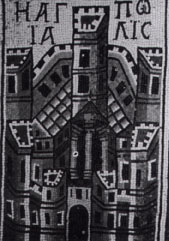 Left: Fig. 1. Mosaic representing Jerusalem (Hagia Polis), Church
of St. Stephen, Ma'in (Jordan), 8th cent. AD
Left: Fig. 1. Mosaic representing Jerusalem (Hagia Polis), Church
of St. Stephen, Ma'in (Jordan), 8th cent. AD
The progress of this new social order, freer and more advanced than ancient slavery, that is Feudalism, is further matured with the coming of Islam in the early 7th century AD which itself then accompanies the further maturation and growth of the art of Palestine and leads it to a highly developed pictorial art of geometric abstraction.
Mosaic floors are almost all of what survived of most of these churches. There are not as yet studies which might reveal how the walls were treated and if the form and subject matter of possible wall pictures were different from those on the floors. Three unique and historical attributes are contained in this mosaic art of Palestine. These three are, one, the formal space of a floor picture which shares the syntax of a carpet; two, the representation of specific empirical landscapes as noted above; and, three, the beginnings of geometric abstraction in the pictorial language.
An examination of the floor of the Church of St. Stephen in Ma'in, located in modern Jordan just south of Amman, dating from the 8th century AD, demonstrates these three attributes. The appearance of a rich Persian carpet is unmistakable. The large rectangular central field is organized into rows which are landscape scenes of natural objects in horizontal sequence one row below another. Within other examples, sequencing might rotate along the four sides of the rectangle. This is a landscape format which has its origins in ancient Egypt. There are very important formal, spatial, and organizational principles which are found in the pictorial logic of the carpet format and the format of sequential rows. Treatment of these is too specialized for the scope of this study. It is enough to point out that mankind's earliest landscapes were not organized necessarily as we would expect them to be today with our habituation to film and the camera.
There is usually a border which is divided into sections containing geometric motifs or views. At Ma'in our example contains sections of unusual pictorial views, landscapes, of cities and towns. Some of these are: Jerusalem (Hagia Polis in Greek equals Holy City which equals al-Quds in Arabic), Nablus, Qaysaria (Caesaria), Ashkelon, Gaza, Amman (Philadelphia), Madaba. In other mosaics at other locations there are views of Beisan, and Jericho, both very ancient cities of Palestine. These mosaics are landscape representations of specific cities and towns on either side of the Jordan River.
These mosaic examples are different from later European Christian representations. The difference, I believe, lies in the fact that these are some of the earliest Christian paintings and that the religion was as yet fresh and pure and not encumbered by bureaucracy or the many later layers of saints and myths which were not part of the original religion. What is pictured in these mosaics is local flora and fauna of ancient Palestine and Syria, the activities of humble craftsmen and peasants, as well as the earliest saints. A simple honesty shines through their faces and through the delight with which these shapes are executed. There are no presentational pictures demanding worship such as the "Crucifixion" or the "Virgin and Christ Child;" nor are there frightening pictures of frontal personages standing in triumvirate formation commanding us into obedience. One has the sensations of voluntary and pleasant community participation.
One mosaic which has typical Byzantine presentational frontality and is prophetic of later European painting is the mosaic at the monastery of St. Catherine in the Sinai. Built by the emperor Justinian, it dates from the 6th century and is presentational in nature with a central Christ and St. John and St. Elyas on either side. These mosaics were not applied only to the floors of sacred edifices. Archaeologists are finding them also in palaces, baths and shops. But it seems that it is the church on which the community extended most of its efforts. After the coming of Islam many Christians and Jews converted to Islam. There was not a replacement of the population by outsiders but rather a large scale conversion of the local population to Islam which was considered a renewal of Christianity which itself was seen as a renewal of Judaism. With this change we see the political, social, economic, and cultural maturing of the then nascent Arab World in Palestine. At this same time substantial new Omayyad Arab villas and palaces were built in modern Jordan which contained mosaics of the type under discussion. Indeed, mosaics of this type which date from this early period exist to this day on the interior of the Dome of the Rock 2 and on the courtyard walls of The Great Mosque of Damascus 3.
Omayyad murals at Qusayr al-'Amra, and Qasr al-Hallabat, and of Khirbet al-Mafjar near Jericho, in both Jordan and Palestine contain illusionist pictures representing landscapes in the traditions of the early Arab art of mosaics of the first eight centuries AD.
The third attribute of these early Arab mosaics, that of geometric abstraction is of special significance. It seems that the ancient Arabs, prior to the ascendancy of Islam in the Arab World, expressed a clear aesthetic tendency towards abstraction. This can be seen on the floors of several churches. Examples are the triple Churches of Saints George, Cosmos, and Damianus at Jerash dating from 526 to 534 AD; and the Church of St. Menas, the Egyptian martyr, at the village of Rihab in modern Syria dating from 635 AD. The floor of the Church of St. Menas is pure in its exclusively geometric patterns and abstractions 4. At the Omayyad palace al-Hallabat the pictures are also strictly abstract and geometric like some of the earlier churches.
As a tangent observation, it is important to note that these buildings were small and humble in contrast to the palaces and castles of ancient societies because in contrast to the ancients the new social order did not rely on the labor of slaves for its economic life. And its ruling layer was less centralized and more numerous as a percentage of the whole. The development of and the causation behind Arabic art cannot therefore be divided into Christian and Islamic. To understand what is happening we must not be blinded by the idea put forward by historians that the Arabs came to Palestine and somehow replaced or overwhelmed the local population. This is how the oppressive history of the West and Israel might describe it trying to make us seem like foreigners in our own land 5.
The historical facts show that Arab identity developed right here in our own land during the first millennium BCE, the first centuries AD. That development began among the tribes and city states of the Arabian peninsula during the first millennium BCE and continued through the Christian era in the areas we now call the Mashreq (The Arab East) during the first six centuries AD and matured during the Islamic centuries throughout the Arab World, both Mashreq and Maghreb (The Arab West). Thus the coming of Islam marked a point of maturation but not a division between an earlier narrative pictorial art and a later geometric abstraction. Clearly Islam as the most modern feudalist religion was the landmark event of the maturation of Arab culture from ancient times. It is crucial to see it as a time of maturation and not a break in the growth of our culture. Ample proof of this lies in the fact that the earlier Christian Arab art contained substantial beginnings of the later geometric art and similarly early Islamic Arab art contained the narrative imagery which is typical of the above noted earlier arts of this region. The truth then is that in pictorial art a formal line of demarcation cannot be placed to coincide with the religious change. In its place I propose the theory which fits the facts more properly. That being, that the large and gradual conversion from Christianity and Judaism to Islam was the point of a change of religion as subjective expression of a deeper historical, cultural, social and economic maturation - that is the change in quality which comes at a certain natural point of increase in quantity.
The development of abstraction occurred in Arabic culture at this particular junction of history and specifically in this region of the world. And this development had little to do with the presence or absence of religious sanctions. The Koran had no strictures against narrative pictures yet the early Arabs devoted much to the development of abstraction. Conversely the Bible 6 contained very heavy handed sanctions against narrative imagery and yet narrative imagery is intimately connected to Christianity. The arts seemed to disregard religious strictures. We can comfortably say that biblical strictures did not stimulate the development of abstraction among Christians anymore than did later Islamic disapproval of imagery stimulate abstraction among the Arabs.
The West as capitalist culture never really understood abstraction in the pictorial arts except as a principle of the organization of narrative imagery. Its appearance in full bloom during the twentieth century was certainly not due to religious strictures or to Western culture but rather to the cultural renewal attending the social upheaval resulting from working class revolution in The Soviet Union. Meanwhile, one can see that the first Christians did not pay attention to these strictures against narrative imagery and proceeded to lay the foundations for early abstraction.
The description above contains stress on the absence of a relationship between religious strictures and the disappearance of narrative imagery. Abstraction was a positive development with social roots and not merely a reaction to strictures of a religious nature. Western historians have generally denigrated Arabic abstraction by describing its flowering as merely a reaction to prohibitions and by labeling it as architectural decoration.
The maturing of Arabic geometric abstraction is the next phase of landscape art in Palestine. The earliest intact example of Arabic geometric abstraction is clearly demonstrated by the Dome of the Rock in Jerusalem. The abstraction seen on the floors of early churches and Omayyad palaces is now developed to a high art on the walls of the Dome of The Rock. This is a pictorial art which is abstract, geometric, and based on the lessons of nature.
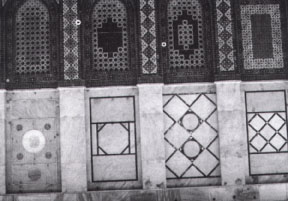
The Dome of the Rock has been regularly restored and the large marble inlays on the lower panels of the exterior were added during the Ottoman period between 1520 and 1540 AD. Thus the abstractions on the Dome cover a period from the beginnings of Arabic art to its latest periods in the form of the mosaics on the interior of the Dome to the later exterior marble inlays.
To characterize this abstraction as either pictorial or based on nature may baffle many. The development of this theory is laid out in a previous paper on Arabic art 7. In it the principles which govern how abstraction is extracted from nature through our visual experiences are explained. The further process of how this abstraction is a developmental step in the growth of pictorial form and content is also explained.
 Right:
Fig. 2. The Dome of the Rock; a View of the Outer Wall. The Lower
Panels are of inlaid Black and White Marble, Early 16th Century
Right:
Fig. 2. The Dome of the Rock; a View of the Outer Wall. The Lower
Panels are of inlaid Black and White Marble, Early 16th Century
Within this paper on the landscape of Palestine, it may be sufficient to mention that all that is in our thoughts about the visual language is based on the things we see with our eyes. Our thoughts reflect the world we see. We see and experience the measure and rhythm of nature. Our mind extracts from our visual experiences principles which are then tested for usefulness through practice and experience. We learn to measure and we test our measuring and if this measuring fails then our buildings and our plantings fail. So we learn abstract measure and abstract rhythms from nature and from the forms of our own human society and we use them as a basis for our pictorial arts. Among Arab thinkers the Sufis made it clear to us that early Arab culture admired what "the mind understands" as being superior to what "the eye sees".
Thus, if this harmony of measure is learnt from the land and the trees and the rocks, then let us not mystify its sources and honestly call it landscape. The problem is not with the art or with the artists. The problem is with us and with scholarship in art which is unable to understand visual abstraction. I believe that scholarship in art history in recent decades has shown a willingness to be blind about the sources in nature and reality of abstract art.
Thus the development of geometric abstraction as clearly exemplified by the Dome of the Rock is another historical artistic event which the Palestinian Arabs can claim to have had a major part in. Its intellectual value to world art is immense and has not yet been properly treated and documented, all western scholars on the subject notwithstanding.
Furthermore, the relationship of surface to building to the space around it and its coordination with our concept of place as landscape is an important extension of this theory. The coordination of rock and architecture in the Dome of The Rock and the way in which the Dome is located to crown the city visually is in itself another form of landscape. The Dome exudes a very Arabic concept of landmark and of city-center. It is a magnet which still today guides the hands of photographers. No view of Jerusalem has meaning without it. It is the ultimate artistic presentation of landscape. It even shamelessly adorns Israeli travel ads on American television further exemplifying its power and their jealous attempt to co-opt our culture.
While the new art of geometric abstraction was developing, the art of Christian icon painting continued to be practiced in the Arab World. Two examples from the Master of Aleppo and from the Master of al-Quds are here mentioned briefly as an interjection to point to the parallel existence of the three dimensional art of narrative illusionism in Christian Arab icons along with the three dimensional art of abstraction in Arabic art. While the Arabs developed abstraction, narrative painting using specific imagery continued as a secondary theme in Arab art history. Its practitioners were Christians who continued to execute icons though not with the richness and originality of the mosaics shown earlier. An obvious rigidity dominated the art during the Middle Ages as it no longer reflected a period of social growth. It came to be a secondary branch of minor proportions. The smallest attempt at modernization by copying European models which had now outstripped Arab icons was and still is rejected by lovers of these icons. The Arab icons of the Middle Ages are very few. They have been studied only minimally. We still have much to learn about them.
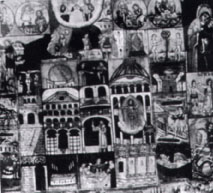
Examples of later icons: "Entry into Jerusalem" and "Saint George Fighting the Dragon" both by Michael Mahna al-Qudsi (the Jerusalemite) dating from the second half of the 19th century. Both icons show a landscape and city view in the distance. The second of them shows a city in the distance which is very probably Jerusalem. "The Land of Palestine" painted by an unknown painter of the early 19th century has qualities of form that recall the ancient art of the Arab World and which we will see in contemporary Palestinian painting. This is the tendency to use a narrative structure of small compartments containing segments of ideas which together build up the whole of the idea (Le Musee Nicholas Sursock 1969).
 Left:
Fig. 3. "The Land of Palestine": Unknown Artist, lst Half of the 19th
Century
Left:
Fig. 3. "The Land of Palestine": Unknown Artist, lst Half of the 19th
Century
The next strong phase of the image of the land of Palestine in Arabic art comes during the twentieth century. Watercolors and drawings were made of Palestine during the 18th and 19th centuries by European travelers. These were artistically inferior and are in truth travel documentation made to take back home to show the exotic lands which might, someday, be conquered and owned 8. Such colonialist "Orientalist" pictures, to my own consternation, are highly prized among contemporary Arab collectors who have learnt to see themselves in the distorted mirror which Europe holds up to us rather than the true and truly wonderful mirror of our own history. Meanwhile, art of monumental and historical proportions lies in dust in our own backyard. These are the exigencies of history.
I will turn now briefly to some of the landscape paintings of Palestinian artists of the twentieth century. A year ago when I visited Ismail Shammout and Tamam al-Akhal with Naser Soumi we were given some wonderful news by Ismail. The total of this exciting news is now on exhibition at Darat al-Funun in Amman. The discovery is a Palestinian painter who had exhibited at the 1933 National Arab Festival of the Arts, crafts, and culture which took place in al-Quds. This artist is Zulfa al-Sa'di and among the paintings shown are two landscapes, one of the "al-Aqsa Mosque" measuring approximately 14x16 inches and the other "A village of Palestine" measuring approximately 10x14 inches. Both are oil on canvas dating from just prior to 1933.
There are numerous Palestinian painters who treated the subject of the landscape of Palestine during the twentieth century. I continuously discover these artists and their work but most of the time there is very little documentation or we are told that their works disappeared with the wholesale theft of our possessions, our homes, and our lands by Israelis.
Another early twentieth century landscape painter of Palestine known more for his icons than for his landscapes was Khalil Halaby of Jerusalem. There is a set of murals by this artist which cover entirely the wall and ceiling surfaces of the Syrian Orthodox Church in Bethlehem. These were completed in 1940 and contain the traditional background landscapes typical of biblical themes. Another Halaby needs to be mentioned when landscape painting of Palestine is under consideration. That painter is Sophie Halaby who recently passed away. Sophie was a serious professional painter who studied in Europe and spent her life in Jerusalem. The landscape and the mountains surrounding the city of her birth and death are a primary subject of her lifetime of work.
During the second half of the twentieth century and in recent decades the Palestinian revolution has given new energy to the art of painting and of landscape in Palestine. Palestinians here and in exile are making great strides and powerful art and much of it represents the land of Palestine.
The image of the land of Palestine in the paintings of contemporary artists has many sources feeding its development. There is influence from European painting of the 19th century. But there are also the qualities of organization from ancient Iraq and Egypt which seem to be a permanent distinguishing quality in the pictorial art of the Arab World. There are the work of several artists, among them: Tamam Al-Akhal, Afaf Arafat, Ibrahim Ghannam, Mona Hatoum, Burhan Karkutli, Sliman Mansour, Muhammad al-Rakoui, Walid Abu Shakra, Omar Shammout, Laila Shawa, Suha Shouman, Naser Soumi, Vera Tamari, Vladimir Tamari, and Samia Zaru 9.
The paintings of Ibrahim Ghannam are ones which in our century would be most typically accepted as landscapes of Palestine. Not only do they possess the illusionist syntax of land below and distant horizon and sky above but they possess the loving sentiment and detailed knowledge of village life and the life of those who till the land. We feel all the wealth of our memories of Palestine when we see the painting "yawm el-hisad" (Day of Harvest). It is easy to revel and relax mentally in the golden wheat and dream of dark green fig trees. A wonderful painting might sometimes be an easy chair for our mind. It is a sentiment which was first expressed by the French painter Matisse.
The installation work by Vera Tamari with the Mediterranean shores of Yafa as its background titled "Oracles from the Sea" is especially wonderful. It brings to us a yearning for the past while it contains promises of the future. Sixteen bas-relief faces made of clay stand at the shores as though they have after long years returned to look at our Yafa and witness what has happened. But it is the idea of return and most of all the fact that they are boldly located on the shores of Yafa that gives great power to this work. There is a measure of assertiveness in going back to the shores of Yafa and lay there her work and claim it with her art as our heritage. This is precisely what is important about this work and why it is significant for the future. Vera Tamari's is a landscape that is unlike the restful familiarity of Ibrahim Ghannam. It contains a newer language but is nevertheless a landscape in its essential attributes.
Two years ago I visited Birzeit University and worked for three weeks with Vera Tamari and her students. True to their visual heritage these students made amazing bas-relief pictures in papier mache of the land of Palestine. They used the language of abstraction. The relationship of the land to their work is unmistakable.
There is an awareness of landscape among the children of our refugee camps that is heightened by the tragic experiences imposed by Israelis. Two such drawings by children, one of the Intifada and one of the Battle of Karameh, are worthy of mention. The second one (Fig. 4) is drawn by a child at least one generation after the battle itself where Palestinian refugees using simple armaments beat back a highly armed and mechanized Israeli invasion. This is a landscape of pride and tradition passed orally from parents to children.
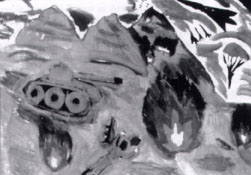 Right:
Fig. 4. Battle of Karameh, painted 1995 by an Unknown Child, Baq'a
Refugee Camp, Amman
Right:
Fig. 4. Battle of Karameh, painted 1995 by an Unknown Child, Baq'a
Refugee Camp, Amman
Now I would like to make a few observations in conclusion. In the art history of the West there is a policy, the purpose of which is to rob us of the dignity which comes from being heirs to our own cultural history. It facilitates the work of robbing us of our natural resources and the fruits of our work. This policy is the habitual misnaming of our art which robs us of credit for it while giving it the appearance of being fragmented and incoherent. The sense of fragmentation is created by giving it numerous and confusing names. I have just begun collecting all these names and I have quickly collected over three hundred such names. I expect to reach seven or eight hundred such labels when I have spent more time.
Concurrent with this mis-labeling policy is a studied avoidance of using the proper national identification for our art and the art of our ancestors. You will rarely find the name Arab or Arabic in Western art history. As one example if you look up the title Arab under art and architecture in the card catalog of the New York Public Library you will find only one book and that is because this one book uses the word Arabic in its title. It is a huge indictment of educational and cultural institutions that I could only find one book in this category and it is a further indictment that only one book in the collection bears the word Arabic in its title. Of course there are many books on the subject if one looks under "decoration" or "Islamic".
The treatment of our art on the basis of religion is supported and itself supports the practice of presenting the land of Palestine as the "land of the Bible". By presenting it as the land of the Bible and by referring to its biblical names during prayer every Sunday morning, Western Christians have come to believe that they own this land and that the "heathen" Arabs who believe in "Allah" instead of "God" are foreign intruders. So it is best, they think, that the Jews have it since they are mentioned so often in the Bible. Of course economic exploitation is completely veiled in such discourse. The "Old Testament" concept of the land of Palestine in art is amply demonstrated by a prejudicial catalogue printed to accompany an exhibition of the work of Palestinian artists in Stockholm presented by the Swedish government supposedly to help support Palestinians (Moberg 1998).
Another observation is the tendency in the West to limit information in the mass media about Palestine and The Arab World to peasant life and traditions. Our peasantry is being destroyed brutally while funds are made available to romanticize their life and preserve their culture. This is accompanied by a total silence about the destruction of our cities such as Yafa, Haifa, Jerusalem, and others. There is in the West the sentiment that the destruction of peasant life is acceptable since in a sense "we are helping them to modernize". But destruction of cities and city culture is not perceived as acceptable. Thus funding is made available to films about peasant life or for the selective preservation and documentation of village architecture. On the other hand, funds to tell the story of the burgeoning cultural and political life of Palestinian cities during the thirties, or the incredible intellectual and political developments in the refugee camps, would be almost impossible to obtain. Funds for the preservation of the architecture of our cities which are now being mercilessly destroyed by Israel would be near impossible to gain. The day when we can freely pursue the development of ourselves will come and may come much sooner than most people imagine. I wish to share with you my very strong optimism about our future and my great respect of our incredible and long history with this, our land of Palestine.
BIBLIOGRAPHY
Bienkowski, Piotr, ed. 1996 Treasures from an Ancient Land: The Art of Jordan. Welfeboro Falls. NH: Alan Sutton Publishing.
Grabar, Oleg 1987 The Formation of Islamic Art. New Haven. CT: Yale University Press.
Loehr, M. 1980 The Great Painters of China. Oxford: Phaidon.
Moberg, U. T. 1998 Palestinian Art. Catalog to an Exhibition at the Konstakademien Vastra Galleriet Fredsgatan 12, Stockholm, August 17, through September 20th, 1998. Uppsala: Almqvist & Wiksell.
Le Musee Nicolas Sursock 1969 Icones Melkites. Beyrouth.
Nusseibeh, S., and Grabar, O. 1996 The Dome of the Rock. New York: Rizzoli.
Piccirillo, M. 1993 The Mosaics of Jordan. Amman: American Center of Oriental Research.
- The script has been translated and reads: "May the lord Jesus Christ bless this place and all among us who love him. Amen, because to him it is that Stephen sings. Abd Ghaythu (and) Habbiba, Amen". BACK
- Built between 685 and 692 AD early in the Omayyad period. A good pictorial treatment of the Dome of the Rock can be found in Nuseibeh and Grabar 1996. BACK
- Built between 706 and 715 AD during the first Omayyad Empire. BACK
- Churches pertaining to this era include the Church of the Map dating from the 6th century AD, Church of the Apostles 578 AD, Chapel of the Twahl Family, the Baptistery Chapel 492 AD, and the Crypt of St. Elianes 595-96 AD, all in Madaba. The Old Diakonikon 530 AD is at Mt. Nebo with its mosaics signed by three artists. The Church of the Holy Martyrs from the middle of the 6th century AD known as Khirbet al-Mukhayyat is, village of Nebo in modern Jordan, the Church of St. John dating from 531 AD in Jerash, and the monastery of St. Catherine built by the Emperor Justinian in the Sinai. See Piccirillo 1993. BACK
- One of the most destructive Western scholars who specializes in Arabic art is Oleg Grabar. In his book on "The Formation of Islamic Art" (Grabar 1987), he goes so far as to declare that Arabic art is not art. On page 102 referring to Arabic architecture he writes "The deeper question that remains is whether, in the light of the evidence and hypotheses presented in this chapter, it is entirely appropriate to think of these monuments as works of art". BACK
- Exodus 20.4: "Thou shalt not make unto thee any graven images or any likenesses of anything that is in heaven or that is in the earth beneath or that is in the water under the earth." This is one of the Ten Commandments. BACK
- Halaby, Dimensions of Arabic Art: Time or Depth (http://www.art.net/-samia). BACK
- A shocking example is one particular work by David Roberts. It is a lithograph titled "Interview with the Viceroy of Egypt at his Palace at Alexandria March 12, 1839". The viceroy is Mohammad Ali of Egypt. The pictorial setting is typically 19th century romantic and clearly representing the average denomination of hack-art paraphernalia rather than any possible actual meeting place. These lithographs were printed by the thousand and hand tinted in the early 19th century by Roberts as a business enterprise. BACK
- Details of the artists of this century come from the book by Ismail Shammout, Amman, 1989. BACK

return to culture