

|
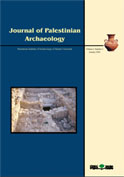
Journal of Palestinian ArchaeologyEditor: Khaled Nashef  The
Journal of Palestinian Archaeology (JPA) is a new journal, published
by the Palestinian Institute of Archaeology of Birzeit University. The
Journal of Palestinian Archaeology (JPA) is a new journal, published
by the Palestinian Institute of Archaeology of Birzeit University.
Editor: Khaled Nashef.
JPA focuses on the archaeology of historical Palestine, its geographical horizon, however, encompasses countries of the Eastern Mediterranean, including the Arabian Peninsula. It includes articles in archaeology, ancient writings, ethnography, Old and New Testament. JPA prefers studies exhibiting new primary material, such as fieldwork reports, collections of artifacts, inscriptions, or individual finds or texts. JPA also seeks articles furnishing innovative concepts, interpretations, and new directives in the archaeology of Palestine and the Arab World.
In addition to the specialists, JPA also addresses readers who view their interest in archaeology and history as a crucial step towards shaping Palestinian historical consciousness. It encourages participation of non-specialist or graduate students, when their contributions enrich the substance of the Journal.
JPA is the platform of the Palestinian Institute of Archaeology (PIA) of Birzeit University. It expresses the ambition of the Institute to enhance among Palestinians an interest in archaeology as an integral part of their history. JPA is the concrete outcome of a policy aimed at promoting fieldwork, research, publication and the development of a graduate program.
JPA publishes mainly in Arabic. However, it welcomes articles in other languages, preferably English, but French and German will also be accepted.
Research Articles and Excavation Reports:
Articles and Studies
Permanent features
Research Articles and Excavation Reports
Articles and Studies
Subscriptions: Annual subscriptions: $75 for institutions, $50 for individuals. Payment by check, payable to Birzeit University.
Editorial correspondence: Manuscripts, and editorial correspondence should be sent to Dr. Khaled Nashef, Palestinian Institute of Archaeology – Birzeit University, P. O. Box 14, Birzeit – West Bank, via Israel.
Address: Order forms with checks should be sent to the Palestinian Institute of Archaeology - Birzeit University, P. O. Box 14, Birzeit – West Bank, via Israel. Tel: +972 2 298 29 74; Fax: +972 2 281 06 56; E-mail: pia@arch.birzeit.edu
Order forms will be sent upon request per fax or mail. For
inquiries and order forms:
Palestinian Institute of Archaeology
The Palestinian Institute of Archaeology (PIA) at Birzeit University is the first academic institution in Palestine which offers an integrated program to train students in the discipline of archaeology. Since its inception in 1977, PIA has succeeded in maintaining and continuing its program, and a large number of Palestinian archaeologists working in the field are graduates of the Institute.
For more than a century, intensive archaeological activities conducted in Palestine have resulted in an enormous accumulation of data, forming the basis for a wide range of studies covering different aspects of the cultural history of Palestine. Palestinians themselves, however, were not in a position to contribute to these studies, nor to offer relevant independent answers, methodological or ideological, to questions concerning their cultural heritage and country.
PIA aims to promote archaeology as a scientific endeavor by applying advanced research techniques to the analysis of material culture. The goal is to develop a Palestinian archaeological tradition, thus, PIA is adopting a course of action that parallels similar efforts aimed at creating new archaeological perspectives.
PIA has previously conducted excavations at Tell Taannek (1985-1987) and Tell Jenin (1977-1984), and since 1996 launched an exemplary long-term research and excavation project at Khirbet Birzeit, offering students and faculty the opportunity to increase field experience, opening new research possibilities, such as, investigating the Palestinian countryside. The excavations at Khirbet Birzeit continued for the years 1998 and 1999. A fourth season is planned for the year 2000. Preliminary reports are published in JPA.
PIA currently offers a BA minor degree in archaeology. The curriculum is designed to train students in the fundamental aspects of fieldwork and research, developing their proficiency by giving them the opportunity to participate in excavations and surveys. In addition to Introduction to Palestinian Archaeology, the Institute offers a variety of theoretical courses, such as Stratigraphic History of Palestine (four courses), Ceramic Traditions of Palestine (two courses), seminars, and special topics. PIA is planning to an MA program hopefully to be initiated by the academic year 2000/2001.
In a step towards founding an archaeological museum connected with the Institute, PIA established 1998 a permanent showroom in which archaeological artifacts from PIA’s excavations are being exhibited, such as pottery vessels, figurines, scarabs and other items.
PIA’s library currently comprises 7000 volumes. Recognizing that a specialized archaeological and philological library is essential for the functioning of PIA program, the Institute has made the expansion of the library one of its top priorities. PIA welcomes book donations, which will be acknowledged in JPA.
The publication of the primary material uncovered in excavations conducted by Palestinian institutions is vital to the development of a Palestinian archaeological tradition. PIA’s publication program is essential to the establishment of an archaeological corpus. Accordingly, PIA developed since 1995 a detailed publication plan for its excavations and surveys. The first of the scheduled publications appeared 1996, the second 1998. There are two volumes in press.
In the series Archaeological Handbooks:
In the series Tell Taannek 1965-1968:
In the series Occasional Publications: |
 return to society |
 JPA
will appear in two issues per year (January and July), between 96 and
128 pages each. The first issue (112 pages) is scheduled for January 2000,
and will appear in February.
JPA
will appear in two issues per year (January and July), between 96 and
128 pages each. The first issue (112 pages) is scheduled for January 2000,
and will appear in February.