

Notes on Palestinian Arabic with Speech Samples
By Kimary Shahin, Birzeit University and University of British Columbia.
The material below provides a taste, so to speak, of Palestinian Arabic, the colloquial Arabic spoken by Palestinians. This vernacular is actually a collection of many colloquials that vary with social group (urban, rural/villager, or bedouin) (see, e.g., Cadora 1992) and geographic location.1 Three aspects are highlighted here: the consonantal inventory, lexicon (vocabulary), and intonation. The speech samples are from men aged 20-25, from Khalil (Hebron), Nablus, Rafat, and Gaza.
Consonantal Inventory
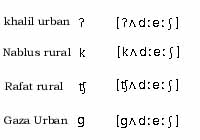
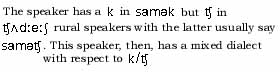
Palestinian varieties differ in consonantal inventory. For example, where most urban speakers have  (glottal stop), some rural speakers have
  (voiceless velar stop), other rural speakers have
  (voiceless post-alveolar affricate), and urban Gaza speakers have
  (voiced velar stop):
The following speech samples indicate this for the four speakers with the question 'How much is a kilo of fish today?'





Lexicon
They also differ with respect to certain words. For example, the word meaning 'here' is one syllable for some speakers, two syllables for others, and the quality of the (initial) vowel varies in the following sentence "What are you doing here laughing?":
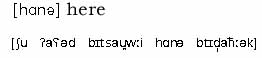 Khalil Urban Lexicon - "What are you doing sitting here laughing?"
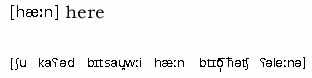 Nablus Urban Lexicon - "What are you sitting here doing? Are you laughing at us?"
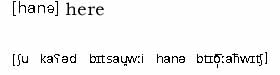 Rafat Urban Lexicon - "What are you doing sitting here laughing away?"
Intonation
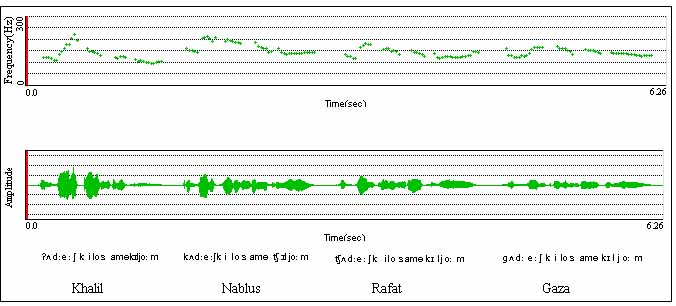
There is also variation in intonation, that is, the raising or lowering of voice pitch over sentences and phrases. For example, while most speakers use a fall or fall-rise pattern for wh-questions, Khalil speakers frequently use fall, fall-rise: "How much is a kilo of fish today?"
Khalil Urban: Fall, Fall-Rise
Nablus Urban:Fall
Rafat Rural: Fall-Rise
Gaza Urban:Fall
This is summarized in the chart below:
Notes
* Thanks to the consultants for their speech samples and to BZU Computing and Radio Studies for facilitating the soundbooth recording. Sound data herein may be freely used, with this article and url cited as source. The waveform editing and pitch analysis used Multi-Speech© 3700 by Kay Elemetrics. The audio has Apple's Quicktime 4© plug-in.
1 Palestinian Arabic is part of the larger Levantine branch of Arabic comprised of Syrian, Lebanese, Jordanian, and Palestinian (Eisele 1987, Fischer & Jastrow 1980); after Jastrow (1999), it is Zone II Arabic, that is, of territory Arabicized due to Islam.
References
Cadora, F. 1992, Bedouin, Village, and Urban Arabic, An Ecolinguistic Study, Leiden, E.J. Brill.
Eisele, J. 1987, "Arabic dialectology: state of the art", Al-Arabiyya, 20:199-269.
Jastrow, O. 1999, "Arabic dialectology: the state of the art", paper presented at the Semitic Linguistics Symposium, Tel Aviv University, January 1999.

return to culture