
An International Conference, Birzeit University, 12-15 November 1998
An International Conference, Birzeit University, 12-15
November 1998
        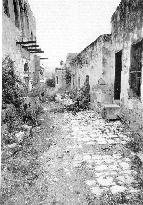 Al-bassa, one of the hundreds of Palestinian villages forcibly evacuated or destroyed in 1948
|
BACKGROUND TO LANDSCAPE STUDIES (Stripping
False Olive Branches, song by Marcel Khalifa) The study of landscape is receiving increased attention throughout the world, especially in the West, many recent books having been produced on the topic (e.g., The Iconography of Landscape, Landscape and Memory, The Experience of Landscape, Landscape and Power, and several publications in related specialized fields). There are also several studies that offer historical and comparative theories on the different modes of interaction with landscape. The world has come to a phase where the range of issues surrounding landscape (that were more implicit in past cultural practices) may well be the most comprehensive in the arts and in the sciences. However, there has not been any equivalent work in Arabic, nor has sufficient practical and theoretical work been undertaken to explore aesthetic, historic and other applications of landscape concepts in this region. Some of what has been done is either limited or ideologically tainted. More seriously, there is only scattered comparative work that relates concepts and applications of landscape in this region to other cultural modes. NOTE ON TERRACES A book from which the terrace photograph on this page is taken comments on the terraces as follows: “Because the Canaanites were largely successful in keeping the Israelites out of the plains and the valleys (see Josh. 17:16-18; Judg. 1:34), the Israelites had to become economically self-sufficient by mastering terrace agriculture” (The Holy Land: A Unique Perspective. Oxford: Lion, 1993; mysteriously, no author is mentioned.) This statement neglects or distorts several things. First, the Palestinians actually working on the terraces in the photograph are invisible in the text. Second, the biblical references thrown in for support actually present a totally opposite view: that Joshua and company fought the Canaanites in the plains and then moved to the hills, and Judges demonstrates the intricate cultural diversity in that period during which the Israelite mixed with or enslaved or killed the Canaanites in the valleys and the hills. As reported by W.J.T. Mitchell in Landscape and Power, the construction of the terraces is a hotly debated issue even among Israeli scholars, whether to believe or not to believe the legitimizing myth that the ancient Israelites can be credited with their construction. Even if one were to grant such a myth, or to grant a real connection between the ancient Israelites and modern Israel, one should still ask who has been keeping the terraces up and planted over the last couple of thousand years and who is still working on them now, in unison with the long past, except the Palestinian farmers. And who, on the other hand, is now concentrating mass agriculture in “the plains and the valleys” in order to export fruits to Europe? It seems the acquisitive, appropriating mind can try to work itself to advantage in every way. There is really much malignment and undervaluing of the Palestinian in this topic.
|
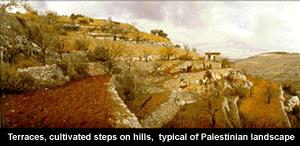 The subject of terraces (cultivated steps on hills) is typical of some
serious misrepresentations circulated about the landscape in Palestine to serve a
political agenda. This ancient feature of the landscape, developed since the time of the
Canaanites, is surreptitiously credited to the biblical Israelites and a connection made
to present Jews and Israel. Such a connection neglects the facts evident even in the Bible
that the Israelites, a nomadic and preliterate people, moved into the agriculturally
developed regions of the Canaanites, acquired much of their culture and crafts, and
eventually either “dwelt” with them or “put them to forced labor.”
