
|
|
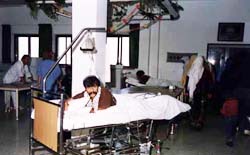 Disabled
patients vary in their dependency level. The role of nurses in the rehabilitation
unit is to help patients and their families to move from the fully-dependent
stage to the partly-dependent stage, and finally to the supportive-educative
system. Nurses attend to the patients' daily needs according to the doctors',
occupational therapists' and physiotherapists' instructions. They also
attend to patients' daily activities (such as eating, washing, dressing,
etc.). Disabled
patients vary in their dependency level. The role of nurses in the rehabilitation
unit is to help patients and their families to move from the fully-dependent
stage to the partly-dependent stage, and finally to the supportive-educative
system. Nurses attend to the patients' daily needs according to the doctors',
occupational therapists' and physiotherapists' instructions. They also
attend to patients' daily activities (such as eating, washing, dressing,
etc.).
Together with the patients, nurses plan the management of urinary and bowel incotinence. Patients are taught all aspects of skin care to prevent pressure sores. Nurses and patients work together to achieve goals related to balance, mobility, transfer and use of technical aids. Emotional supprot and communication skills are part of the nursing care. Nurses communicate with patient and family, helping them to accept the disability and teaching them new methods of meeting their daily requirements, with a total of 28 beds. The premises are carefully designed to meet the special needs of paraplegics and tetraplegics. The department is equipped with enough equipment to manage the mild complications of patients. The staff comprises 10 qualified staff nurses and 14 practical nurses and a nursing director. All nurses are locals. The department has a staff development plan to develop the knowledge of nurses in ward management, infection control, and nursing skills. |






