
|
|
|
||||||||||||||||||||||||||||||||||||||||||||||||||||||||||||||||||||||||||||
|
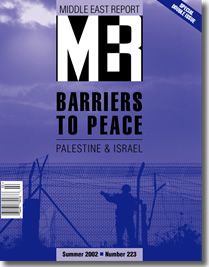
Barriers
to Peace Forthcoming in the summer 2002 issue of Middle East Report. Editorial-MER 223 Chris Toensing Note: An early version of this issue's editorial was inadvertently sent to the printer. MERIP regrets the error.
But there was nary a whisper at the rally about the Israeli armored columns which only six days before had commenced their fateful drive on Beirut. The Reagan administration, hearing the muted reaction even among the American peace movement, endorsed the exile of PLO fighters based in Beirut and blunted Congressional initiatives to cut US military aid to Menachem Begins government. Twenty years and millions in arms contracts later, another US administration winks and nods as another Israeli government sends tanks and warplanes after the terrorist infrastructure of the Palestinians, exacting another horrible civilian toll. Initial US justifications of Operation Defensive Shield as self-defense, George W. Bushs tepid call upon Israel to withdraw without delay and vague promises to the Palestinians of a coming political horizon recall similar twists and turns in the Reagan administrations tacit support of the invasion of Lebanon. Indeed, as Rema Hammami argues in this issue, the US may very well regard the ongoing Israeli incursions to eliminate armed Palestinian militants just as the editors of the Washington Post regarded the dismantling of the PLO in 1982: Israel [is] doing a nasty job that almost every other nation, including the US, wanted done, but did not have the heart to do itself. To proceed with its overriding objective for the Middle Eastregime change in Iraqthe White House needs to tamp down Palestinian resistance to the 35 year-old Israeli occupation. US goals may also require the resurrection of a peace process, but early signs are that this will be a process for the sake of process, without well-defined goals or a strict timetable, which need not be leading to actual peace. Debates over the question of Palestine in the Bush administration are infamously to the right of the Reagan eras. Hard-line national security hawks compete with Christian Zionists in Congress to raise the loudest cheers for Israeli military adventures, and urge Bush to accept Israeli Prime Minister Ariel Sharons equation of Yasser Arafat with Osama bin Laden. Though there is no George Shultz on the Bush team to speak for the more genteel Republicans tied to the Saudis through the major oil companies, overall US interests still dictate a utilitarian respect for the existential fears of Arab regimes. The present focus on reform of the Palestinian Authority allows the US to perpetuate its trick of mollifying Arab capitals with seeming support for Palestinian state building while avoiding any confrontation with Sharon and the pro-Israel lobby. The terms of discussion have certainly changed, but the familiar pattern of US patronage for both Israeli impunity and Arab regime stability has survived Defensive Shield with scratches that appear to be healing. But, unlike in 1982, today the question of Palestine is squarely on the agenda of the broader American liberal-left. This past April 20, perhaps 100,000 activists converged upon Washington to demonstrate against Bushs ever expanding war on terrorism and for global economic justice. Partly by design and partly in response to the spirit of the moment, the long-planned peace and justice rallies yielded the day to Palestine. Kaffiyehs and Palestinian flags dotted each of the four feeder marches, and dominated the merged throng that wound its way to the Capitol. The diversity of the marchers was the most encouraging sign: Arab and Muslim Americans, who were very well-represented, are building alliances with other traditional progressive constituencies. This extraordinary event was a measure of how deeply awareness of Israel's occupation policies has penetrated American public opinion, as are the polls showing majority support for a Palestinian state and growing doubt that the US is hardly an honest broker in the conflict. Though the status quo is deeply entrenched, the April 20 rally could indicate that US administrations may one day pay domestic political costs for their failure to pursue a just peace in Israel-Palestine. |
|
|
|
|
Home
| Contact/Intern |
Info | Middle
East Report | Press Info Notes |
Newspaper Op-Eds
| Giving |



























 At
least 700,000 people jammed the streets of New York on June 12, 1982
to demand full disarmament from the heads of state gathered to discuss
nuclear policy at the United Nations. The raucous crowds chants of
No nukes! drew favorable comment from German Chancellor Helmut Schmidt,
who praised the great and positive moral force protesting outside
the UN building.

 visitors
since March 1, 2000.