| |
Culture
and Politics
(Middle East Report 219,
Summer 2001) Back
to 219 Table of Contents
The Joint Strike
Fighter in the Middle East
Luke Warren and Erik Floden
(Luke Warren is
media director and an analyst at the Council for a Livable World Education
Fund, a Washington arms control advocacy organization. Erik Floden is
director of the Arms Trade Oversight Project at the Council for a Livable
World Education Fund.)
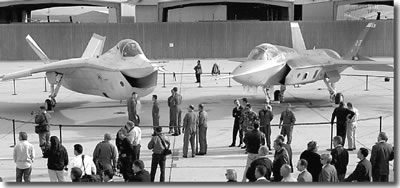
Joint Strike
Fighter prototypes on display at Edwards Air Force Base, California.
(Evelyn Kristo, Antelope Valley Press/AP Photo)
|
The
Middle East dominates the world arms buying market, spending $82.5 billion
on weapons from 1992-1999, virtually half the value of weapons bought
worldwide during that period.(1) The United States, the region's largest
arms supplier for decades, supplied 51 percent of that total, or $41 billion.(2)
A combination of factors accounts for these statistics, primarily Washington's
push to export increasingly sophisticated weapons systems, and the ability
of Middle Eastern countries to purchase expensive equipment. Given that
neither of these factors will change any time soon, and that comprehensive
regional peace remains elusive, the Middle East arms bonanza is likely
to continue.
Currently, the Pentagon is developing a major new weapons system called
the Joint Strike Fighter (JSF) -- a stealthy, next-generation, all-purpose
attack plane intended to corner the world fighter market and scheduled
to enter production around 2010. While the JSF will maintain qualitative
air superiority for the US Air Force, Marines and Navy, it is the first
fighter to be designed primarily for export. Given its huge export potential,
the JSF has a good chance of surviving Secretary of Defense Donald Rumsfeld's
strategic defense review, due in July, which may scrap other weapons programs
on the Pentagon's wish list. The JSF is targeted to cost around $35 million,
same as an F-16, making it affordable even for countries with the most
modest economies. With their large arms budgets, Middle East countries
will probably procure the JSF in large numbers. Israel and Turkey have
already committed to do so.
Designed for Export
US defense industries are increasingly hard-pressed to reap large profits
from Pentagon weapons purchases alone. Newer weapons tend to cost three
to four times more than the weapons they replace, forcing the US armed
forces to buy fewer of them. Decreased demand from the Pentagon drives
up the weapon's cost again, exerting further pressure on the armed forces
to economize their purchases. The only way for US arms manufacturers to
stop this profit-sapping inflationary spiral is to export vast numbers
of arms. Their marketing plans have changed accordingly.
In conjunction with the defense industry, the Pentagon is actively canvassing
other countries to help with the research, development, funding and procurement
of the Joint Strike Fighter. The JSF is the first major weapons system
designed from the start to incorporate the industrial participation of
any US ally with the time, money and technical expertise to invest in
the program. Countries that join the US in helping to develop and pay
for the plane gain an expedited export process. Depending on its level
of investment and participation (see sidebar), a country can actually
help to design the JSF or purchase the plane at a cheaper cost.
|
|
Foreign
Participants in the Pentagon’s Joint Strike Fighter Program
There
are four tiers of foreign participation in Joint Strike Fighter
(JSF) research and development. Participation at any level
implies a commitment to purchase a number of planes, after
the JSF is designed and tested.
Full
Collaborative Partner
One country, Great Britain, committed $200 million for full
access to the design process, including representative personnel
within the JSF program office. This level of participation
buys extensive influence over details of the plane’s
design.
Associate
Partners
Representative personnel at the JSF office have limited access
to and influence over fighter design, but must negotiate their
participation with the US personnel in the office. Denmark,
the Netherlands and Norway (as a group) pledged $30 million
total to buy in at this level.
Informed
Customers
“Informed customers” get limited access to information
about the fighter as it is being developed, but cannot influence
design. Representation at the JSF program office is negotiable.
Canada and Italy spent $10 million each to be “informed
customers.”
Major
Participant
This recently created category is also called Foreign Military
Sales Participation or Fee for Service. “Major participants”
negotiate directly with the JSF office for access to specific
information (e.g. cost projections or simulation studies)
on a pay-as-you-go basis. Israel, Singapore and Turkey—the
three “major participants” to date—are not
allowed representative personnel at the program office.
Source:
General Accounting Office, GAO/NSIAD-00-74 Joint Strike Fighter
Acquisition
|
|
Israel and Turkey
are both looking to up their current levels of participation, and other
nations in the region will soon feel the need to purchase similar jets
in order to keep pace. But no one besides the US is building or developing
a plane that will be as stealthy, capable and affordable as the JSF. Most
Middle East nations' aircraft will be near the end of their service lives
when the JSF enters production around 2010. These countries will either
have to replace their aging planes with older, but upgraded jets, like
the F-16, with very expensive F-22s ($190 million apiece) or with the
new and affordable JSF. Given most countries' tendency to buy newer jets,
and the strategic alliances in the region, the US will be in prime position
to sell hundreds of JSFs in the Middle East.
Spurring an Arms Race
Despite decreasing their truly massive levels of weapons spending in the
1980s and early 1990s, the Gulf states continue to make high-profile arms
buys. In 2000, the United Arab Emirates (UAE) bought 80 F-16s superior
to those in the US arsenal for nearly $8 billion.(3) These F-16s will
have longer range, greater weapons payload and better radar, avionics
and electronic warfare capacity than the US Air Force versions. The UAE
is paying the research and development costs for the radar and avionics
systems, which will be the best attack jet systems in the world when they
are eventually built. To complete the deal, the UAE acquired US software
source codes that will allow them to alter the friend-or-foe designations
on the jets' cockpit displays. These codes could allow the UAE to designate
other F-16s as foes, conceivably making it easier to target US or Israeli
jets. This is the first time the US has shared these codes with a non-NATO
ally.
The UAE deal has already spurred additional arms procurement in the region.
In 1998, the UAE pressured the US to sell them Advanced Medium Range Air-to-Air
Missiles (AMRAAMs) as part of their potential F-16 purchase. Since AMRAAMs
or similar technology had not yet been sold to any country in the Middle
East, and the US desired to maintain Israel's regional military superiority,
Israel was cleared to purchase the missiles as well. Within months, both
Saudi Arabia and Bahrain had signed contracts for the AMRAAM, and Egypt
had purchased surface-launched versions. In six months, the number of
nations in the Middle East with AMRAAMs went from zero to five, not including
Turkey, which already had the missiles, as a NATO member. With the F-16
and AMRAAM deals, the US demonstrated that it will sell virtually any
kind of arms technology to win an export contract.
Aging Air Forces
After the 1990-91 Gulf war, the Israeli-Turkish strategic alliance has
been the main justification for major arms procurement in the Gulf states,
Egypt and Jordan. Turkey will soon need to replace at least 265 F-4s and
F-5s, and a bit later 272 F-16s.(4) Israel will soon retire 80 F-4s and
51 A-4s, and sometime during the next decade its nearly 100 F-15s and
300 F-16s will also near the end of their service lives.(5) Both countries
could replace all these planes with JSFs.
Egypt and Saudi Arabia -- always keen to match Israel's air force capabilities
-- will buy Joint Strike Fighters on the heels of any Israeli purchase,
provided that the JSF's cost remains in the $30-40 million range. Riyadh
could need up to 344 JSFs to replace a variety of older aircraft, including
several F-15s, but the Saudis are currently looking into buying a number
of F-16s, so that would slightly reduce their potential JSF purchase.(6)
In ten years, Egypt will need nearly 400 new attack jets to replace the
majority of its aging air force.(7) Additionally, Cairo's annual $1 billion
in US military aid could buy over 30 JSFs. Bahrain and Qatar will be close
behind Saudi Arabia and Egypt, mainly because they do not have as much
disposable income. But as these countries have smaller, older air forces,
if they start saving money now, they could replace their entire air forces
with JSFs as soon as they are available. Jordan will likely lag behind
even farther, again because of money and a recent F-16 purchase, but they
will need to replace approximately 85 planes when the JSF becomes available.(8)
Jordan may settle for another small F-16 purchase in a few years, but
the significant US military grant aid to Jordan that accompanied the 1994
peace deal with Israel could speed up a JSF purchase.
Other Gulf countries -- Oman, Kuwait and the UAE -- will probably not
buy JSFs in the first wave because their air forces will still be relatively
modern in 2010. Eventually, though, all three nations will want to equalize
their air forces with the rest of the region by acquiring the JSF.
Israel could cause future demand for the JSF to skyrocket, if it buys
the F-22 -- which will be the world's most sophisticated air-to-air fighter
-- to replace its presently aging fighters. No other country in the region,
except perhaps Saudi Arabia, can afford F-22s (Israel can only afford
them because of US military aid). Every other regional power will then
have to buy larger numbers of the cheaper JSFs to match Israel's qualitative
advantage with a quantitative advantage.
JSF and Regional Tension
By themselves, arms races rarely spark conflicts, but if they do, it is
because one power gains an impressive military advantage over its enemies.
Since most Middle Eastern countries will be able to buy the JSF as soon
as it is available, the regional balance of power should not shift dramatically.
The JSF will, however, greatly widen the arms gap between US allies and
Iraq, Iran, Syria and Libya, who must rely on Russian and -- if present
arms and economic embargoes erode further --
European weapons. But Russian equipment is not as capable as US equipment,
and certainly Russia and Europe will have nothing as advanced or as cheap
as the JSF to offer in its stead.(9) For the Gulf states and other US
allies, this nearly guaranteed long-term superiority over Iraq and Iran
will have the effect of focusing their attentions even more closely on
the capacities of the Israeli-Turkish alliance, whose continued access
to the most advanced US weaponry is also almost certain. Advanced arms
sales do increase the lethality of any conflict, and -- simply because
the arms races they generate sow mistrust and tension -- they do not improve
regional security. With a comprehensive regional peace looking distant,
the planned Joint Strike Fighter sales to Israel and Turkey are probably
exacerbating regional tensions.
Endnotes
1) Richard Grimmet, Conventional Arms Transfers to Developing Nations,
1992-1999 (Washington, DC: Congressional Research Service, August 2000),
pp. 42, 43.
2) Grimmet, p.10.
3) David Fulghum, "UAE's F-16s Will be Envy of USAF Pilots,"
Aviation Week and Space Technology (March 13, 2000), p. 24.
4) International Institute for Strategic Studies (IISS), The Military
Balance, 2000-2001 (London: Oxford University Press, 2000), p. 79.
5) IISS, p. 143.
6) IISS, p. 153.
7) IISS, p. 138
8) IISS, p. 144.
9) Craig Covault, "Russian Air Force Faces Deepening Crisis,"
Aviation Week and Space Technology (March 5, 2001).
|





























 visitors
since March 1, 2000.