| |
Culture
and Politics
(Middle East Report 219,
Summer 2001) Back
to 219 Table of Contents
An Uprising at
a Crossroads
Rema Hammami and
Jamil Hilal
(Rema Hammami,
a contributing editor of Middle East Report, teaches anthropology at Birzeit
University. Jamil Hilal is a Palestinian sociologist and writer living
in the West Bank.)
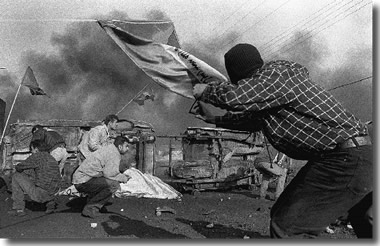
Taking cover from Israeli fire, Ramallah. (Laurent Guerin)
|
More
than eight months have passed, and over 500 lives have been lost, since
the second intifada broke out in September 2000, but few, if any, of the
uprising's original goals have been achieved. Instead, the iconic enemy
of Palestinian nationalism, Ariel Sharon, was elected Israeli premier
at the head of a "national unity" government with Foreign Minister
Shimon Peres providing a "dovish" public relations cover. Two
Arab summits held since October did little more than promise financial
support for the intifada, with little of it actually materializing. US
elections brought to power a new administration apparently as obsessed
with the unfinished business of the Gulf war as it is averse to reprising
Bill Clinton's role in the "peace process." Finally, the long-awaited
UN Security Council vote for an international peacekeeping or protection
force for the Palestinians was scuttled by a US veto on March 28. The
Bush administration seconds Sharon's rhetoric pledging no negotiations
before the "violence" stops. Even the most hopeful analysts
only suggest that the US has yet to formulate a clear policy toward the
Israeli-Palestinian conflict. Meanwhile, settlements continue to expand
and in a recent poll, 72 percent of the Israeli public supported even
greater use of armed force to put down the uprising.(1)
The second intifada has taken place within a conjuncture of forces that
are profoundly inimical to the achievement of its fundamental aim of ending
Israel's occupation of the West Bank and the Gaza Strip.(2) The external
forces would present a formidable challenge to any anti-colonial movement.
But the internal conditions of Palestinian politics are also deeply unfavorable
to the uprising's ability to reap transformative, as opposed to incremental,
gains. The intifada has provided the context for a widening internal debate
on the limitations of the present leadership, as well as on the need for
democratic reform. But the continued absence of independent political
movements capable of mobilizing a challenge based on these issues, added
to the constraints imposed by the current crisis, means that a democratic
transition is unlikely either during the intifada or in its immediate
aftermath. Nevertheless, the Palestinian Authority (PA) is clearly at
a crossroads, caught between its inability to wrest concrete political
gains from the intifada and unrelenting economic, diplomatic and military
pressure to "end" the uprising. This has led to a situation
where the PA's continued existence is now up for debate.
Strapped for Cash
Over the last few years, donor money, tax receipts and customs and VAT
payments (once they were finally put in unified national accounts) have
covered the PA's general operating costs. Significantly, customs and VAT
revenue, which are controlled by Israel, made up almost two thirds of
the PA's formal working budget. Since last autumn, Israel has refused
to transfer these VAT payments, at the same time that donor emergency
aid has actively bypassed the PA and been funneled through international
agencies like UNWRA and UNDP. Other crucial sources of revenue -- statist
or state-linked business concerns in the "private sector" (e.g.,
the Jericho casino) and control of major commodity flows like gasoline,
cement and gravel -- are also now in disarray. Income from these sources
had covered the costs of some of the security services, maintained the
upper levels of the bureaucracy and helped to retain the loyalty of other
constituencies inside and outside the West Bank and Gaza. With the disappearance
of Israeli good will and the decline of Israeli and foreign tourism, income
from these sources has eroded. The leadership's decision to go along with
the intifada represents a weakening of the economic elite within the PA
that was implicated in these commercial concerns; many of them were considered
most amenable to compromise at Camp David II. Only an estimated $15 million
of the $1 billion in Arab aid promised at the October 2000 summit has
arrived. The gap suggests that the Arab regimes, while anxious to deflect
internal criticism by pledging monetary support to the intifada, have
also been using money as a means to pressure the PA into returning to
the Oslo process.(3)
In March 2001, UN Special Representative to the Middle East Terje Larsson
held a press conference in which he warned that the PA was "on the
verge of imminent collapse." Larsson's warning, though exaggerated,
seems to have made the international "shepherds" realize that
too much financial pressure on the PA might backfire: the PA could become
either too radicalized or too weakened to return to negotiations. The
European Community stepped in with a $15 million monthly "loan"
to the PA to offset Israel's withholding of VAT payments. In March, the
second Arab summit pledged an additional monthly soft loan of $30 million
over a period of six months, also to help cover civil service salaries.
While the PA is still financially strapped, it has enough revenue to ensure
-- for a short time -- the basic survival of its formal institutions.
Limitations of PA Leadership
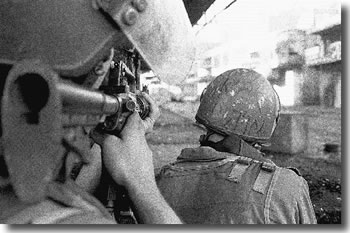
Israeli
soldier takes aim at a youth in Hebron. (Laurent Guerin)
|
But perhaps more
significant than the budgetary crisis is the unabated criticism of the
PA's shortcomings as government. Public sentiment against the Authority's
ineptness and corruption has intensified, as most PA institutions have
proven poorly equipped to respond to public needs during a national emergency.
Civil defense measures from the police and security forces remain rare;
instead, local municipalities carry most of the burden of dealing with
physical destruction from Israeli military attacks. The PA also has remained
largely absent in other areas. The PLO's Palestine Red Crescent Society,
along with NGOs like the Union of Palestinian Medical Relief Committees,
have been more active in emergency medical services than the Ministry
of Health. Given its financial crisis, the PA also has been unable to
address the public's mounting economic losses. In December 2000, the Ministry
of Labor offered a one-time payment of 600 NIS ($150) to workers who had
lost their jobs in Israel -- and then this money dried up. A recent survey
conducted by the Birzeit University Development Studies Program found
that 81 percent of Palestinians who received cash or in-kind support during
the intifada have received it from a non-PA source -- either UNRWA or
the alms (zakat) committees linked to religious institutions. In bearing
the brunt of Israel's economic and military war, the populace has largely
been left to fend for itself.
But popular criticism of the PA has focused equally on its inability --
or unwillingness -- to provide a clear overarching strategy for the uprising.
The same Birzeit survey found that 43 percent of respondents thought there
was a need to replace the PA with a new government. (Yasser Arafat retains
a higher personal approval rating -- 47 percent -- than any leader from
the secular or Islamic oppositions.) Active resistance to the Israeli
occupation appears only fitfully guided by the National and Islamic Forces
(NIF), the coalition of political movements that are ostensibly leading
the intifada, but which have offered little direction or vision of their
own. A common refrain since October is that "there is no leadership."
Israel's declared war against the uprising has thrown the limitations
of the PA's rule into stark relief.
By bombing the "installations" of PA security forces and assassinating
individual Hamas and Fatah activists, former prime minister Ehud Barak
and now Sharon have sent a message to the Israeli public that the Israel
Defense Forces (IDF) remain in control. But these counterinsurgency tactics
also seem directed at reinforcing a sense among Palestinians of the IDF's
almost supernatural powers of surveillance, as well as the PA's impotence.
This conscious projection of Israel's all-engulfing power (and thus the
PA's and the population's total dependence on it) contrasts sharply with
the behavior of Israeli governments -- especially Labor governments --
since 1993. Oslo's pretense that the two sides were equal "partners
for peace" demanded that the PA leadership be awarded the requisite
veneer of autonomy. Now the pretense is gone. Instead the clear message
is that Israel controls the majority of Palestinian public funds, controls
Palestinian workers' access to their most crucial labor market and determines
whether the Palestinian government, including its legislative council,
can meet or not. The segmentation of Palestinian territory, including
the Gaza Strip, into dozens of blockaded areas has made the practice of
self-government by the PA virtually impossible. For the first five months
of the intifada, Yasser Arafat was unable to "visit" the West
Bank at all. Once in the West Bank, he was similarly obstructed from "visiting"
the Gaza Strip. The Palestinian Legislative Council (PLC) has met only
twice since October; the first attempted meeting was called off because
most of its members could not reach Gaza. Israel allowed the PLC meeting
in March to go ahead, in hopes that Arafat would "denounce violence,"
but did not allow PLC member Marwan Barghouthi (head of the vilified tanzim
in the West Bank) to attend. Ironically, this has effectively centered
even more decision-making power in Arafat's hands. The nominal institutions
of collective decision-making, weak in the past, now seem almost defunct.
Strategies of Rule
At the March PLC meeting, Arafat, for the first time since the creation
of the PA, spoke of the need for internal political and institutional
reform, affirmed his commitment to the rule of law and raised the issue
of corruption. He asserted that preparations were underway to hold long-awaited
elections for local governments, chambers of commerce and mass organizations.
In the world press, Arafat's statements about reform went unnoticed, as
Israel and the US focused solely on his failure to call on Palestinians
"to end the violence." Within the PA and among Palestinian political
parties and the population at large, Arafat's call for reform was seen
as a response to internal discontent -- though not necessarily a harbinger
of things to come.
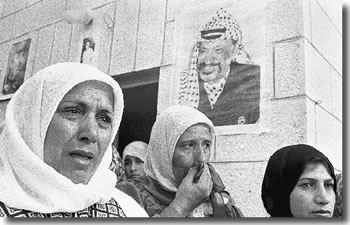
Funeral
in Beit Ur, West Bank. (Laurent Guerin)
|
Clearly, fault lines
have emerged in the strategy of rule that the leadership developed during
the Oslo process. Two aspects of that strategy have particular relevance
in understanding the choices that lay ahead. First, PA rule was not exercised
through internally coherent government institutions empowered with specific
functions within a framework of law. Rather, PA rule was largely accomplished
outside of the new institutions of government and at their expense. Formal
government institutions served as symbols of "statehood on the way"
and as mechanisms of patronage, primarily through government employment
for returning PLO exiles and crucial local constituencies. Simultaneously,
the strategy of rule included the integration of structures and figures
from the PLO (as representatives of the national liberation movement)
into the highest levels of PA executive decision-making. Whereas the fundamental
structures of the government were left inchoate and disempowered, its
uppermost executive was conflated with the leadership of the national
liberation movement. This conflation of the PLO and the PA, at the expense
of democratically elected government representatives, is exemplified by
the structure known as the "Palestinian leadership" (al-qiyada
al-filastiniyya). For the past six years this structure has been the highest
decision-making body in the PA. It combines the ministerial council, members
of the PLO Executive Committee, the speakers of the PLC and the Palestine
National Council and some of Arafat's advisers. Such arrangements suggest
that, given the deep uncertainties of Oslo, Arafat is unwilling to make
the transition away from the national liberation movement to "autonomy
government" before full-fledged statehood. He has often justified
limiting the PLC's powers by reference to the higher and more encompassing
power of the PLO, as the representative of all Palestinians, not just
Palestinians in the West Bank and the Gaza Strip, whom the institutions
of the PA represent.
With this strategy and the strength of the state party, Fatah, the leadership
was able to survive the early challenge of Hamas to its power. The overall
system has been able to deflect (less influential) nationalist and reformist
challenges due to its medusa-like power structure and the leadership's
continued ability to project nationalist legitimacy in the conflict with
Israel. Their popular support declining, most PLO factions have become
more dependent on the leadership since the early 1990s. As such, these
factions have benefited from the representation of the PLO in the PA's
executive. In this position, PLO factions could remain a "loyal opposition"
able to criticize the Oslo process (and even the PA) as long as they did
so within the boundaries of the political field delineated by the leadership.
Until recently -- as proven by the fate of Hamas and Islamic Jihad at
various times during the 1990s -- it was armed struggle that lay outside
the acceptable parameters of opposition to Oslo or the PA's policies.
This strategy of rule enabled the leadership to deal with the main challenge
of the indefinite interim period which followed the 1994 Declaration of
Principles: how to enter a state formation process under the control and
auspices of the colonial power, while retaining the mantle of the national
liberation movement. To meet this challenge, the leadership needed to
keep its contending political constituencies committed to (or at least
not actively resisting) a deeply flawed diplomatic process. But consent,
if not commitment, to the "peace process" could only be sustained
if there was enough hope that Oslo would lead to the realization of full
Palestinian national rights. Against all odds, the leadership kept this
hope alive in the last few years by claiming that the concessions of the
interim period would be recompensed by iron resolve during final status
talks. The breakdown of the Oslo process at Camp David was the almost
inevitable end game.
Reform or Liberation?
The end game which produced the intifada (with the help of Sharon's visit
to al-Aqsa) also exposed the tension within the PA's identity: it is simultaneously
a ruling -- though not sovereign -- government and the institutional heir
to the national liberation movement. The longer the intifada continues
without reaping diplomatic gains, the stronger the voices calling for
full national liberation become, at the expense of "governance."
The emerging debates about the "internal situation" reflect
the PA's dual identity. In line with Arafat's PLC address, there are forces
that focus mainly on "reform" of the PA, advocating new elections
for the PLC and local councils, and the development of the rule of law.
They tend to call for an emergency government to address the particular
needs of the intifada. At the opposite extreme, there are calls for the
dissolution of the PA as a government, its replacement by the PLO and
a return to armed struggle as the means to liberate Palestine.
Talk of reform has been around for a while, but now it is much more vocal.
Many of the same groups and individuals who had attempted to develop "third
way" democratic parties over the past few years (mostly figures from
the left factions or NGOs, and secular independents) are currently the
main purveyors of reform talk.(4) In some cases, earlier attempts have
now crystallized into a joint political platform with strong reform content.
But such initiatives have yet to finalize a political program or, more
crucially, an organizational structure. The public rallies known as "popular
conferences," held in some West Bank towns in March and April by
a coalition of nationalist factions, repeatedly sounded the theme of the
need for internal reform: new elections, the rule of law, separation of
powers and combating corruption. But most speakers did not develop these
demands in any programmatic way, nor could they draw links between their
stated support for continuation of the uprising and the need for government
reform. None of these factions have a large, organized mass base, or a
clear strategy for effecting reforms.
Fatah and the Opposition
The calls for reform emanating from within Fatah are perhaps more significant.
Fatah, like most nationalist movements, brings together a wide and contradictory
array of social forces. It encompasses dominant elements of the bureaucratic
leadership as well as the new statist economic elite, local economic elites,
top military brass and members of the security forces. Most important
are its mass organizations, including its Shabiba youth wing, its women's
committee and the regular party organization or tanzim.(5) These mass
structures tie "the street" to the leadership. But while the
top political leaders of Fatah tend to be returnees from exile, the mass
organizations, both in membership and leadership, tend to be from the
"inside." While in Gaza the mass organizations were largely
absorbed into PA civilian and security structures, in the West Bank they
remained relatively distinct from the PA. Significantly, the leadership
of the mass organizations is dominated by the younger generation of mid-level
cadre, who came of age during the first intifada, and acquired their current
positions through democratic party elections over the past five years.
This same leadership has been the driving force of the current uprising
in the West Bank.(6)
As far back as the 1997 Fatah Regional Conference in Beit Sahour, the
weaknesses of the Oslo process as the strategic means to liberate Palestine
were beginning to take their toll. That conference ended with movement
leaders calling for a possible return to "armed struggle," in
an attempt to hold the movement together, particularly in the face of
opposition from Hamas. Following Camp David and Sharon's fateful visit
to the Haram al-Sharif, the internal tensions finally exploded and what
has become known as the tanzim took to the streets. Fatah sees itself
as continuing the legacy of resistance -- including armed struggle --
that had dominated the history of the PLO. But since Fatah is also the
"ruling party," it does not see itself in opposition to the
PA but as a necessary complement to the PA's role in negotiations. At
an April 2001 roundtable in Ramallah, Marwan Barghouthi was explicit on
this point: the formation of the PA is a historic achievement that needs
to be protected. While asserting that "the intifada also poses a
criticism of the internal situation [PA rule]," he added that reform
of the government is currently impossible.
Other elements in Fatah reject Barghouthi's moderation. The unknown group
responsible for the January 2001 assassination of Hisham Mekki, the Palestine
Broadcasting Authority chief known for his corruption, is widely assumed
to be affiliated with Fatah. Clearly the movement's call for preservation
of the PA, while also undertaking armed resistance, creates new pressures
that cannot be controlled. The recent participation of Force 17, and other
security organs, in armed activities against Israel suggests that the
state military apparatus finds it hard to remain a bystander while relative
ingénues take over its legacy of armed struggle. The Fatah movement's
role as the vanguard of the intifada, in conjunction with its move onto
the military terrain, sets in motion a rebalancing of power within the
ruling elite -- not outside it.
At the other end of the spectrum are the voices calling for a full-fledged
return to a national liberation movement and the dissolution of the PA.
These have come from two sources: Islamists and left PLO factions. Hamas
and Islamic Jihad -- having been the main victims of PA rule and now being
major beneficiaries of the uprising -- have a clear interest in such a
revision of national strategy. On the left, there are those who view the
intifada as an opportunity to bury the Oslo accords -- which they have
always rejected -- and return to the framework of the PLO, where they
might regain some of their lost influence. Beyond these political debates,
the fate of the PA hangs in the balance of the war of nerves between the
Israeli and Palestinian leaderships.
War of Nerves
One of Barak's main strategies vis-á-vis the intifada was to prevent
the PA from reverting to its liberationist roots, either in the form of
the old PLO or in a new reconstructed form. This clearly had to do with
the exigencies of his electoral campaign, but also reflected his commitment
to Oslo as the framework through which Israel could safeguard its interests.
Hence, despite the early signs of Arafat's "reversion" -- releasing
Hamas and Islamic Jihad prisoners, and allowing the creation of the NIF,
made up of PLO and Islamist factions -- Barak's use of repression was
interspersed with invitations to negotiate.
By contrast, Sharon has mounted an international campaign to demonize
the PA as a "terrorist entity," and continually presents Arafat
as an obstacle to security and peace. The current Likud discourse is like
an artifact from another age. After Oslo, the word "terrorist"
had been reserved for Hamas and Islamic Jihad. Now it refers to any form
of Palestinian resistance to occupation, and includes the Fatah tanzim
and Force 17, Arafat's presidential guard. Sharon states that there can
be no negotiations before Arafat has arrested (or rearrested) this broad
panoply of "terrorists" and reinstituted security cooperation
with Israel. But should talks resume, Sharon is offering nothing more
than a long-term interim agreement that would keep most of the West Bank
under Israeli control, retain all the settlements and defer negotiations
on Jerusalem and refugees. It is obviously impossible for Arafat to agree
to this, raising the question of Sharon's intentions. Some argue that
he seeks to permanently destroy the PA, burying Oslo and ending Arafat's
career. Given the constraints of international and coalition pressure,
Sharon is more likely using the threat of the PA's destruction to push
Arafat back into a more amenable position. Arafat's tactical response
seems to be to send all possible signals -- to the US, the Europeans and
the Arab world -- that he is prepared to let the entire edifice of the
PA collapse, and revert if necessary to some form of armed resistance.
Arguably, if all else fails, Arafat retains and probably strengthens his
legitimacy by reinstating himself as leader of a liberation movement.
Most likely, an exit from the current impasse will be found before this
stage is reached. The joint Jordanian-Egyptian proposal currently on the
table offers an "honorable exit" based on the Sharm el-Sheikh
ceasefire deal brokered by Clinton in late October 2000. It stipulates
the withdrawal of Israeli forces from PA-controlled civilian areas, the
lifting of internal sieges and the transfer of VAT payments owed to the
PA. In return, the PA would crack down on armed resistance and gradually
reenter security cooperation with Israel. Negotiations would then resume
on final status issues while outstanding interim agreements by Israel
would be implemented. Most crucially for the Palestinian leadership, the
package includes a full settlement freeze -- which the PA could present
as the achievement of the uprising.
Arafat reluctantly has agreed to the Jordanian-Egyptian proposal, but
Sharon has not. But growing European and UN support and favorable comments
from the left wing of Labour and the US indicate that the proposal may
evolve into a face-saving device for both parties. If the Jordanian-Egyptian
proposal does become an exit from the current war, it is likely that reform
of government will once again become the salient Palestinian political
debate. But since Fatah is the only strong force to have emerged through
the intifada, a new balance of power within the current system rather
than the system's radical overhaul will probably be the main outcome of
the debate. There are wider debts to be paid. The immense costs of lost
lives, homes and livelihoods cannot be completely ignored. The leadership
probably hopes that show trials of a few corrupt PA officials and a resumption
of work in Israel's labor market after months of impoverishment will suffice.
What is certain is that this intifada will leave a collective memory of
government failure in the face of mass hardship. Whether the intifada
will also lead to a point beyond Israel's enduring occupation of Palestinian
land has yet to be seen.
Endnotes
1) Ha'aretz, April 4, 2001. In other findings: 79 percent of those surveyed
agreed with Sharon's policy of no negotiations before the end of violence
and 53 percent believed the purpose of the intifada was simply to cause
harm to Israel.
2) For an overview of the backdrop to the uprising see Rema Hammami and
Salim Tamari, "Anatomy of Another Rebellion," Middle East Report
217 (Winter 2000).
3) Even these mostly Saudi donations are stuck in the accounts of the
Islamic Development Bank, as the Saudis and others are locked in negotiations
with the PA about "development plans" and a "transparent
mechanism" for the funds' distribution. Other Gulf aid tended to
wind up in the hands of Hamas, which has rebuilt its welfare institutions
and, thereby, its popular support.
4) In particular, figures formerly in the left factions (the PFLP, the
DFLP, Fida', the PPP and so on) can be found at the forefront of initiatives
to create new parties or movements. These figures are motivated by alienation
from entrenched factional leaderships (such as those in the PA executive)
and the search for political relevance.
5) See Graham Usher, "Fatah's Tanzim: Origins and Politics,"
Middle East Report 217 (Winter 2000).
6) Many individual members of the Fatah cadres that had been absorbed
into the PA in Gaza are now working under the rubric of what are called
the Popular Resistance Committees, not in any official PA capacity.
|





























 visitors
since March 1, 2000.