Adam Hanieh, Birzeit Webmaster
24 September, 1999
| 1996 first half |
1996 second half |
1997 first half |
1997 second half |
1998 first half |
1998 second half |
1999 first half |
1999 second half |
|
| Academic and research | 4 | 0 | 6 | 9 | 17 | 20 | 20 | 21 |
| Arts and culture | 0 | 0 | 0 | 3 | 8 | 8 | 8 | 9 |
| Business and economy | 0 | 0 | 3 | 7 | 9 | 13 | 14 | 14 |
| Government and services | 3 | 3 | 7 | 7 | 17 | 17 | 20 | 28 |
| Human Rights | 0 | 2 | 5 | 7 | 9 | 12 | 15 | 15 |
| Industry and Products | 0 | 0 | 2 | 6 | 6 | 6 | 6 | 9 |
| Internet and Computers | 0 | 5 | 10 | 12 | 15 | 15 | 17 | 24 |
| News and Media | 0 | 0 | 3 | 4 | 5 | 11 | 11 | 14 |
| Online memorials | 0 | 0 | 2 | 6 | 6 | 7 | 7 | 7 |
| Organizations and Associations | 0 | 0 | 3 | 10 | 16 | 18 | 27 | 27 |
| Personal Homepages | 0 | 1 | 1 | 4 | 5 | 6 | 11 | 13 |
| Political Parties | NA | NA | NA | 3 | 4 | 4 | 4 | 4 |
| Schools and Universities | 2 | 2 | 8 | 8 | 10 | 13 | 13 | 15 |
| Tourist Information | 0 | 1 | 5 | 7 | 14 | 19 | 23 | 28 |
Total |
9 | 14 | 55 | 95 | 140 | 169 | 196 | 228 |
Percentage change from preceding year |
- | - | - | 578% | - | 78% | - | 35% |
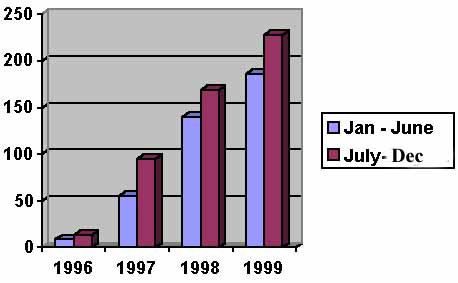
The table and graph above show that the rate of increase in websites has slowed over the last 12 months (35% from end of 1998 - September 1999 as opposed to 78% increase from end of 1997-end of 1998) although there has still been an overall numerical increase. In addition, there has also been a qualitative increase concerning both technical and informational issues.
If we look at the level of penetration of the web in different sectors it is still low (see table below for an approximate breakdown of number of institutions in different categories). Three sectors have seen a large relative increase (the NGO sector, government and service sector and the tourist sector).
| Category | Number |
| Primary and Secondary Schools | 527 |
| High Schools and Universities | 1054 |
| Ministries | 28 |
| Municipalities | 114 |
| Hospitals and Clinics | 76 |
| NGOs | 1200 local and around 200 international organizations(excluding educational insitutions) |
There is an increasing differentiation in quality with many of the new websites being outstanding but many websites remaining static for the last 12 months. It is estimated around 35% of websites have not been updated within the last 12 months. One indication of quality is the number of Golden Olive Award winners. This award is given to websites of outstanding quality based in Palestine and there were thirty winners out of a possible 204 (internet and computer websites are excluded). This is around the same percentage as last year but it should be noted that eighteen of these websites were first time winners and ten were new to the WWW within the last 12 months. Thus while the rate of numerical increase may have slowed, there has been an increase in the quality of new websites coming online.
It is noticed from many informal discussions that although there is an increased understanding of the importance of the WWW in distributing information, many organizations still devote little resources to it. In particular, the task of developing a website and maintaining it is often given as an extra job to a staff member with many other responsibilities or a relative of an employee who "knows something about the internet". Very few organizations employ someone specifically for the web, for those that do there is a very noticeable difference in quality (for example Birzeit University, MIFTAH and the Palestine Central Bureau of Statistics).
However several Palestinian organizations are using the web in an impressive manner and have expanded their presence on the Internet over the last 12 months. BADIL, The Palestinian Society for the Protection of Human Rights and the Environment (LAW), The Palestinian Human Rights Centre (PHRC), the Palestinian Human Rights Monitoring Group (PHRMG) and MIFTAH all send out regular press releases by email and put them on the WWW immediately. All these organizations also place their reports and publications online.
It is also now possible to find virtually all important statistics, documents and maps on Palestinian websites located within the country - something not possible 1 year ago. Important to mention here are: the Palestinian Central Bureau of Statistics and the Centre for Palestinian Research and Studies (census and opinion polls); SHAML, BADIL (refugee information); PASSIA, ARIJ and the Health, Development, Information and Policy Institute (maps); ARIJ and Maan Development Centre (environmental issues); JMCC and the Jerusalem Quarterly File (analysis); and the websites mentioned early for human rights related information.
Two points should be noted here though - firstly, there is no centralized source of information for all this information available from within the country (where most of the information is gathered) so it is often difficult to know how to find the information (one of the aims of the Complete Guide is to help point people in the right direction). Secondly, it is significant that apart from the PCBS none of these organizations are official Palestinian Authority websites.
Although a large majority of websites are still "brochure" sites (one or two pages with little information, a phone number, and rarely updated) there has been progress in the types of information presented on the WWW from Palestine. There has been an increasing number of Palestinian websites utilizing video and audio rather than just text based information.
In December 1998 a hunger strike was called by students at Birzeit University around the issue of political prisoners. During the hunger strike the Birzeit Webteam videotaped interviews with student leaders from all political blocs in both English and Arabic and presented this with daily news stories about the strike. This was done cheaply and easily using a hand-held video camera and a computer.
Birzeit also began an online radio station which is the first of its kind in the West Bank. The radio station covers issues about the university as well as general news about the situation in Palestine. It has around 1000 listeners/show and interestingly the number of people who listen to the Arabic program is the same as the English. The BBC recently broadcast excerpts from Birzeit OutLoud on a new show called A World in Your Ears. It is rumoured that some local Palestinian radio stations currently broadcasting in the Ramallah area are considering broadcasting their shows over the internet.
The Palestinian Legislative Council is working on developing its website including the addition of live Real Audio broadcasts of events and interviews with council members.
Some companies in Palestine have begun developing multi-media CD Roms with information on Palestine. Worth mentioning here is Rama International who have produced a country profile of Palestine on CD with narrated video clips, music and images.
One of the most important features of the internet is its ability to allow Palestinians to speak for themselves and not through traditional media that is at best unsympathetic to the Palestinian cause. There is still little sign of the ordinary Palestinian voice on the WWW with most of the web development occurring through high-profile organizations. We can assume though that on an informal level this is occurring especially with the proliferation of internet cafes throughout the area. A visitor to these internet cafes will find them packed with young people surfing the WWW, chatting and sending email (see http://www.birzeit.edu/ramallah/internet.html for information on some of these cafes available in the Ramallah area).
One development in this respect is The Across Borders Project (see www.acrossborders.org) which was initiated by the Information Technology Unit at Birzeit University and aims to establish websites and internet centres in Palestinian refugee camps was launched earlier this year. The first centre has been established in Dheisheh Refugee Camp and work will begin soon on a similar centre in the Gaza Strip.
As an organizing tool the internet enables instant communication around the globe and thus as means of organizing people on a global basis it is very important. A good example of this during the last 12 months was the campaign around Burger King in the Israeli settlement of Maale Admumim. It was very exciting to see that this campaign originated from discussions initiated on the Freedom List (run from Jerusalem) and involved a very wide range of organizations inside and outside the country. It involved campaigning through the internet as well as direct-action campaigning. The internet enables many-to-many communication as opposed to one-to-many. We see this with the many discussion groups set up around different issues. Instead of one person or group, writing an article or monopolizing discussion, issues can be debated in a much more open and productive fashion. The Burger King campaign was successful and hopefully will be repeated soon.
There has been an increase in more technically sophisticated websites in Palestine over the last 12 months. One area pioneered by Arab Supernet, a private company based in Ramallah, is the use of web-database interface. Arab Supernet have designed a system which enables companies to add information about themselves straight on to the web. Although it still needs to be taken up by local companies in a big way, such a system is a good step forward.
There is also more information offered in Arabic (around 8% of websites on the Complete Guide). Many of these sites require an Arabic-enabled browser which is still the main problem in designing websites in Arabic (otherwise information needs to be offered as scanned images). A local company has recently launched an Arabic guide to websites in Palestine, similar to the Complete Guide. It can be found at http://www.palseek.com
Internet Access in Palestine
A recently published survey by the Palestine Central Bureau of Statistics (available at http://www.pcbs.org/english/com_use.htm) provides useful information on some aspects of Information Technology in Palestine. The survey reveals that around 6.9% of households in the West Bank and Gaza Strip have a computer. The total number of computers is 33,867 of which the overhwhelming majority is concentrated in the West Bank (29038 in the West Bank as opposed to 4,829 in the Gaza Strip). Of the total number 24,723 are located in urban areas with refugee camps having the lowest percentage number at 2,554.
Costs for internet access through and ISP range from $10-25/month for dialup access and $200-400 for a lease-line connection at 32 K. It should be remembered that the average Palestinian wage is just over US$300/month (PCBS).
Within the major Palestinian population centres there is fairly strong coverage from Internet Service Providers (ISPs). There are 10 ISPs covering major population centres. (Jerusalem (6), Ramallah (4), Bethlehem (4), Hebron (2) , Tulkarem (1) , Qalqilya (1), Jenin (1), Nablus (2), Gaza (3)).
At this stage there is no direct Palestinian connection to the internet backbone so all ISPs must go through an Israeli service Provider. Internet bandwidth ranges from 128K to 768 K. There is an estimated 8000 clients for these ISPs. These figures represent the number of individual, institutional and corporate customers for ISPs. The real number of Palestinians who use the internet is much higher. All universities have internet access as well as several high-schools. As mentioned earlier there is also an increasing number of Palestinian internet cafes available at very reasonable prices.