
 At approximately 5:30 pm on Saturday, March 29, 1997, an Israeli Border Policeman shot and killed Birzeit University student Abdallah Khalil Abdallah Saleh, 20, during clashes at the checkpoint north of al-Bireh, on the main road to Jerusalem. According to eyewitnesses Abdallah was killed by a single shot to his heart from a distance of approximately 80-100 meters.
Abdallah studied electrical engineering at Birzeit University and had almost completed his second year. His family lives in Beit Sahur—a Palestinian town neighboring the illegal Israeli settlement construction on Mount Abu Ghnaim which led to international condemnation, as well as new rounds of demonstrations and over 450 Palestinian injuries. The university observed a day of mourning and held a memorial service for Abdallah. A number of his friends as well as student leaders spoke at his memorial. Hundreds of students travelled to his house to pay condolences.
The killing took place in an atmosphere charged with tension, and at a time when the political negotiations threatened to cease altogether. Abdallah was killed on the ninth day of clashes following Israel’s decision to proceed with building the illegal settlement of Har Homa on Mount Abu Ghnaim. Continued Israeli settlement construction, especially in Jerusalem, contradicted the terms of the political accords which stipulated that nothing be done to prejudice the outcome of final status issues like Jerusalem and settlements. Witnesses reported that during the clashes soldiers had fired rubber bullets and tear gas at the demonstrators some of whom suffered light injuries until shortly before Abdallah was killed when an Israeli military officer was injured by stones thrown by the demonstrators. Subsequently, witnesses noticed two live bullets shot at “shoulder height”. Witnesses said they thought the bullets were explosive because of the way the rocks in the hill behind them exploded upon impact.
The witnesses reported that Abdallah was shot shortly thereafter with a single live bullet. According to a medical report issued by Ramallah Hospital, Abdallah was pronounced dead on arrival and was noted upon examination to have a penetrating gunshot wound on his left upper chest. Abdallah was killed after two hours of clashes which took place in a context known by Israeli soldiers to be charged with tension.
It was not evident from available information what heightened threat would have justified the introduction of live ammunition. Furthermore, the location and nature of the wound raise serious questions about the possibility that the soldiers deliberately employed lethal force. For this reason, Birzeit University welcomed the announcement of an official investigation of the killing and calls for the publication of the results of the investigation. Birzeit University also calls for the halt to the construction of illegal settlements which are counterproductive to Israel’s declared intention to participate in a peace process with the Palestinian people.
RETURN TO TOPFor many years HRAP has taken its mandate from the standards embodied in the Universal Declaration of Human Rights, the Fourth Geneva Convention, and related treaties and conventions. In its opening words, the Universal Declaration argues that “recognition of the inherent dignity and of the equal inalienable rights of all members of the human family is the foundation of freedom, justice, and peace in the world.”
In two decades of work documenting and protesting violations by the Israeli authorities of basic rights of individual students and staff, or of the university as a whole, the Project shared the international contention that the occupation itself must be brought to an end for human rights and the rule of law to prevail. The Israeli occupation in itself stands as an affront to the basic rights of the Palestinian people.
The arrival of the Palestinian National Authority (PNA)—a legitimate organ of governance—called, therefore, for the development of a new way of thinking and intervening. While HRAP’s mandate and the human rights standards remained constant, the context shifted dramatically. Instead of working for the elimination of an authority, the Project welcomed a new era when it was possible to work in cooperation with the authority to build and develop Palestinian society on the basis of the rule of law and human rights.
This fundamental difference informed the work of HRAP in 1996. The Project remains convinced that it is in the common good that the universal standards of human rights provide a foundation for the governance of society at all levels. The Project has, therefore, documented all violations of the standards and endeavored to intervene in their defense. This issue of the Birzeit Human Rights Record includes an overview of major issues addressed in 1996, as well as recommendations drawn at the conclusion of the year. (See pages Areas of Concern--Israeli Authorities and Areas of Concern--Palestinian National Authority.)
RETURN TO TOP As of May 1, 1997, there were 41 Birzeit students and no staff in Israeli prisons. None of the detainees are female. Three students were under interrogation. On 1 May, 8 students were in administrative detention, i.e., detention without charge or trial. There were 2 students and no staff detained illegally in the Palestinian prisons.
On Tuesday, 11 February, Israeli authorities released 31 female Palestinian political prisoners as agreed upon in Annex VII of the Israeli-Palestinian Interim Agreement on the West Bank and the Gaza Strip (Oslo II), signed September 28, 1995, in Washington, DC. Two Birzeit University students were among the women released.
The release of political prisoners is a necessary adjunct to a process of reconciliation. In contrast, Israel has continued to detain even those prisoners never charged or tried. The eight students listed below are among the 275 Palestinians held in “administrative detention”, without charge or trial. (See Areas of Concern--Israeli Authorities.)
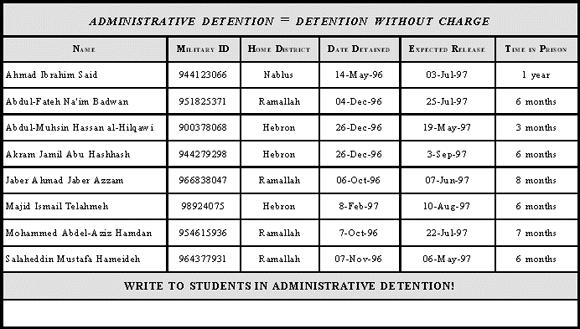

* Bahjat was arrested and released since the last issue of the Human Rights Record.
** Mustafa was released from administrative detention and arrested less than one month later for being in the West Bank without a permit to study. He remains in prison awaiting trial.
RETURN TO TOPOn Monday, 3 March, thousands of students and academics around the world raised concerns about unnecessary harassment of their colleagues from Gaza to Israeli diplomatic officials around the world. They delivered more than 6,000 signatures to Israeli officials as part of an international petition drive coordinated by the “Gaza Students Campaign” of the Cambridge University Palestinian Society.
Participants delivered petitions to Israeli embassies in at least seven world capitals and to Israeli prime minister Binyamin Netanyahu’s office directly. The petition called on Israel “to guarantee academic freedom for the students, teachers, and staff of Gaza who work in the West Bank.” It also emphasized “that Palestinian education is of great importance to the peace process, and call[ed] upon Israel to ensure that this education is not denied.”
Palestinian students participated in the campaign, circulating petitions and submitting them to Netan-yahu. Israeli and Palestinian human rights groups also worked with campaigners. On 3 March, B’Tselem, an Israeli human rights organization, ran a full-page advertisement listing over 100 Israeli academics who support the rights of Gaza students in the leading Israeli daily newspaper Ha’aretz.
Academic Freedom First, the International Campaign for Gaza Students, continues. For more information read the article below. Academics and students should also check out the Cambridge University Palestinian Society’s latest ideas and efforts.
RETURN TO TOP
Just before the close of 1996, HRAP launched an official Academic Freedom First website. The site is full of information about the Gaza student problem and more: Meet some Gaza students and read about their experiences in the photographic exhibit Portrait and Testimony or find out more about the harassment of Gaza students in the background paper Understanding the Issue. For ideas on how to get involved in the campaign read the Campaign Platform or check out the Action Page.
In a time when the prospects for progress on this issue have seemed particularly bleak, the active involvement in other human rights and solidarity organizations has been most welcome. The Cambridge University Palestinian Society’s enthusiastic organizing is described in the article above. Lots of local press coverage was generated from this effort, contributing to the overall understanding of the ongoing difficulties in the “peace process.” Starting in the autumn, B`Tselem, the Israeli Information Center for Human Rights in the Occupied Territories, launched an intensive campaign “Speak out for Academic Freedom” involving Israeli academics and students, as well as international students, in efforts to resolve the Gaza student issue. Their efforts resulted in a series of newspaper advertisements signed by more than 100 Israeli academics, as well as other activities. Human Rights Watch/Middle East has been a long time supporter of the campaign for Gaza students; during the petition drive they acted as the coordinating center for 66 participating US universities.
As this newsletter is being prepared, anger is mounting over Israeli intransigence in building a new settlement in Jerusalem. The permit system stands as another in a list of examples of Israel’s reluctance to take real steps toward peace. It incites anger and hatred, without need or benefit. This permit system places students as a lost item on the negotiating table; instead of inviting them to join in the movement to create a lasting peace, it presents daily reminders of the current reality.
RETURN TO TOPIn 1996, students subjected to interrogation by the Israeli General Security Services (GSS) faced more extreme violence and torture. On five occasions in the year HRAP considered that the threat to the health and well-being of a student in interrogation had reached alarming levels, and sought an injunction from the Israeli High Court against the use of violence by the GSS. In two additional cases HRAP documented the use of extreme violence in interrogation but was not able to take the matter to the High Court. Interventions to the High Court protested the methods used in interrogation including severe and prolonged shaking, beating, protracted sleep deprivation, hooding, position abuse, and temperature abuse.
With one exception, each time the court was asked to restrain the GSS it decided on behalf of the student detainee and ordered the GSS to refrain from the use of violence. In December, the Project approached the court on behalf of student Mohammed Abdel-Aziz Hamdan who had been interrogated for eleven days in the Russian Compound in Jerusalem. The application for an injunction was submitted to the Israeli High Court of Justice on Wednesday, 13 November. At this time the GSS agreed to suspend the use of violence.
The following day, however, the GSS requested that the court revoke the injunction on the grounds that the defendant “possesse[d] extremely vital information the immediate procurement of which would help save human lives and prevent serious terrorist attacks in Israel” and therefore made it necessary to interrogate Mr. Hamdan without restraint. The High Court granted the request and revoked the injunction. Mr. Hamdan, who had now been held by the Israeli authorities for 38 days, was returned to the Russian Compound for continued interrogation. (For more information about Mohammed Hamdan, see story below.) (For details of the court ruling, read their decision.)
The court’s ruling in the case (the second such ruling--see article in HRR No. 17) led the UN Committee against Torture, the oversight body for the Convention against Torture, to demand from Israel “a special report on the question of the decision taken by the Supreme Court and its implications for the implementation of the Convention [against Torture] in Israel.” In March, Nigel Rodley, UN Special Rapporteur on Torture stated that Israel is legalizing the use of torture in interrogating Palestinian detainees.
 Mohammed Abdel-Aziz Hamdan, 34, teaches school in the village of Deir Dibwan. In 1991, the Palestinian Council for Higher Education selected him to participate in Birzeit University’s educational program, in which teachers improve their skills and receive a diploma from the university. Mohammed began his studies in February 1992 and completed two semesters before being detained by the Israeli military authorities. In November 1992, Mohammed was arrested at his home in Beit Sira. After a month of interrogation, the Israeli authorities deported Mohammed to south Lebanon along with more than 400 Palestinians. Mohammed was allowed to return from Lebanon in late 1993 and immediately imprisoned for three additional months. He was released in February 1994.
Mohammed spent the better part of 1996 in prison. He was arrested by the Palestinian National Authority in March in an arrest campaign following the killing of 60 Israelis in suicide bomb attacks. From March until August he remained imprisoned without charge or trial. The Palestinian High Court of Appeals declared his detention illegal on 18 August, and still he was not released. Finally on 26 August he was allowed to go home.
When released he returned to his home in Beit Sira, located in a part of the West Bank still under full Israeli control. He must have considered the risk of being rearrested, as the Israeli military has often rearrested Palestinians released by the PNA. Exactly six weeks later on 7 October, the Israeli military authorities arrested him at his home in the middle of the night. They informed him that he would be detained “administratively”--i.e. without charge or trial--for four months.
On 24 October he was arrested from prison and taken to interrogation in Jerusalem. Eighteen days later when his lawyer, Adv. Elia Theodory, first visited him in the Russian Compound, Mohammed had been subjected to severe interrogation including shaking and hitting, and sleep deprivation for days on end. Mohammed spent most of the time tied to a small chair with his hands and legs cuffed and a filthy hood placed over his head. He was beaten each time he fell asleep.
Theodory immediately contacted Adv. Andre Rosenthal to apply to the Israeli High Court for an injunction blocking the use of violence against him. After initially issuing an injunction, the court cancelled it on the second day. (See above.) In two visits following this Mr. Hamdan reported to his lawyers that the interrogators had returned to the previous techniques including one episode of violent shaking, and prolonged sleep deprivation. Mr. Hamdan’s interrogation was extended until 24 December when the court prevented the GSS from extending it further. On 24 December Mr. Hamdan was issued with a new four-month order of administrative detention. He was scheduled to be released on April 23, 1997 at which time he was issued with a new administrative detention order for the period April 23-July 22, 1997. He remains in prison. He was never charged with any offense.
In 1996, Israeli practices against administrative detainees (those held by administrative order without charge or trial) moved into a new phase wherein it became commonplace to extend their orders ad infinitum. During the year, 19 students were placed in administrative detention and 5 students continued terms of administrative detention that began in 1995. Students were ordered imprisoned for periods of between 2 and 18 months. On January 1, 1997, 7 students remained in prison based on an administrative order.
Student Ali Rabia’ was issued with four consecutive orders without charge or trial. He was held between October 1995 and April 8, 1997. He spent more than one and one-half years in prison. Ali also was administratively detained February through June 1995. In the 27 months between February 1995 and April 1997, Ali has been imprisoned for all but 3, i.e. two full years, despite the fact that he has never been charged. Two other students have been held for more than 6 months in administrative detention.
In 1996, 66 students from Gaza were arrested and imprisoned after being caught studying “illegally” in the West Bank. Not one student from Gaza had permission to study in the West Bank between February and December. Israeli negotiators recently stated in bilateral negotiations that “there is no solution for the Gaza students.” In the last two academic years all students have been denied permits most of the time. A student who obeyed the permit system would have missed the entire 1995-96 academic year and the 1996-97 academic year to date. For more information, see We, The Undersigned ... and http://www.birzeit.edu/aff.
For many years the HRAP has documented the harassment of students and staff via arbitrary detention. Throughout its history, the project has documented the high incidence of arbitrary detention, especially in relation to students. This has often been seen as a means of harassment and intimidation. On average during the past two decades 65 percent of persons detained were subsequently released without charge. In 1996, without including 280 students arrested and released in a massive raid on 28 March, 75 percent of detainees were interrogated and then released or placed in administrative detention without charge.
In the preamble to the interim agreement of September 28, 1995, (“Oslo II”) Israeli and Palestinian negotiators reaffirm “their determination to put an end to decades of confrontation and to live in peaceful coexistence, mutual dignity and security, while recognizing their mutual legitimate and political rights.” The concerns outlined above illustrate widespread ongoing violations of the basic human rights of Palestinians by the Israeli authorities. Peace cannot be realized in this situation.
While Israel continues to claim that the methods of interrogation used by the General Security Service do not constitute torture, international consensus refutes the claim. The Convention against Torture clearly states that no exceptional circumstances may be invoked as a justification of torture or other cruel, inhuman or degrading treatment
The practice of habitually detaining students without charge or trial stands in direct violation of their most basic rights. The increased use and prolongation of administrative detention stands as an affront to the spirit of the Oslo Accord which pledged to moving toward the release of all political prisoners.
In the past two academic years, students following Israeli regulations would have been deprived entirely of their education. The failure to resolve this matter undermines support for the peace process and works against the good of all people in the region. Israeli authorities should a.) state unequivocally their support for the Gaza students’ right to continue their education at the university most suited to their academic and personal circumstances; and b.) adopt, publish, and follow standardized and transparent procedures which will enable all students to continue their studies uninterrupted.
The overriding trend that posited the greatest concern for HRAP with respect to the activities of the PNA in 1996 was the failure to respect the basic due process rights of most detainees. PNA security agencies functioned frequently in an extralegal manner. Detentions did not take place in the context of applicable laws—no warrants were issued, no charges submitted, and no trial undertaken. Court ordered releases were not implemented. While eventually permitted to visit most detainees, responsible officials regularly blocked the access of the project lawyer to detainees —as their lawyer. Prison officials and security personnel frequently showed disregard for the role of the law and the judiciary in building society.
On Sunday, August 18, 1996, a five-judge panel of the Palestinian High Court of Appeal sitting in Ram-allah declared the prolonged detention of 10 students illegal and ordered their immediate release. The decision of the judges was unanimous. The High Court immediately issued release orders for each of the students which were delivered by the lawyers to the Ramallah Central Prison. Despite the direct order of the court, the students were not released. Prison officials argued that the power to order the release of the detainees lay with the President of the Palestinian National Authority and not with the judiciary. The 10 detainees were released at intervals. The final one was released on Thursday, January 18, 1997—10.5 months after his arrest and five full months after the court ordered his release.
Over the course of the year, 29 students and one employee were detained illegally by Palestinian security forces. In none of these detentions was a warrant issued for the arrest or were any judicial proceedings followed with respect to the detention. The detainees were imprisoned in Ramallah and Jericho Central Prisons, and in special interrogation prisons for both the Mukha-barat al-’Ameh (General Intelligence) and the Amn al-Waqa’i (Preventative Security Service) in Ramallah, Jericho, and Dhahariyya. Of the 30 detainees, 17 were interrogated and 2 were charged and tried.
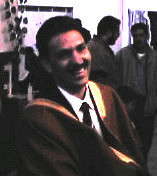 Detentions lasted for an average of five months and three days. The longest period for which a student was detained without charge or legal proceeding was 318 days (10.5 months). Five were detained for more than 250 days (8.3 months). The academic costs of the prolonged detention of students raised further concerns. As a result of their detentions three students missed three semesters of classes, and nine missed two semesters.
Across the board, the prisons where the detainees were held failed to have standard procedures to facilitate access by the detainees to their lawyer. The access of the lawyer to the detainees depended on the responsible individual at the prison gate, rather than on the system. Detainees in interrogation were usually blocked from seeing their lawyer or families, even when serious concerns had been raised about the health or well-being of the detainee. In the Ramallah Central Prison, regular visits by family and the lawyer were permitted after the initial period of detention. In the Jericho Central Prison, arrangements were developed for regular family visits, but visits by the lawyer remained difficult.
In contrast, two students were summoned and questioned concerning criminal charges—in these two instances warrants were issued, and the basic procedures mandated by the law were followed. Furthermore, their interrogation took place without the use of violence.
On 18 December 1996 at 10:30 pm, the Palestinian State Security Court in Jericho sentenced student Abdul-Nasir Isma’il al-Qeisi to life in prison with hard labor for his alleged involvement in the 11 December 1996 killing of two settlers by the village of Surda in the Ramallah District, West Bank. The trial was closed to the public and lasted approximately 15 minutes. According to our reports, Abdul-Nasir asked for a lawyer but was informed he could not have a lawyer “because there was no time”. The HRAP lawyer, who had been in regular contact with the Palestinian security forces and the military prosecutor since Abdul-Nasir’s arrest on 11 December, was not contacted.
The functioning of the State Security Courts fails to adhere to minimum requirements for an independent court of law. Furthermore, the courts in their very structure violate minimum standards of international law, including: the right to a fair and public trial by a competent, independent, impartial court; the right to have adequate time to prepare one’s defense; and the right to be defended by a lawyer of one’s choice. The sentence handed down by the State Security Court is ratified by the President without any possibility of appeal to a higher court.
Take immediate steps to reaffirm its role and importance. HRAP would like to emphasize again the importance of an independent judiciary in organizing and developing a vibrant and successful Palestinian society. The structures and procedures that have come to be called “the rule of law” are essential for insuring a balance of powers and a respect for the equal rights and opportunities of all citizens. Respect for basic due process rights must form the foundation of the future state. Actions that are taken today set important precedents for the coming period.
The use of violence in interrogation is an affront to the dignity of both the interrogator and the detainee and can only lead to dangerous divisions within Palestinian society. The governance of society counts on the full respect for the humanity of every member. In this light we call on the competent authorities to take the following steps: a) Publish a ban on torture and all violence in interrogation; b) Establish and publish complaint procedures for persons alleging to have been subjected to torture or other violence by or at the instigation of a public official; c) Open criminal proceedings against persons alleged of committing torture; and, d) Train security personnel in forensic research and the rules of evidence.
Clarify the regulations governing arrest, interrogation and detention. Confirm the right of prisoners to meet with their lawyers and the importance of legal counsel in matters concerning detention. Confirm the right of detainees to appear before a court of law to appeal the grounds of their detention. Train security personnel in rights of detainees and in proper procedures. Establish procedures in the prisons for locating and tracking prisoners.
The State Security Court cannot be an instrument to uphold the rule of law and impart fair and just rulings. It should, therefore, be abolished and the civilian courts should be supported in their important work.
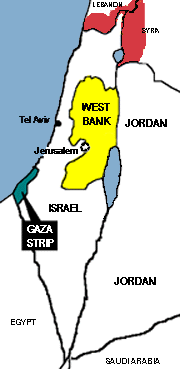
Palestinians from the West Bank wishing to enter Gaza (even those who do not require a special permit to enter Jerusalem) have been regularly blocked by Israeli authorities. As the work of Birzeit University professors often involves travel to Gaza, this has interfered regularly with the work of members of the university community.
Center for Occupational and Environmental Health Sciences (COEHS) director Ramzi Sansur reported that for months he has been unable to visit the COEHS laboratory in Gaza. Dr. Sansur notes that successful management requires hands-on involvement and regular consultations with staff and contractors who use the analytical, training, and other services of the laboratory.
As reported in HRR No. 15, since 1991 COEHS has been working to address regional issues surrounding the control of agricultural pests. The project has involved ongoing research, international training, and, the organization of training seminars on safe pesticide usage and pest control in the occupied territories. COEHS extension workers have been denied access to Gaza for several years. For more information, see the COEHS homepage.
The Continuing Education Department (CED) organizes specialized courses and training. (See the CED Homepage.) Many CED courses have an audience in both Gaza and the West Bank. Two times in recent months an Israeli-imposed ban prevented Palestinian CED trainers from entering Gaza to carry out courses. In March CED had organized a course entitled “Public Relations Management” in cooperation with the Palestinian Ministry of Planning and International Cooperation (MOPIC). The 25-hour course was designed for 20 directors of Public Relations Departments representing most PNA ministries as well as several security forces.
CED contracted an expert in personal communications skills to conduct the first module. The expert had traveled to Gaza on numerous occasions. The module was to have taken place on Friday and Saturday, 21-22 March. Permits were arranged for the expert and the CED staff person responsible for the project to enter Gaza, as required by Israel. On the first day of the course Israeli banned all carriers of Israeli or Jerusalem identity cards from Gaza “for security reasons”. (Such a ban does not effect Israeli settlers who are free to enter.) After two hours of negotiations with border officials, the trainer and the CED staff person were forced to return to Jerusalem and the course was postponed.
Birzeit University professors and administrators, including Political Science professor Dr. Ali Jarbawi and Public Relations director Albert Agha-zarian, have also been impeded from carrying out training, or other responsibilities by their inability to enter Gaza. Such measures violate the right to freedom of movement and undermine the development of Palestinian society and its institutions. For the sake of the peace process it is vital that the development of Palestinian society continues unhindered.
RETURN TO TOP