As anywhere in Palestinian society, "Jerusalemites" make up a vital component of the Birzeit University community. Today, 13 percent of the student body, 17 percent of the teaching faculty, and 13 percent of the staff come from East Jerusalem. The links between the university and Jerusalem, located some 25 kilometers from the university, extend to the earliest days of the school, prior to the Israeli occupation of the West Bank (including Jerusalem) in June 1967.
[[EARLY PHOTOS LINKING BZ WITH J. or map showing proximity.]]Days after occupying East Jerusalem, Israel annexed the city in violation of international law and extended Israeli law over the city. Israel issued East Jerusalem Palestinians who were present during their census with identity cards categorizing them as "permanent residents" of "Israel". (Residents who were not present during the census were deprived of their right to reside in the city from that time.) At the same time Israel announced that any resident of East Jerusalem willing to pledge loyalty to the State of Israel could apply for citizenship. Palestinians largely refused citizenship in the country of the occupying power.
From its first days in the city, Israel violated its obligations as a signatory of the Fourth Geneva Convention, a convention drafted with the express purpose of protecting the rights of civilians in times of war, or the aftermath of war. Article 47 of the Convention explicitly prohibits "individual or mass forcible transfers, as well as deportations of protected persons ... regardless of their motive."
By refusing to allow Palestinians who had been displaced during the war (and were, therefore, not present for the census) to return to their homes and families, Israel began a process intended to alter the demographic composition of the city. This process has continued until today. "Since the annexation of East Jerusalem by Israel in 1967, all Israeli governments have made great efforts to reduce significantly the number of Palestinian residing in East Jerusalem. These efforts include harsh restrictions on Palestinian construction in the eastern part of the city, a rigid policy on family unification, and minimal investment in infrastructure, and are part of a policy to strengthen Israeli sovereignty in East Jerusalem so that it cannot be challenged in the future."[B’Tselem/HaMoked, The Quiet Deportation: Revocation of Residency Rights of East Jerusalem Palestinians (Jerusalem, April 1997) print version, page 4.]
In 1988, the Israeli Supreme Court ruled that the Entry into Israel Law should be applied to Palestinian residents of East Jerusalem, in so doing it classified Palestinians as foreign residents whose right to reside derived from the state’s beneficence.
Beginning in about 1994, the Israeli Ministry of Interior began aggressively implementing a policy by which residency was defined as "a question of reality", not as an inviolable fact. In 1996, the Minister of Interior stated that, in fact, "when a person moves his or her 'center of life' outside of Israel, that person’s residency expires automatically." (B’Tselem/HaMoked, The Quiet Deportation, printed version p. 17) Since that time hundreds, if not thousands, of Palestinians have been denied the right to live within the Israeli-defined borders of Jerusalem. Their status often has been changed from one day to the next, based on the decision of a single bureaucrat.
According to international law, the notion of "center of life" has no relation with a person’s right to live in their hometown. In fact, there is no possibility for the "automatic expiration" of a person’s residency in her or his home. International law has sought to protect a person’s right to leave and return from their home—without exception. (Article 12, International Covenant on Civil and Political Rights)
Whether carried out via bureaucratic procedures, threat of force, or force, individual or mass forcible transfers, or "expirations" of residency permits, are absolutely prohibited. Article 147 of the Fourth Geneva Convention defines deportation and transfer as a "grave breach" of the Convention, equivalent to a war crime in customary international law.
Israeli governmental perceptions of "reality" require thousands of Palestinian families to enter into conversations about this slippery concept of the "center of life" in efforts to avoid being "procedurally" deprived of their rights. As B’Tselem stated in a June 1997 letter, "According to this policy, all Palestinians who have lived outside of Jerusalem for a period of time, whether in a foreign country, in another part of the West Bank, or in Jerusalem’s suburbs, just meters outside the municipal boundaries, are liable to lose their rights as Jerusalem residents. Every Palestinian resident of East Jerusalem who cannot prove that he or she currently lives in Jerusalem and has lived there continuously in the past, permanently loses the right to live in the city of their birth."
Where you live, where you work, who you marry, where your children are born, in which school you study or choose to enroll your children, where you receive your medical services, and "the time ... spent in Israel and outside of Israel" all factor into the Israeli calculation of a Palestinian’s "center of life". Needless to say, the same calculations are not applied with respect to Israeli citizens who travel or live permanently elsewhere. Hundreds, if not thousands, of Palestinians of East Jerusalem have been deprived of their rights as residents of the city through this procedure. Thousands more are threatened by the same measures.
Most Birzeit University students and staff from Jerusalem live in Jerusalem and commute the 25 kilometers between their homes and the university. Others, for whatever reason, live closer to the university. Some register their children in schools in Jerusalem, others—again for whatever reason—prefer to register their children in schools closer to the university.
By teaching or studying at Birzeit University … or traveling frequently to attend conferences or seminars … or living near the university … or enrolling their children in schools near the university … Birzeit faculty and students risk being accused of shifting their "center of life" out of Jerusalem, and thereby losing their right to live in the city, to visit their families in the city, to inherit property, or to seek medical care.
In recent months increasing attention has been cast upon Israel’s revocation of the residency rights of East Jerusalem Palestinians. The revocation of residency rights only makes up one aspect of a multifaceted policy designed to force Palestinians to leave East Jerusalem and to permanently alter the demographic composition of the city. Other aspects of the policy include the denial of family reunification for Palestinians in East Jerusalem, discrimination with respect to the planning and development of East Jerusalem, strangulation of the economy of East Jerusalem through a policy of closure, and the aggressive development of illegal Jewish-only settlements in occupied East Jerusalem.
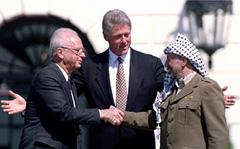
The Declaration of Principles on Interim Self-Government Arrangements, signed by Israel and the PLO on September 13, 1993, postponed the discussion of a number of issues, including Jerusalem, for "permanent status negotiations". The permanent status negotiations were to begin three years after the withdrawal of Israeli forces from Jericho and parts of the Gaza Strip. Palestinians argue that parties to the negotiations undertook to refrain from taking any steps to prejudice the outcome of the final status issues during the intervening period. They say that negotiation for peace while their lands are being seized and their people are being disposessed of their residency rights, is like trying to resolve a war without calling ceasefire.
In the earliest days of the "Madrid talks" the United States articulated to the Palestinians a clear position with respect to Jerusalem. "The United States understands how much importance Palestinians attach to the question of east Jerusalem…. [W]e do not recognize Israel's annexation of east Jerusalem or the extension of its municipal boundaries, and we encourage all sides to avoid unilateral acts that would exacerbate local tensions or make negotiations more difficult or preempt their final outcome. (US Letter of Assurances to Palestinians, October 18, 1991) Nonetheless, the United States has failed to intervene convincingly in the face of Israeli aggressions against Palestinian of East Jerusalem.