

The Ramallah Council over the years
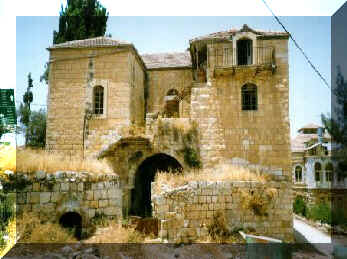
If the reader would like to have an idea, even though limited, of what Ramallah was like prior to the creation of town council, he should visit one of the underdeveloped villages today (if an underdeveloped village could be found). It would be composed of enclosed courtyards with each enclosure consisting of several houses joining one another. Leading to these enclosures is a curved, narrow, dirt passageway .
 The town council of Ramallah was established in 1910. To the praise of the
people of Ramallah could be mentioned their long history, their love of progress, and the
swiftness with which they accepted new ideas and concepts. About ten years after they
began to emigrate to America and have contact with foreigners, it occurred to them to
organize a town council to support and see after the affairs of their town. This confirms
the prevailing notion that the progress of Ramallah or any other town cannot be traced to
a particular person or group of persons, but to all the people collectively. Truthfully,
there are some persons who served their town; However, if there had not been a positive
response from the masses, not much would have been expected from the service of
individuals.
The town council of Ramallah was established in 1910. To the praise of the
people of Ramallah could be mentioned their long history, their love of progress, and the
swiftness with which they accepted new ideas and concepts. About ten years after they
began to emigrate to America and have contact with foreigners, it occurred to them to
organize a town council to support and see after the affairs of their town. This confirms
the prevailing notion that the progress of Ramallah or any other town cannot be traced to
a particular person or group of persons, but to all the people collectively. Truthfully,
there are some persons who served their town; However, if there had not been a positive
response from the masses, not much would have been expected from the service of
individuals. 
It appears that one of the first decisions of the council had to do with their concern for the cleanliness of the town, since the first thing they decided was to pay a wage to the shop and inn owners so they could undertake the cleaning and lighting of the town, and they imposed a fine on anyone who threw trash into the streets. The lighting of the town was accomplished by using kerosene lamps.They also decided to hold a livestock market every Thursday, and appointed a watchman over the trees and gardens of the town. During the early years of the municipality, they were concerned with building roads and, therefore, built the western road that leads to the orchards.
Evidently, the interest of the town council was not limited to the affairs of Ramallah alone, but extended to the neighboring villages as well. They also assisted the poor who were unemployed by granting them financial aid or exempting them from payments.
At the same time, the town council was concerned with the public totality and prohibited the sale of alcoholic beverages at inappropriate locations which might lead to an infringement of public decency.
Often some of the shop owners would regulate their scales below actual weight, so the municipality started examining them and levying a fine of all the owners whose scales were under weighing. At the beginning of World War I, the council limited the prices of particularly foodstuffs, for fear of price manipulation by the merchants. They were also concerned with supplying water to the town.
The town council did not overlook health interests either. Fearing the spread of an epidemic during the war, the council warned shop owners in Ramallah and Bireh to put toilets inside their stores, and fined anyone who urinated in the market. They also decided to set up a slaughterhouse.
The war years were hard on the people of Ramallah. The epidemic had spread, food had diminished, and prices were unreasonable. Deaths increased among the sons of the town as well as those who had emigrated there from neighboring villages. The activities of the town council were also considerably curtailed. In spite of all this, however, we are able to say that Ramallah held out. However, neither did the town council overlook other matters relating to the town's progress and prosperity. In 1919 the municipality procured an architect from Bethlehem to design for the council three plans for organizing the town. Several dirt roads were opened, public roads were paved, and it was decided to use Lux lanterns rather than kerosene lamps to illuminate the town.
In 1934 the town council imposed an education tax in the amount of two percent of the appraised value of homes. After two years the tax was increased to three percent. In 1937 the municipality became a commission presided over by an administrative officer and that arrangement continued until 1940.
In 1948 land was purchased for the Girls' High School, the building was completed in 1952, and instruction began immediately. In the same year it was agreed to purchase land for the Ministry of Education to build a center for teachers at ad-Da'aq near the present cemetery.
The municipality acquired land south of the cemetery near al-Masayun on which to build a college for training teachers related to UNRWA (United Nations Relief and Works Agency) and it was registered in the name of the municipality.
In 1959 land in the center of the city was acquired and a city park built there in 1960. The town council built a luxurious edifice for the municipality near the park in 1961. The lower rooms consist of a great hall for meetings and gatherings. In 1960 the Islamic Bureau of Waqf completed construction of a mosque on the ruins of the inn, al-Khalil.
After 1967 war, the Municipal Council continued its work inspite of the difficulties imposed by the Israelis and the hardships of the people under occupation. .Soon after the occupation the Mayor was expelled to Amman.
In 1974 municipal elections were held and the council reflected the national unity. The late Mr. Kareem Khalaf, was the Mayor but the Israeli authorities terminated his services in 1982. This prompted the whole council to resign. From 1982-1986, an Israeli officer was appointed to run the municipality. From 1986-1996 a Palestinian from Ramallah was appointed as a Mayor by the Israeli with an appointed Council of five members. In July 22nd, 1996, President Arafat appointed the current council till elections take place.
The Municipality consists of the following departments:
Administration
Engineering
Accounting and Finance
Health
Library
Garage
There are seventy seven employees. the number of workers for city works, solid waste collection, sanitary, garage as well as slaughter house are (150) one hundred and thirty five.
At present, the council consists of the Mayor and ten members.
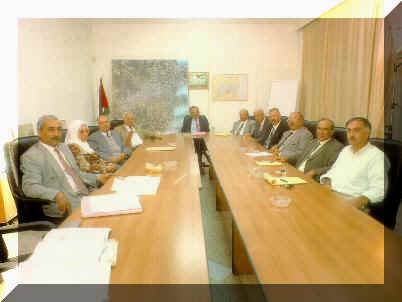
Ramallah Council Members
[Profile] [History] [Council] [Projects] [Ongoing] [Plans] [Culture] [Resort]
Site graphically designed and coded by

Rama International, P.O. Box 1313, Ramallah, Palestine
Telefax: 02 995 3139, Email: info@rama-intl.com