|
|
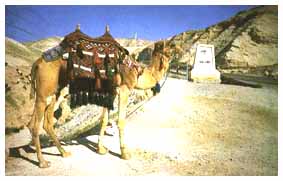 |

A sign indicating sea level on the main Jerusalem - Jericho road. From here the road starts to descend towards Jericho which sits 250 m below sea level and to the southern shores of the Dead Sea, 450 m under sea level. |
||
=========================
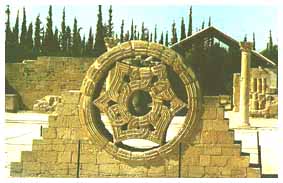 |

This monument was intended as a decoration for a window that the excavators placed it in the main court. It illustrates how the Umayads transformed Roman motifs into Islamic motifs. Caliph Hisham (AD 724-743) or Al Walid (AD 743-4) built the palace. |
||
=========================
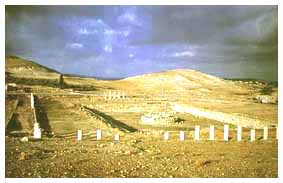 |

A large pool (70 m x 45 m) built by Herod in the center of a grand Roman garden. Water used to be brought to the pool by a canal from Solomon's pools. The pool was also used for swimming and sailing of small boats. The cylindrical structure in its center was probably a resting-place. |
||
=========================
 |

Founded by St. Saba of Cappadocia in the 5C, it was once a center of theological literature. This picture was taken from the women's tower to the South. Women are forbidden to enter the monastery, however, they may look out on the monastery from the tower. |
||
=========================
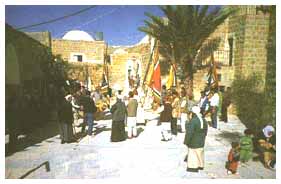 |

Mawsim Al Nabi Musa is a popular religious occasion in Palestine. It is also an important social event and a time for celebration and relaxation. The British mandate authority banned celebrations in 1932. The festival was resumed this year 1997, when this picture was taken. |
||
=========================
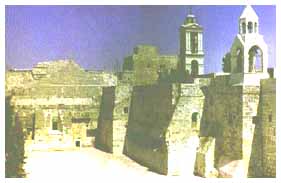 |

Queen Helena initiated the construction of the basilica over the cave of the Nativity in AD 327. The present structure is the 6C Justinian church. The fortress-like church is in the center of the city of Bethlehem facing Manger Square. The present entrance, the Door of Humility, is only 120 cm high. |
||
=========================
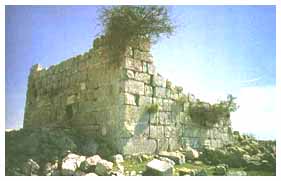 |

The Hellenistic tower of Beitin – Ramallah is thought to be the site of Jacob's dream of a ladder reaching up to heaven. Nearby is a Byzantine monastery the remains of which are still visible today. |
||
=========================
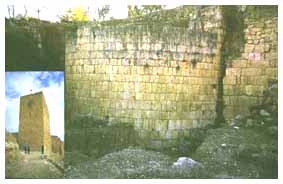 |

A rounded Hellenistic tower from Sebastiah (Samaria) – Nablus, C4-3 BC. The small picture to the left shows a Byzantine Square tower of AD 6C monastery of St. Saba near Bethlehem. |
||
=========================
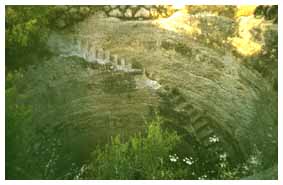 |

A picturesque Arab village, 10 km north of Jerusalem. This magnificent rock cut pool with its spiral staircase is of 12th-11th century BC. The steps continue beneath the rock flour of the water chamber. The water system is the most interesting in Palestine, denied water to attackers while making it available to inhabitants under siege. |
||
=========================
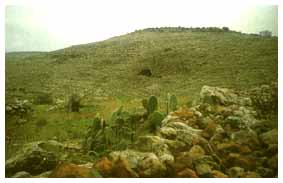 |

The cave lies on the northern bank of Wadi Al Natuf, in the Ramallah area. It was formed by karastic activity. Here were first discovered the remains of the Natufian culture that was named after the Wadi. this culture dates to the middle of the Paleolithic period (10000-8000 BC). |
||
=========================
Please address your comments on this page or orders to PACE@PLANET.EDU.

|

|
 Home
Home
|
||