|
MERIP
Primer on the UPRISING IN PALESTINE
Introduction
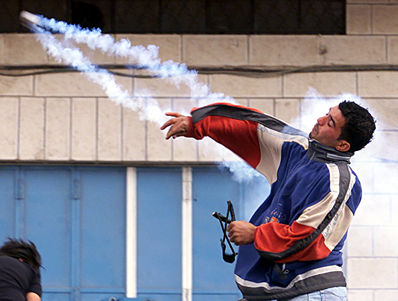
A
Palestinian throws back to Israeli soldiers a teargas canister
during clashes in the West Bank town of Ramallah Wednesday
Oct. 25, 2000. Over four weeks of violence have left
more than 168 Palestinians dead in the West Bank and
the Gaza Strip. (AP Photo/Enric Marti)
|
Not so long
ago, US President Bill Clinton hosted Israeli Prime Minister Ehud
Barak and Palestinian leader Yasser Arafat to discuss final arrangements
for peace in Palestine and Israel. In late October 2000, peace
seems very far away. Since September 28, over 180 people–all
but 12 of them Palestinians–have died, and thousands
more Palestinians have been wounded, as a popular uprising rages
against the Israeli occupation of the West Bank and the Gaza Strip.
What is the history of the conflict over Palestine? Why did Ariel
Sharon’s visit to a mosque in Jerusalem provoke Palestinian
public opinion? Is Israel right to blame Arafat for the numerous
Palestinian deaths and injuries? Can US mediation help to stop
the violence? Does the US media do a good job educating Americans
about what’s happening in Israel and Palestine?
The Conflict
over Palestine
At the start
of the 20th century, the Ottoman Empire ruled much
of the Arab world, including the lands that now constitute Israel
and the Occupied Territories. With the Allied victory in World
War I, the area came under the control of the British who made
contradictory promises to Arab and Zionist leaders about how–and
by whom–the Mandate of Palestine was to be governed. At the
time, 90 percent of the population was Arab; the Jewish community
included long-time residents and new immigrants fleeing persecution
in Russia and, later, other parts of Europe. A three-year uprising
in the late 1930s against British rule and increased Jewish immigration
resulted in a British proposal to partition Palestine into Jewish
and Arab states. UN General Assembly Resolution 181 reaffirmed
partition in 1947.
The war that
followed led to the establishment of the State of Israel; Israel,
Egypt, and Jordan each claimed sovereignty over parts of the territory
designated for a Palestinian state, displacing some 750,000 Palestinians.
Less than 20 years later, in the June 1967 War, Israel gained
control of the rest of the former Mandate of Palestine (the Gaza
Strip and the West Bank, including East Jerusalem, which Israel
annexed in 1980), the Egyptian Sinai (since returned to Egypt),
and the Syrian Golan Heights. UN Security Council Resolution 242,
never implemented, affirmed "the inadmissibility of the acquisition
of territory by war" and called upon Israel to withdraw "from
territories occupied in the recent conflict." The 1970s and
1980s saw Arab-Israeli wars in 1973 and 1982, the 1978 Camp David
Accords between Israel and Egypt, the outbreak of the Palestinian
intifada in December 1987, and Yasser Arafat’s condemnation
of terrorism and recognition of the state of Israel in December
1988.
The Madrid
peace conference followed the Gulf war in October 1991. A year
later, secret Israeli-Palestinian talks began in Oslo, Norway,
culminating in the September 1993 Declaration of Principles (DoP)
on interim Palestinian self-government, signed by Arafat and Israeli
Prime Minister Yitzhak Rabin. The DoP set out a process for transforming
the nature of the Israeli occupation but left numerous issues
unresolved, including the status of Jerusalem, the right of return
for Palestinian refugees, the disposition of Israeli settlements
(whose expansion continues until today) and final borders between
Israel and a Palestinian state.
Under the
DoP, Israel relinquished day-to-day authority over parts of the
Gaza Strip and West Bank to the Palestinian Authority, headed
by Arafat who returned to Gaza in 1994. However, ultimate power
remained with Israel, which exercised its control by frequently
sealing off the Palestinian-governed areas from the rest of the
Occupied Territories and from Israel. Subsequent agreements in
1995, 1998 and 1999 failed to resolve these issues. With Palestinian-Israeli
negotiations stalled, US President Bill Clinton called a summit
at Camp David in July 2000. After two weeks of intensive negotiation,
the talks ended without a deal.
Who Is
Ariel Sharon?
A retired
army general, Ariel Sharon, 72, has been a major figure in Israeli
politics for decades. In 1971, he led a systematic campaign to
quell opposition in Gaza through massive repression, expulsions,
and arrests. He was first elected to the Knesset in 1977 and,
as defense minister in 1982, he led the Israeli invasion of Lebanon.
An Israeli tribunal found Sharon indirectly responsible for the
massacre (by Lebanese militias under Israeli control) of thousands
of Palestinian and Lebanese civilians living in the Sabra and
Shatila refugee camps. In the aftermath, he was removed as defense
minister but retained a role in the Cabinet as "minister
without portfolio."
In the early
1990s, Sharon served as housing minister and promoted a massive
construction drive to increase Israeli settlement in the occupied
West Bank and Gaza Strip. In 1998, Prime Minister Benjamin Netanyahu
named Sharon foreign minister. As current head of the Likud party,
Sharon has vociferously criticized Prime Minister Ehud Barak for
negotiating with the Palestinians. He maintains a residence in
Jerusalem’s Old City (draped in an Israeli flag) and his
provocative visit to al-Haram al-Sharif on Sept. 28, and the harsh
Israeli response to the protests that followed, helped ignite
the current uprising.
Who Controls
the Palestinian Street?
Since 1994,
portions of the West Bank and the Gaza Strip have been administered
by Yasser Arafat’s Palestinian Authority (PA). The PA is
not a fully sovereign state like Israel or the United States,
but it does provide municipal services and attempts to maintain
order in the areas under its control. The PA’s top ranks,
including Arafat, mostly belong to Fatah, the largest faction
of the Palestine Liberation Organization (PLO). But Fatah is independent
of the PA, and Arafat does not control the entire organization.
The current uprising in the Occupied Territories has pushed militant
local leaders of Fatah to the forefront, and Fatah units have
coordinated much of the street fighting.
Above all,
the ongoing intifada expresses cumulative popular anger
at both the violence of the Israeli occupation and the compromises
Arafat seems willing to make on basic Palestinian national rights–such
as the establishment of a viable sovereign state, the right of
return for Palestinian refugees displaced in 1948 and 1967 and
Palestinian sovereignty in East Jerusalem. Fatah has, to a limited
extent, been able to channel this anger in street protests. When
Ariel Sharon visited the Haram al-Sharif on September 28, the
ensuing Palestinian protests were spearheaded by Islamists and
students–the sectors of the population that are most militant
in their criticisms of the Oslo process, and among whom Fatah
enjoys little influence. Since the initial protests, Arafat’s
moves to contain the violence have been unpopular on the Palestinian
street. Huge crowds in the West Bank and Gaza demonstrated against
Arafat’s presence at the October 17 Sharm al-Sheikh summit,
and the failure of Arab leaders to agree on concrete action against
the Israeli occupation at the October 21-22 Cairo summit.
The PA security
forces whom Arafat does control directly have only rarely intervened
in armed clashes. Arafat does not control the armed Fatah cadres,
nor the stone-throwing students and youths who constitute a disproportionate
number of the dead and wounded. He could crack down on the uprising,
but to do so would strengthen the voices that describe the PA
as a proxy police force for the Israeli occupation, and endanger
his status as leader of the Palestinian cause.
The "Honest
Broker" and the UN
Since Israel’s
1967 occupation of the West Bank, Gaza and East Jerusalem, there
has been a nearly unanimous international consensus on how to
resolve the crisis: an international conference based on international
law and United Nations resolutions. But Israel disagreed, and
the US backed Israel’s rejection.
After the
Cold War, the US has often relied on the UN to negotiate agreements
and provide peacekeepers to end regional wars and crises: in Cambodia,
Angola and Guatemala and more recently in East Timor, Sierra Leone
and elsewhere.
But the US, while mentioning one or two UN resolutions in passing,
kept Israel-Palestine diplomacy under its own control. Washington–Israel’s
major financial, diplomatic and military backer–claimed the
role of the "honest broker." The actual requirements of international
law (like Israel’s obligations as an occupying power to protect
civilians and to prohibit settling Israeli citizens in occupied
territory) and existing UN resolutions (such as 194, ensuring
the right of Palestinian refugees to return and receive compensation)
were sidelined in favor of US-brokered talks between Israel, the
strongest military power in the Middle East and the 17th wealthiest
country in the world, and the stateless Palestinians living under
occupation or in exile.
In the 1991 Madrid talks, the US-Israeli Memorandum of Understanding
stated explicitly that the UN would have no role. In the 1993
Oslo process, the UN was ignored. In 1999 when over 100 signatories
of the Geneva Conventions met to assess Israeli compliance with
the Conventions, the meeting lasted only ten minutes in order
to "avert friction" with Israel. The failed 2000 Camp David summit
ignored the UN altogether.
In October 2000, as Palestinians continued to die, Tel Aviv insisted
that any UN fact-finding commission would be nothing but a "kangaroo
court," and that it would accept only separate Israeli and Palestinian
investigations under overall US authority. When 14 out of 15 members
of the UN Security Council voted to condemn Israel’s excessive
force against civilians, it was the US alone that abstained. US
Ambassador Richard Holbrooke threatened to veto any further resolution,
stating that the virtually unanimous current resolution had taken
the UN "out of the running" to play a role in negotiations.
The September-October 2000 occupation crisis ushered in an unprecedented,
albeit significantly limited, role for UN Secretary General Kofi
Annan.
A special session of the UN’s High Commission for Human Rights
passed a strong resolution condemning the "grave and massive violations
of the human rights of the Palestinian people by Israel", and
establishing a "human rights inquiry commission." An enormous
US lobbying campaign resulted in Washington’s Western allies
opposing the vote, and many non-aligned countries abstaining.
When the General Assembly convened, US diplomats again went into
high gear to dampen the language of the resolution. Only six countries–the
US, Israel and four Polynesian island states–voted no, though
nearly a third of the General Assembly abstained.
On October
25, the US House of Representatives voted 365-30 to call on Arafat
to stop the violence. Congressional leaders said the House felt
compelled to pass the resolution to counter the UN resolutions
that are "biased against Israel." The same day, the
House passed a new foreign aid bill. Israel will receive $2.82
billion in the next fiscal year–18.9 percent of the total
and the largest aid amount of any country.
After almost a month of clashes, over 130 Palestinians and eight
Israelis dead, and a military occupation and siege tighter than
ever, the best hope for peace is a return to UN resolutions, international
law and direct UN involvement in Israeli-Palestinian diplomacy.
Providing international protection to Palestinians and putting
Secretary-General Kofi Annan in charge of negotiations instead
of President Bill Clinton would certainly raise at least a glimmer
of such hope.
Five Questions
the US Media Should Ask About the Violence in the Middle East,
But Don’t
1. Why didn’t
Ehud Barak prevent Ariel Sharon from visiting the Haram al-Sharif?
2. Why do
news accounts refer to Palestinian citizens of Israel as "Israeli
Arabs," when they call themselves Palestinians?
3. What were
the Israeli soldiers who were "lynched" on October 12
doing in Palestinian-controlled Ramallah?
4. Do peoples
under military occupation have a right to resist the occupation?
5. Why should
the US have a "special relationship" with Israel?
For
links to further information and updates about the situation in
Palestine and Israel, click here
|





























 visitors
since March 1, 2000.