
Contents
From the Editor
Constructing an International Criminal Court
-Joe Stork
Alternatives to an International Criminal Court
-Lisa Hajjar
Democracy or Ethnocracy?
-Oren Yiftachel
Fifty Years Through the Eyes of "New Historians" in Israel
-Ilan Pappe
Countering Israel's 50th on the Internet
-Steve Niva
Deir Yassin Remembered
-Phyllis Bennis
Dis/Solving the "Refugee Problem"
-Rosemary Sayigh
The Myth of Gender Equality and the Limits of Women's Political Dissent
in Israel
-Simona Sharoni
Between a Rock and a Hard Place: Arab Women, Liberal
Feminism and the Israeli State
-Lisa Hajjar
US Aid to Israel
-Phyllis Bennis
The Contradictions of Economic Reform in Israel
-Michael Shalev
The Enigmas of Shas
-Graham Usher
Tensions in Iran: The Future of the Islamic Revolution
-Olivier Roy
From Schmaltz to Sacrilege - Rubber Bullets
-Rebecca Stein
To Clear the Minefield - Notes from the Minefield
-Karen Pfeifer
Letter: Funding and Middle East Studies in Europe
-Drewery Dyke
Editor's Picks: New and Recommended Reading
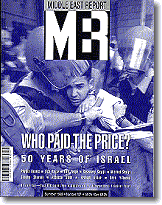
Who Paid
the Price?
50 Years of
Israel

From the Editor
This issue of Middle East Report is intended as a counterpoint to the celebrations of Israel's 50th anniversary and Zionism's 100th. In representing perspectives that have not been addressed during these celebrations, we emphasize those people who have been victimized, marginalized and excluded by the creation of the state of Israel. In doing so we attempt to answer the question not posed by these celebrations, namely, "who paid the price of Israeli state-building?"
It has also been 50 years since the drafting of the Universal Declaration of Human Rights. Article 19 of the Declaration declares that "everyone has the right to freedom of opinion and expression; this includes freedom to hold opinions without interference and to seek, receive and impart information and ideas through any media regardless of frontiers." Perhaps the cornerstone of the entire Declaration, this article is of particular interest to progressives involved in news media. While numerous human rights organizations work for the implementation of the Declaration in the Middle East, journalists throughout the region continue to face extensive government censorship, harassment, imprisonment and execution. In fact, it is difficult to speak of the free press anywhere in the Middle East.
In an ironic admission of the role of government in censorship in Algeria, Algerian Communications Minister Habib-Chouki Hamraoui announced on March 19 that "a forthcoming information law would 'guarantee' freedom of the press and access to information ... and that journalists would no longer be arrested, prosecuted or jailed for their reporting activities" (Index on Censorship, 3/98). The Algerian government is not alone in targeting journalists.
During that same week in Palestine, the Israeli army shot and wounded 14 Palestinian journalists covering clashes between the Israeli army and Palestinian demonstrators in Hebron. Putting this in the larger context of Israel's 50th year and the continuing abuse of Palestinian human rights, Edward Said recently wrote (Index on Censorship 3/98), "There can be no concept of human rights, no matter how elastic, that accommodates the strictures of Israeli state practice against 'non-Jewish' Palestinians in favor of Jewish citizens. Only if the inherent contradiction is faced between what in effect is a theocratic and ethnic exclusivism on the one hand and genuine democracy on the other, can there be any hope for reconciliation and peace in Israel/Palestine."
This issue of Middle East Report also marks my last as editor. As a member of the MERIP staff for the past three years I have had the privilege of working with many talented people who continue, with me, to support the work of MERIP with dedication and commitment. Laurie King-Irani, who joined the MERIP staff in May, will take over as editor of this magazine in July. Formerly editor of al-Raida (the Lebanese quarterly journal of the Institute of Women's Studies in the Arab World), Laurie brings to MERIP a background in Middle East anthropology and a commitment to progressive politics and social justice.
-Geoff Hartman

 visitors
since March 1, 2000.
visitors
since March 1, 2000.