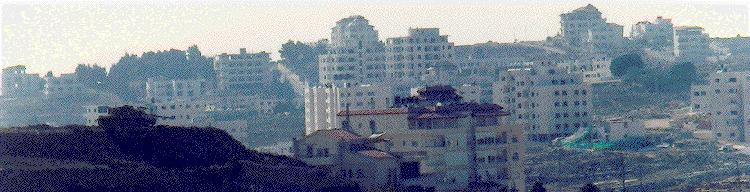
As clashes broke out across the West Bank after the opening of the Western Wall tunnel near Al-Aqsa mosque in the Old City of Jerusalem, the international media descended in droves on Palestinian towns including Ramallah to cover the story.
Media coverage was better than usual but today’s news is always quickly replaced by tomorrow’s news. The result - a medium that does not perform an archiving function. As students were involved and among the injured, Birzeit University staff were involved in documenting the developments. Birzeit photographer Yasser Darweesh commented that, “I saw things those days that I will never forget.”
A decision was made to publish material about the clashes on the University website. The material would not be removed, remaining permenantly available to visitors. Within two days, a website was available - On the ground in Ramallah: Reports from a town become battlefield, http://www.birzeit.edu/palnews/war - with over 50,000 words of textual information, 80 photographs and many links to other locally-based organisation’s sites.
Within 10 days, around 3,000 visits were recorded to the special site, over twice the number of visits to Birzeit’s entire website in previous months. The server statistics for October showed that over 5,000 seperate visits had been made to the Birzeit webserver as a whole, three times as many as in previous months. In November the trend continued, with just over 4,000 visits, the decrease attributed to the fact that no major developments had taken place in the area.
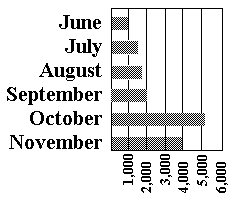
Above: Visits to Birzeit’s website since its June 1996 launch on the Internet.
| NOTE: The recently-updated Palestine Archive funding proposal is now available on-line in both HTML and MS Word 6.0 formats (http://www.birzeit.edu/palarc). The project is at last moving towards realisation. For more information on how to support this project, see the article on funding news in the center pages or contact the Birzeit Webmaster. |
Birzeit’s reporting on the clashes was itself news! To the best of our knowledge, no other non-media organisation has ever reported live from a conflict zone with multiple, daily updates, using the World Wide Web. The novelty of the experiment attracted the attention of several television and print journalists, including Robert Fox of the London Daily Telegraph, Canadian CBS television and newspapers from as far afield as South Africa and the United States.
The Net magazine also reviewed A Personal Diary, which produced the Photo Diary for the On the ground in Ramallah site, in its December edition. Various Israeli radio and television stations also mentioned the website in their programmes.
| “New technology takes Intifada on to the Internet” Article by Robert Fox, Daily Telegraph 1 October 1996 |
The Telegraph article, although sensationalist in tone, does highlight the uses that Birzeit is establishing for Palestinian information technology. In the coming final status period the need for the Palestinian voice to be heard on the Internet is greater than ever. These and other articles about the Birzeit website are available at http://www.birzeit.edu/web.
At Birzeit, we are hoping that coverage such as that mentioned above will serve to draw attention to the need for Palestine’s Internet to be developed and thus bring in the funding needed to fulfil this vision.
COMMENT by Nigel Parry, Birzeit University Webmaster
The Palestinian-Israeli conflict has always taken place primarily in a "warzone" where words, not bullets, are used as ammunition. When live ammunition does enter the conflict, their voices are quickly "put into context" by the slick Israeli propaganda machine. "If we opened fire," it smiles, "we had no choice." "If they opened fire," it sobs, "now you see what our efforts to achieve peace are up against."
On Wednesday 25 September, as Palestinian protesters and police across the West Bank and Gaza Strip were met with live ammunition, helicopter gunships and tanks, a group of Birzeit University staff and students rolled out a vehicle of our own, our site on the World Wide Web, for us a new vehicle of communication still developing into its role at the university after only three-and-a-half months of service.
In Ramallah, as Israeli soldiers killed unarmed Palestinian demonstrators, we photographed them doing it. As Israeli spokesmen emphasised that their troops were "only" using "rubber bullets", we took photographs of injured people’s faces and of the plastic-coated steel bullets that tore through them. As Israeli soldiers cheered, danced and gave each other "high fives" when they shot demonstrators in the head with live ammunition, we stood quietly and watched as witnesses. As Palestinian Police finally opened fire on Israeli soldiers, who had been shooting both Palestinian civilians and policemen from inside Palestinian territory, we noted the context. As helicopters shot up civilian homes, we collected the fragments of the 20mm explosive bullets they used. In the hospital, as the floors we walked on became stained with blood, we collected statistics on the injured, dead and brain dead. Then we went to work. It’s amazing what you can do with a flatbed scanner, a 486 computer and a modem.
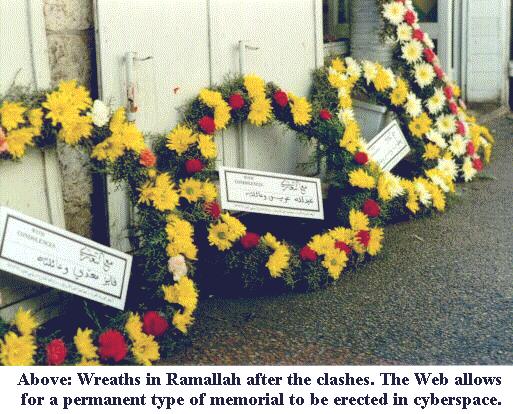
There were problems with our experiment, but overall it went pretty well. In the fast-food, fast-paced world of international media, people responded with relief and gratitude to our daily, in-depth and local summaries. Visitors encountered personal testimonies of those who were there and over 80 photographs depicting the events. They could review statements issued by local and international organisations, and link to other Palestinian websites with information on the conflict. Within ten days, twice the number of people that usually visit the university website each month visited our special website - "On the ground in Ramallah - Reports from a town become battlefield". By the end of two weeks a total of 3,000 people had submitted around 15,000 requests for documents and 10,000 requests for photographs from our webserver. Some of these people then forwarded the textual information around the Internet via e-mail.
Strangely enough, the real difficulties faced in the project were not limited to those associated with the obvious psychological stress of witnessing excessive violence or the ever present threat of injury to our writers and photographers, although many other journalists did get injured. Rather, difficulties in our "battle" stemmed from the technical side of things.
Running a highly-accessed website obviously requires human resources, as well as fast, efficient and appropriate equipment, neither of which we have in abundence. Marking up all the text into a Web-ready format and letting people know when new material was posted on the site was a mammoth task. Scanning the photographs alone took several hours, not to mention the challenge of finding someone to develop them in the midst of a 4-day commercial strike.
There are many voices claiming that the Internet will change the world by changing the way we communicate with each other and democratising access to information. William Gibson, author of several futuristic novels about how computers and society interact, told Newsweek recently that, "The Internet is global. And I think that people who grow up on it will have a better chance of growing up globally. If you facilitate the global exchange of information, things will be more difficult for your average dictator or demagogue...I do have a faith that if this technology becomes completely ubiquitous, it will do more good than harm."
Yet who is really facilitating this technology? Palestine has just 40 websites, three quarters of which were put together with limited resources and unlimited ingenuity, a necessity resulting from the suffocation of the economy, education and training by an on-going military occupation.
The biggest challenge facing the emerging "global" on-line community, located primarily in the North, will be how to make it truly global. At the moment, two separate tracks of progress exist which threaten to make the Internet nothing more than an electronic club for the exchange of information between rich nations.
The average country in the South can read more on-line information about itself that originates from the North than from within its own borders. The South is capable and eager to define its own reality in cyberspace but it is not going to be able to achieve this in the near future. In the end, inclusion or exclusion comes down as usual to money. The slow pace of the North’s funding of information technology projects in the South is more likely the result of a lack of awareness than any conspiracy theory. All the glittery "dancing baloney" appearing on European and North American websites to attract the attention of the bored Web surfer, certainly appears at this end of The Download Time to testify to ignorance of the situation of those of us for whom the phrase "finite resources" will be an acquaintance for many years to come.
So who will be bold? Who is prepared to address the biggest challenge, that of inclusion in the information technology revolution? Who will step forward to enable local institutions to release the Internet"s "permission to narrate" to the South? Who will equip and arm the millions with an unparalleled opportunuty to communicate as equals? The battle may already be lost in this decade. The question is, can the /war/ still be won?
As the end-September clashes occupied our time and we rushed to provide regular updates for the thousands of visitors to the On the ground in Ramallah site, Birzeit launched an “appeal for reporting resources” on the same site. The website has so far been produced on slow, outdated equipment, and the strike during the clashes that delayed photo developing in particular made it imperative that we are better prepared for future events. The appeal found on http://www.birzeit.edu/palnews/war/appeal.html asked for money for computers, scanners, digital and video cameras and a host of other equipment to make the task of producing a high-quality website in difficult conditions that little bit easier.
Within 24 hours, Charley Reese got in touch with the Webmaster via e-mail, saying, “Congratulations to you and your students for the excellent job you did in reporting. I am an American journalist and would like to help in some manner.” We were delighted. After that similar offers of support began to come in. To date we have received the following support:
This is the status of the appeal to date. Some other donations are en route or are currently being processed by banks at this point. All donations will be announced unless requests are made otherwise. Fundraising events organised by friends of the University are scheduled in the US to attempt to raise money for this appeal. Birzeit’s World Wide Web Project will be publishing reports and accounts to show how all donations of money and equipment are used.
The appeal for equipment represents just one aspect of the overall Palestine Archive project, which the Public Relations Office and Computer Center hope will address the need in particular for personnel to produce Web information. Such information, from an independent Palestinian source, is crucial during this important period in the country’s history. Websites, which will include a daily, on-line English-language newspaper, and CD-ROM discs of the material will be produced, funding permitting. Friends of the University are encouraged to donate or make representations to funding organisations which whom they have links. The project proposal minus budget is available on-line in the Palestine Archive, either in HTML form (http://www.birzeit.edu/palarc/arcfinal.html) or as a zipped MS Word 6.0 document (http://www.birzeit.edu/palarc/arcfinal.zip). Pkunzip.exe will extract the file.
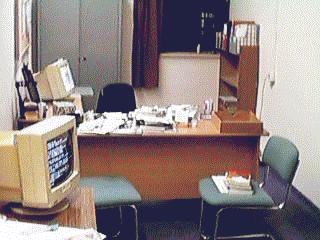
Based in the Public Relations Office, located in the Administration Building of Birzeit University, the World Wide Web Project has been short of space. Plans to expand the project to sound and video Web-publishing capacity, the need for more space for coming workstations, scanners and other computer hardware, necessitated the physical expansion of the work environment.
The former mail/post room located between the Computer Center and Public Relations Office was recently given to the Web Project, enabling a quieter and larger space for its work. The opening of a physical channel between the two offices offered easier access to both, as well as an appropriate metaphor for Birzeit’s new marriage of the information skills of the Public Relations and the technological skills of the Computer Center.
The new World Wide Web Center, although still very much a part of Public Relations, will be forging new paths to introduce students and faculty to the Internet, as well as studying ways to increase the pace and breadth in the development of Palestinian information technology skills.
In addition to providing training and the resources to produce high-quality websites and in the future - multimedia authoring tools - it is hoped that the Center will establish a library to this end, and has launched an appeal for Internet-related magazines and books. Visitors will be able to browse the shelves to pick up HTML hints, an introduction to multimedia authoring, If you have any printed Internet resources that you have finished with, please send them to the Center at the address on the front page of this newsletter. This is one simple way in which you can help make an impact on the development of IT skills among young Palestinians.
Volunteers with HTML experience and/or good Arabic-English/English-Arabic translation skills will be welcomed, although please note that no funds for housing or expenses currently exist.
The Birzeit Webmaster will oversee and coordinate the development - funding permitting - of the Palestine Archive project, Web training at the University, and the continued development of the Birzeit Website.
Future plans, far beyond these, include the offering of training to all Birzeit students in Internet-related computer skills as part of a non-accredited diploma-type course within the University structure. More and more Palestinian organisations and institutions are demanding these skills and experience, and Birzeit University is committed both to preparing its students for the challenges of the future and to looking for ways to serve Palestinian society. Activities with the new Birzeit Media Center are also planned.
This all, of course, will require extensive resources, and although all of these projects are still in the initial stages, we are please to see encouraging progress towards their fulfilment.
“I was really proud to find a homepage for one of the greatest universities in my country on the Net. It makes you feel proud that you are a Palestinian. It simply says that - no matter what - we will be there forever on the Internet.” Osama, Utah State University
“Just ran across your photos on the Web. As an American who has made a few trips to the Middle East, I appreciate the different perspective from what we hear in the US media. Good work.” Ron Kemp, North Carolina State University
“My thanks to everyone who has contributed to the website. I took some of the photos to my classes. It has been a wonderful source of information and of being able to feel ‘right there’ in a way. Alf shukr!” Annie Higgins, University of Chicago
“I have been trying to surf the Web for photos of the recent terrible events in Palestine, but was never satisfied. Thanks a lot for the information and the photos you have on the Web.” Suhail Qumri, North Park College, Chicago
“Thank you for preparing such a comprehensive website about what has been going on in Ramallah. It has been hard not really knowing what has been going on in my hometown.” Nakhleh Hussary, North Park College, Chicago
“I love what I saw at your site. Keep up the good work. I am a BZU alumnus and very proud of your work. I hope that BZU, as always, will continue to lead the fight for Palestine and now more urgently for democratization.” Gabi Rahil
“I have accidentally bumped into your BZU Web Site, and was very happy to browse through it. I was at one point in my life a student at BZU, and am interested in following up on the university's news, and other local issues. Just wanted to thank you for a job well-done. I was especially impressed with the What's New part, and how current it is. Keep up the good work.” Ola Siksik, Vancouver, B.C., Canada
Chemistry Department (http://www.birzeit.edu/chem) Brief information about this department, available for a couple of months now. A pretty basic site but it is early days yet.
Faculty of Engineering (http://www.birzeit.edu/eng) In one moment, the entire faculty went on-line. The faculty is committed to developing the site and will be updating material soon. Excellent if you want to contact engineering faculty members via e-mail, although one of their faculty is working on a CGI script that will offer a searchable directory for all Birzeit e-mail addresses. Please note that only a few Birzeit staff currently use e-mail, although training is underway.
Palestine and Arabic Studies Program (http://www.birzeit.edu/pas) International students wishing to study Arabic in the Middle East need look no further. Birzeit’s PAS program has it all. A simple but comprehensive website that intends to expand, offering the thoughts of current students, details of special lectures, events and trips from the current semester and more! Please link to this website.
Complete Guide to Palestine’s Websites (http://www.birzeit.edu/links) It’s been expanded, with new reviews and an easy-to-navigate, cache-able button bar. New bits include where it’s at featuring sites of the month, and search the internet, with links to websites about palestine to follow shortly.

Final Status Issues (http://www.birzeit.edu/finalstatus) An initial and experiemental version of one of the Palestine Archive project modules, Final Status Issues only has a few brief entries on closure at the moment with updates planned. To follow next will be a section on Jerusalem. Working on this website would be an excellent opportunity for an intern wishing to pick up some experience. Contact the Birzeit Webmaster for more details.
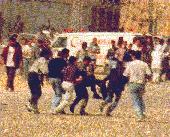
On the ground in Ramallah (http://www.birzeit.edu/palnews/war) The website contains day-by-day, area-by-area, overviews of the events all over the West Bank and Gaza during the end-September clashes; commentaries on the events; quotes from Birzeit faculty and students; a photo diary; statements by the university in Arabic and English; press releases from other organsiations; articles; an appeal for Web reporting resources for the University; and links to other websites with related material.
Address: Public Relations Office Birzeit University
P.O. Box 14, Birzeit, West Bank, Palestine
Tel: +972-2- 998-2075 Fax: +972-2- 995-7656 E-mail: webmaster@birzeit.edu