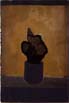
The works attest to the genius of the artist, who reached a surprising artistic maturity at a young age, with powerful works depicting a few recurring motifs: Cats, planes, neckties.Potted cactus plants; executed in a forceful, direct and minimalist style.
Abu Shaqra's short but brilliant artistic career, was in many ways a cautionary tale. He lived and worked in Tel Aviv in poor financial conditions, pushing him to execute his works with oil on paper (instead of canvas). His talent was soon recognized, and he was able to obtain a teaching position at the Israeli Kalisher Academy, to exhibit at important Israeli venues, and to win important Israeli art awards. His works sold very well after his death, acquired by Israeli collectors as well as art institutions. The Tel Aviv Museum held a major posthumous retrospective exhibit of his works in 1990.
Besides obvious talent, this success owed much to the leitmotif of Abu Shaqra' s works: The potted cactus. It was hijacked by some prominent Israeli critics as signifying Abu Shaqra' s variations on the Israeli Sabra (the Hebrew word for cactus, referring to Israelis born in Palestine). Other critics reduced Abu Shaqra's thorny cacti to a mere reflection of the pain of the cancer that was eating him away. The original Palestinian specificity of the symbol of the cactus (Sabbar) and its emblematic national connotations were expressly denied.
It makes sense that for Abu Shaqra -a young man of rural Galillean background- the cactus would be fraught with symbolism, especially after his transplant to Tel Aviv, where he lived close to the ruins of Arab buildings destroyed in 1948. We can also see that with the progress of his illness, the depiction of the potted cactus became more stark and tortured, as a joining of the three traits in Abu Shaqra's life: His Palestinian identity, his foreignness in Israel, and the progress of his disease. Further, it is sad to note that while he had refused to participate in an Israeli 40th anniversary art exhibit, after his death, his works were featured in the Israel Museum's 50th anniversary of Israel art retrospective...
The exhibit catalogue featured a text by artist Kamal Boullata, shedding light on the history of the cactus in Palestinian visual arts, used as a means of "Palestinising" the subject matters of the imported art of easel painting at the start of this century. This, even before the Nakba, and the subsequent transformation of the cactus -as ubiquitous proof of the existence of hundreds of demolished Palestinian villages- into a pervasive symbol of Palestinian steadfastness, and attachment to the land.
Besides his obvious talent - some Arab artists even see him as the single most important Arab contemporary visual artist- Abu Shaqra's life and work are a perfect symbol of the history of the takeover of the land of Palestine by Israel: From the takeover of the land, to the takeover of its symbols, to the takeover of representations of the symbol, and its creators…