
January 15, Israel and the Palestinian Authority reached an agreement for an Israeli redeployment from the West Bank city of Hebron.

February 1, Israeli government release of the women prisoners.
February 26, Israeli government announced that they had approved plans
for a new Jewish settlement in East Jerusalem, a predominantly Arab area.
March 3, Palestinian leader Yasser Arafat had a meetings with U.S.
President Bill Clinton and other U.S. officials .
March 4, Israel ordered four Palestinian organizations to close their
offices in East Jerusalem.
March 7, the Israeli cabinet approved a plan to increase the West Bank
lands under Palestinian authority control by 9 percent. The offer has been
rejected by the Palestinian authority .
March 13, a Jordanian soldier opened fire on a group of Israeli school
children near the Israeli-Jordanian border, killing seven.
March 15, Arafat called for an emergency conference in the Gaza Strip.
Several European countries and the United States attended the conference.
Arafat called the conference to pressure on Israel to abandon the Har Homa
project .
March 18, Israeli workers began construction at the Har Homa site.
March 21, a bomb exploded in a sidewalk cafe in Tel Aviv , killing the
bomber and three other people. Dozens more were wounded.
March 7 and 21, the United States vetoed a United Nations (UN) Security
Council resolution that described the new settlement as "illegal." The
United States routinely vetoes Security Council resolutions it perceives as
biased against Israel.
March 27, when U.S. mediator Dennis Ross returned to the region for
meetings with Arafat and Netanyahu.
March 30, in a show of solidarity with Arafat, members of the 22-nation
Arab League voted on March 30 to recommend that its members suspend ties
with Israel.
June 3, members of Israel's Labor Party selected former army chief of staff Ehud Barak, 55, as the new party leader .
July 30,Two martyr bombers exploded themselves in a crowded market in Jerusalem, killing themselves and at least 13 others, and wounding more than 150 people. Hamas, took responsibility for the bombings.
August 21, retaliating for Israel's choke hold on the West Bank and Gaza Strip, the Palestinian Authority began enforcing a partial boycott of Israeli goods.
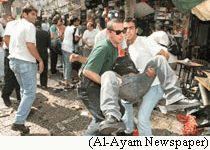
September 4, Three martyr bombers evidently acting in concert set off
bombs on a popular shopping promenade in Jerusalem on Thursday, killing
four passers-by and themselves.
September 9, United States Secretary of State Madeleine Albright arrived
in Israel the first stop on a week-long Middle East tour aimed at generating
new momentum for the stalled Israeli-Palestinian peace process.
September 19, Israeli troops fired rubber bullets at stone throwing
Arabs until Palestinian police intervened to stop the protests in the West
Bank town of Hebron on Friday. No one was hurt in the demonstration by
about 50 Palestinians against an Israeli government deal letting Jewish
seminary students stay in Arab East Jerusalem buildings in place of the
Jewish families who occupied them.
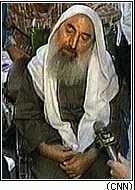
October 1, Sheik Ahmed Yassin the 61-year-old founder of the militant
Islamic group Hamas was released from Israeli prison , as part of a
prisoner swap touched off by a failed Israeli assassination attempt in
Amman, the capital of Jordan.
October 8, The long-frozen peace process thawed somewhat as Netanyahu
and Palestinian National Authority (PNA) President Yasser Arafat met for
the first time since February 1997.
December 11, Palestinian census takers stand in the rain, knocking on people's doors in traditionally Arab east Jerusalem. But many residents literally hide behind their closed doors, fearing a census which anywhere else would be an exercise in basic civics. Even answering questions as simple as "Do you have central heating?" can be risky. East Jerusalem's Palestinians do not allow themselves to be photographed, for fear that Israeli authorities will revoke their residency cards and evict them from the city where their families have lived for centuries. The first-ever Palestinian census turned into a tug-of-war over Jerusalem when Israel's government pushed a bill through Parliament blocking Yasser Arafat's census-takers from operating in the disputed city.


