


 Palestinian - Timeline 1900+
 1845 - 1914 - Jews in Palestine 1896 - 1916 - Zionist movement 1916 - Sykes-Picot Agreement 1917 - Balfour Declaration 1918 - Jews migration 1919 - Palestinians first National Conference 1920 - San Remo Conference 1922 - A Mandate of Palestine 1929 - The riots 1936 - A six months General Strike in Palestine 1937 - The Peel Commission 1939 - The British government restricting Jewish immigration 1945 - Britain's Palestine Dilemma 1947 - Great britain withdraw & the UN partition plan 1948 - First Arab-Israeli War 1948 - Israel founded 1954 - Nasser Takes Charges 1956 - The Suez campaign 1958 - Arabs Unite 1964 - PLO established 1967 - The Six days War 1972 - Munich Olympics 1973 - The October War 1974 - PLO representative of the Palestinian people 1979 - Camp David peace treaty 1979 - Russian Jews 1980 - 1995 1996 1997 1998 1999 2000 2001 Palestine Home page
The number of Jews in Palestine was small in the early 20th century; it increased from 12,000 in 1845 to nearly 85,000 by 1914. Most people in Palestine were Arabic speaking Muslims and Christians. Support for the Zionist movement came largely from Jews in Europe and North America.

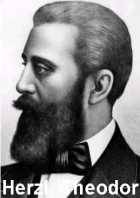
In 1896 following the appearance of anti-Semitism in Europe, Theodore
Herzl, the founder of Zionism tried to find a political solution for the
problem in his book, 'The Jewish State'. He advocated the creation of a
Jewish state in Argentina or Palestine.
In 1897 the first Zionist Congress was held in Switzerland, which issued
the Basle programme on the colonization of Palestine and the establishment
of the World Zionist Organization (WZO).
In 1904 the Fourth Zionist Congress decided to establish a national home
for Jews in Argentina.
In 1906 the Zionist congress decided the Jewish homeland should be
Palestine.
In 1914 With the outbreak of World War I, Britain promised the independence
of Arab lands under Ottoman rule, including Palestine, in return for Arab
support against Turkey which had entered the war on the side of Germany.
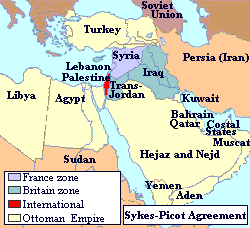
Britain and France signed the Sykes-Picot Agreement, which divided the Arab region into zones of influence. Lebanon and Syria were assigned to France, Jordan and Iraq to Britain and Palestine was to be internationalized.
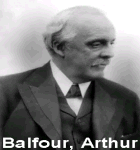
The British government therefore issued the Balfour Declaration on November 2, 1917, in the form of a letter to a British Zionist leader from the foreign secretary Arthur J. Balfour: “His Majesty's Government view with favour the establishment in Palestine of a national home for the Jewish people, and will use their best endeavors to facilitate the achievement of this object, it being clearly understood that nothing shall be done which may prejudice the civil and religious rights of the existing non-Jewish communities in Palestine, or the rights and political status enjoyed by Jews in any other country.
After World War I ended in 1918, Jews began to migrate to Palestine, which
was set aside as a British mandate with the approval of the League of
Nations in 1922.
After World War I the terms of the Balfour Declaration were included in the
mandate for Palestine approved by the League of Nations in 1922. The
mandate entrusted Great Britain with administering Palestine and with
assisting the Jewish people in “reconstituting their national home in that
country.”
Large-scale Jewish settlement and development of extensive Zionist
agricultural and industrial enterprises in Palestine began during the
British mandatory period, which lasted until 1948. The Jewish community, or
Yishuv, increased tenfold during this era, especially during the 1930s,
when large numbers of Jews fled Europe to escape persecution by the Nazis.
Tel Aviv became the country's largest all-Jewish city, dozens of other
towns and villages were founded, and hundreds of Jewish agricultural
collectives (kibbutzim) and cooperatives were established.
Many Jewish political parties founded in Eastern Europe as part of the
world Zionist movement developed bases in mandatory Palestine. They
included labor, orthodox religious, and nationalist groups whose leaders
emigrated from Europe and after 1948 became political leaders and officials
in the new Jewish state.
The Yishuv extended its institutions after World War I. Among these
institutions was an assembly with a National Council that managed the
community's day-to-day affairs in education, health, social welfare, and
other services. Jewish religious life was supervised by a Rabbinical
Council that controlled marriage, divorce, and other family matters. Local
government institutions were also developed to run the city of Tel Aviv and
many smaller Jewish settlements. The educational system, cultivating Hebrew
language and culture, expanded, and the Hebrew University in Jerusalem was
founded.
The World Zionist Organization and the Jewish Agency for Palestine assisted
the Yishuv by raising funds abroad, recruiting Jewish immigrants, and
seeking political support from Western governments.
The Palestinians convened their first National Conference and expressed their opposition to the Balfour Declaration.
The San Remo Conference granted Britain a mandate over Palestine and two years later Palestine was effectively under British administration, and Sir Herbert Samuel, a declared Zionist, was sent as Britain's first High Commissioner to Palestine.
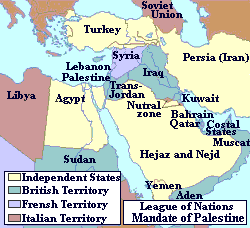
The Council of the League of Nations issued a Mandate for Palestine. The Mandate was in favor of the establishment for the Jewish people a homeland in Palestine.
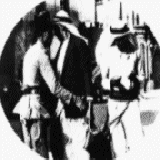
In August 1929, the century's first large-scale attack on Jews by Arabs
rocked Jerusalem. The riots, in which Palestinians killed 133 Jews and
suffered 116 deaths. Mostly inflicted by British troops were sparked by a
dispute over use of the Western Wall of Al-Aqsa Mosque ( this site is
sacred to Muslims, but Jews claimed it is the remaining of jews temple all
studies shows clearly that the wall is from the Islamic ages and it is part
of al-Aqsa Mosque). But the roots of the violence lay deeper in Arab fears
of the burgeoning Zionist movement, which aimed to make at least part of
British-administered Palestine a Jewish state.
The British had made promises to both Arabs and Zionists. The 1917 Balfour
Declaration supported the establishment of a "national home" for the Jews,
while pledging that nothing would be done to " prejudice the civil and
religious rights" of the Arabs. But the very presence of a Jewish homeland
would, Arabs insisted, infringe on those rights.
The Palestinians held a six months General Strike to protest against the confiscation of land and Jewish immigration.
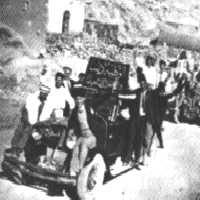
Since the Balfour Declaration of 1917 (which endorsed the idea of a Jewish
state within Palestine), the British government had been struggling to
reconcile the conflicting aspirations of Jews and Arabs in Palestine, which
Britain administered under a League of Nations mandate . Those who still
believed in the possibility of peaceful coexistence between the two groups
got a grim comeuppance in July 1937 when the Peel Commission, headed by
Lord Robert Peel, issued its report. Basically, the commission concluded,
the mandate in Palestine was unworkable There was no hope of any
cooperative national entity there that included both Arabs and Jews, . The
impetus for the commission's formation had been the most recent spark of
Palestinian violence.Riots and Arab protests against the Jews in Palestine
had been escalating throughout the 1920s and '30s. In the mid-1930s, in
response to the thousands of Jews who'd arrived from Europe, Palestinian
Arabs formed the Arab High Committee to defend themselves against what they
perceived as a Jewish takeover A general strike exploded into a revolt.
Desperate for a solution, the British appointed Lord Peel to study the
situation. The Arab leadership boycotted the study.
After dismissing the possibility of Arab-Jewish amity, the commission went
on to recommend the partition of Palestine into a Jewish state, an Arab
state, and a neutral sacred-site state to be administered by Britain.
Within two years, Britain found itself in a no-win situation, and on the
eve of World War II issued the infamous "White Paper" severely curtailing
Jewish immigration into Palestine.

The British government published a new White Paper restricting Jewish immigration and offering independence for Palestine within ten years. This was rejected by the Zionists, who then organized terrorist groups and launched a bloody campaign against the British and the Palestinians. The aim was to drive them both out of Palestine and to pave the way for the establishment of the Zionist state.
With World War II over and the Nazi death camps open for the world to see,
Zionists redoubled their demands that Britain open its Palestine mandate to
unlimited Jewish immigration.
Jewish terrorist groups the Irgun Zvei Lumi and the Stern Gang escalated
their campaign to force Britain's hand.
Arabs in the region opposed a Jewish influx, but in Palestine itself they
lacked unified leadership. So in March 1945, Saudi Arabia, Syria, Lebanon,
Iraq, Transjordan, Yemen, and Egypt organized the League of Arab States to
pressure Britain from the other side. Britain's new labour government
(unlike its predecessor) strongly sympathized with Zionism's goal, yet it
hoped to remain friendly with the Arabs. Adding to the British quandary was
President Truman. whose Zionist leanings were clear. In April 1946,
yielding to U. S. pressure, Britain sent yet another commission to study
the issue. The Anglo-American Committee of Inquiry recommended that 100,000
European Jewish refugees be admitted immediately, that restrictions on
Jewish land purchases in Palestine be lifted, and that a binational
Jewish-Arab state be established under United Nations trusteeship. Faced
with the political and economic costs of policing Palestine, the British
gladly turned the matter over to the UN. In 1947 the UN sent its own
commission to seek answers to the Palestine problem. The result, the
following year, was the founding of Israel and war between the Jewish and
Arab .
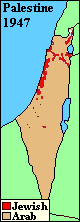
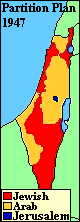
Exhausted by seven years of war and eager to withdraw from overseas colonial commitments, Great Britain in 1947 decided to leave Palestine and called on the United Nations (UN) to make recommendations. In response, the UN convened its first special session in 1947, and on November 29, 1947, it adopted a plan calling for partition of Palestine into Jewish and Arab states, with Jerusalem as an international zone under UN jurisdiction; the Jewish and Arab states would be joined in an economic union. The partition resolution was endorsed by a vote of 33 to 13, supported by the United States and the Soviet Union. The British abstained.
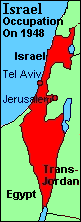
In Palestine, Arab protests against partition erupted in violence, with
attacks on Jewish settlements in retaliation to the attacks of Jews
terrorist groups to Arab Towns and villages and massacres in hundred
against unarmed Palestinian in there homes , that soon led to a full-scale
war. The British generally refused to intervene, intent on leaving the
country no later than August 15, 1948, the date in the partition plan for
termination of the mandate.
When it became clear that the British intended to leave by May 15, leaders
of the Yishuv decided (as they claim) to implement that part of the
partition plan calling for establishment of a Jewish state. In Tel Aviv on
May 14 the Provisional State Council, formerly the National Council,
“representing the Jewish people in Palestine and the World Zionist
Movement,” proclaimed the “establishment of the Jewish State in Palestine,
to be called Medinat Israel (the State of Israel) … open to the immigration
of Jews from all the countries of their dispersion.”
On May 15 the armies of Egypt, Transjordan (now Jordan), Syria, Lebanon,
and Iraq joined Palestinian and other Arab guerrillas who had been fighting
Jewish forces since November 1947. The war now became an international
conflict, the first Arab-Israeli War. The Arabs failed to prevent
establishment of a Jewish state, and the war ended with four UN-arranged
armistice agreements between Israel and Egypt, Lebanon, Jordan, and Syria.
The frontiers defined in the armistice agreements remained until they were
altered by Israel's conquests during the Six days War in 1967.
The population balance in the new state of Israel was drastically altered
during the 1948 war. The armistice agreements extended the territory under
Israel's control beyond the UN partition boundaries from approximately
15,500 to 20,700 sq km (about 6,000 to 8,000 sq mi). The small Gaza Strip
on the Egypt-Israel border was left under Egyptian control , and the West
Bank was controled by Jordan. Of the more than 800,000 Arabs who lived in
Israeli-held territory before 1948, only about 170,000 remained. The rest
became refugees in the surrounding Arab countries, ending the Arab majority
in the Jewish state.
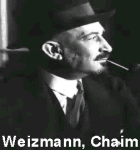
Israel's Provisional State Council organized elections for the first
Knesset (parliament) in 1949. Chaim Weizmann, the most prominent Zionist
leader of the prewar period, became the country's first president.
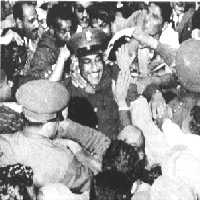
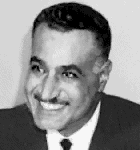
For almost two years, Colonel Gamal Abdal Nasser had quietly directed Egypt's revolution-from-above, while General Muhammad Naguib served as president and prime minister. In February 1954, the colonel stepped to the fore. Citing Naguib's ties to the banned Muslim Brotherhood and his intention to restore the old system of government, Nasser forced him to resign. In April, Nasser took over the premiership.
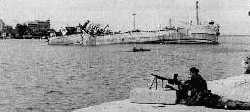
Attempts to convert the Israeli-Arab armistice agreements into peace
treaties were unsuccessful. The Arabs insisted that the refugees be
permitted to return to their homes, that Jerusalem be internationalized,
and that Israel make territorial concessions before they entered peace
talks. Israel charged that these demands would undermine its security and
refused them. Frequent incursions by refugee guerrilla bands and attacks by
Arab military units were made, which Israel answered with forceful
retaliation. Egypt refused to permit Israeli ships to use the Suez Canal
and blockaded the Straits of Tiran (Israel's access to the Red Sea), which
was seen as an act of war. Border incidents along the frontiers with Egypt
escalated until they erupted in the second Arab-Israeli War in October and
November of 1956.
Great Britain and France ostensibly joined the attack because of their
dispute with Egypt's president Gamal Abdel Nasser, who had just
nationalized the Suez Canal. Nasser took over the canal after Great Britain
and France withdrew offers to finance the construction of the Aswân High
Dam. Israel scored a quick victory, seizing the Gaza Strip and the Sinai
Peninsula within a few days. As Israeli forces reached the banks of the
Suez Canal, the British and French started their attack. The fighting was
halted by the UN after a few days, and a UN Emergency Force (UNEF) was sent
to supervise the cease-fire in the Canal zone. In a rare instance of
cooperation, the United States and the Soviet Union supported the UN
resolution forcing the three invading countries to leave Egypt and Gaza. By
the end of the year their forces withdrew from Egypt, but Israel refused to
leave Gaza until early 1957, and only after the United States had promised
to help resolve the conflict and keep the Straits of Tiran open.

The 1958 merger of Syria and Egypt into the United Arab Republic was the
first of a series of dramatic realignments throughout the Middle East,
inspired by the vision of Gamal Abdal Nasser. Syria had been moving in the
Egyptian dictator's ideological direction since the fall of a rightist
military regime in 1954: the new junta, dominated by the socialist Ba'ath
party, had followed Egypt in recognizing Mao's China and acquiring Soviet
arms, Squeezed between Washington (which backed anti Soviet Arab
governments against their nonaligned neighbors) and a growing domestic
Communist movement, Syria's leaders decided to put their pan-Arabist
notions to the test. National borders, after all, were a Western invention
. Syria would lose nothing and gain untold strength by melding with dynamic
Egypt. More changes followed quickly. Yemen, though ruled by a conservative
monarch, sought security by affiliating itself with the U.A.R. in a
confederation called the United Arab States, The Western-oriented kingdoms
of Iraq and Jordan formed a rival union. In Saudi Arabia, King Saud was
forced to cede authority to his relatively pro-Egyptian brother Faisal
after being implicated in a plot on Nasser's life. In Lebanon, civil war
erupted between Syrian-backed Arab nationalists and supporters of
pro-Western president Camille Chamoun. In Iraq, when Premier Nuri al-Said
decided to aid Chamoun, pro-Egyptian officers revolted killing Said along
with King Faisal II and most of the royal family. The Iraqi-Jordanian
federation was no more.
Fearing the spread of Nasserism to Lebanon, the United States sent 10,000
troops and sponsored talks between the warring factions. A compromise led
to elections, and General Fuad Chehab less enthusiastically pro-Western and
friendlier to Nasser than Chamoun became president.
Except for Jordan, all the Arab nations had now fallen more or less into
Cairo's camp. But they soon fell out again. Iraq's strongman, Abdul Karim
Kassem, developed a bitter personal rivalry with his Egyptian counterpart .
The Syrians came to resent Nasser's authoritarianism, while the Saudis and
Yemenites resisted his socialism. And by 1961, when Syria seceded from the
U.A.R. , Arab unity lay in ruins.
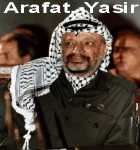
The Palestine Liberation Organization was established. On 1 January 1965 The Palestine 'Revolution' began .
After the Suez-Sinai war Arab nationalism increased dramatically, as did
demands for revenge led by Egypt's president Nasser. The formation of a
united Arab military command that massed troops along the borders, together
with Egypt's closing of the Straits of Tiran and Nasser's insistence in
1967 that the UNEF leave Egypt, led Israel to attack Egypt, Jordan, and
Syria simultaneously on June 5 of that year.
The war ended six days later with an Israeli victory. Israel's
French-equipped air force wiped out the air power of its antagonists and
was the chief instrument in the destruction of the Arab armies.
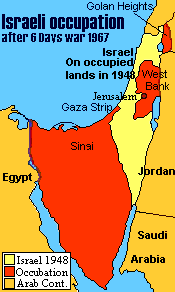
The Six days War left Israel in possession of Gaza and the Sinai Peninsula,
which it took from Egypt; Arab East Jerusalem and the West Bank, which it
took from Jordan; and the Golan Heights, taken from Syria. Land under
Israel's jurisdiction after the 1967 war was about four times the size of
the area within its 1949 armistice frontiers. The occupied territories
included an Arab population of about 1.5 million.
The occupied territories became a major political issue in Israel after
1967. The right and leaders of the country's orthodox religious parties
opposed withdrawal from the West Bank and Gaza, which they considered part
of Israel. In the Labor Alignment, opinion was divided; some Laborites
favored outright annexation of the occupied territories, others favored
withdrawal, and some advocated retaining only those areas vital to Israel's
military security. Several smaller parties, including the Communists, also
opposed annexation. The majority of Israelis, however, supported the
annexation of East Jerusalem and its unification with the Jewish sectors of
the city, and the Labor-led government formally united both parts of
Jerusalem a few days after the 1967 war ended. In 1980 the Knesset passed
another law, declaring Jerusalem “complete and united,” Israel's eternal
capital.
The 1967 war was followed by an upsurge of Palestinian Arab nationalism.
Several guerrilla organizations within the Palestine Liberation
Organization (PLO) carried out guerrillas attacks on Israeli military
targets , with the stated objective of “redeeming Palestine.” Guerrillas
attacks on Israelis targets at home and abroad unified public opinion
against recognition of and negotiation with the PLO, but the group
nevertheless succeeded in gaining widespread international support,
including UN recognition as the “sole legitimate representative of the
Palestinians.” .
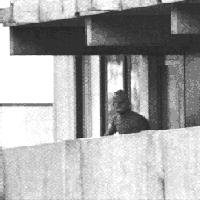
The stunning performances of the young Soviet gymnast Olga Korbut and the gold medals of American swimmer Mark Spitz and British athlete Mary Peters could not dispel the horror in Munich when the 20th Olympic Games became the setting for an guerrilla attacked which left 11 Israeli athletes dead. The attacked began just before dawn on September 5th when eight hooded guerrillas scaled the fence around the Olympic Village. Bursting into the dormitory where the 11 Israeli athletes were sleeping, they shot two dead and took the other nine hostage, threatening to kill them unless 200 Arab guerrillas were released. The German authorities agreed to take the guerrillas to Furstentbldbruck military airfield where a Lufthansa airliner was waiting on the tarmac to fly them out of the country. There they were ambushed by German marksmen, but in the ensuing gun battle all nine hostages were killed in the cross-fire.
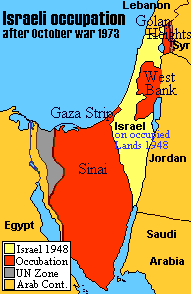
In 1973 Egypt joined Syria in a war on Israel to regain the territories
lost in 1967. The two Arab states struck unexpectedly on October 6, which
fell on Yom Kippur , Israel's holiest fast day . After crossing the suez
channel the Arab forces gain a lot of advanced positions in Sinai Peninsula
and Golan Heights and manage to defeat the Israeli forces for more then
three weeks . Israeli forces with a massive U.S. economic and military
assistance managed to stop the arab forces after a three-week struggle and
defeat with the cost of many casualties,and the Arabs strong showing won
them support from the Union of Soviet Socialist Republics (USSR) and most
of the world's developing countries . Saudi Arabia and Kuwait financed the
Arab forces, making it possible for Egypt and Syria to receive the most
sophisticated Soviet weapons , and the Arab oil producing states cut off
petroleum exports to the United States and other Western nations in
retaliation for their aid to Israel.
Israel, forced to compete with the nearly unlimited Arab resources, was
faced with a serious financial setback. Only massive U.S. economic and
military assistance enabled it to redress the balance, but even American
aid was unable to prevent a downward spiral of the economy.
In an effort to encourage a peace settlement, U.S. President Richard M.
Nixon charged his secretary of state, Henry Kissinger, with the task of
negotiating agreements between Israel and Egypt and Syria. Kissinger
managed to work out military disengagements between Israel and Egypt in the
Sinai and between Israel and Syria in the Golan Heights during 1974.
The Arab Summit in Rabat recognized the PLO as the sole legitimate representative of the Palestinian people. At the United Nations General Assembly, the UN reaffirmed its commitment to an independent sovereign state in Palestine and gave the PLO observer status at the United Nations. Yasser Arafat, chairman of the PLO, addressed the General Assembly of the United Nations.
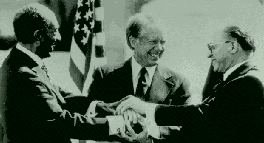
Begin, however, was the first Israeli leader to achieve a peace settlement with an Arab state. It resulted from the surprise initiative of President Anwar al-Sadat of Egypt, who in November 1977 flew to Jerusalem, where he addressed the Knesset and called on Begin to begin peace talks. After protracted negotiations sponsored by U.S. President Jimmy Carter at Camp David, Maryland, the Egyptian-Israeli peace treaty was signed in Washington, D.C., on March 26, 1979. Although the treaty ended the prospects for war between Israel and Egypt, many issues remained between the two countries, including the problem of arranging for Arab autonomy in the occupied West Bank and Gaza.
The Jews of the Russian empire had been oppressed for centuries, and though
the pogroms ended under Soviet rule, discrimination did not. Fearing
international embarrassment and a "brain drain" of skilled workers, MOSCOW
had long restricted emigration. But in the 1970s, detente brought a
loosening of curbs. The exodus peaked in 1979 , when more then 51,000 exit
visas were issued.
The sharp increase, coinciding with the conclusion of the second
U.S.-Soviet Strategic Arms Limitation Talks (SALT II) , was widely seen as
an attempt to influence treaty ratification. A second Soviet foreign policy
goal to achieve most favored nation status with the United States was
equally important: In 1979, U.S. officials were considering repeal of the
Jackson-Vanik Amendment, a 1974 law that tied trade grants to free
emigration.
Even as emigration soared, the Kremlin cracked down on Jewish activism
reviling refuseniks (the term for those refused permission to leave) as
"agents of world Zionism" and sentencing many to long terms in labor camps
or psychiatric institutions. The 1977 arrest of Anatoly Shcharansky, a
young mathematician who'd talked openly with Western reporters about his
failure to gain an exit permit, generated international outrage. Charged
with spying for the CIA, Shcharansky was convicted in a closed trial, and
served nine years in prison before being released to Israel as part of a
spy exchange. His case was extraordinary only in the attention it drew.
Watchdog groups estimated that by 1979, some 180,000 Soviet Jews had filed
for visas, yet emigration plummeted the following year, when SALT II failed
to be ratified and the Carter administration - reacting to the Soviet
invasion of Afghanistan - imposed a grain embargo. By 1984, the number of
emigres had slumped to 896.

