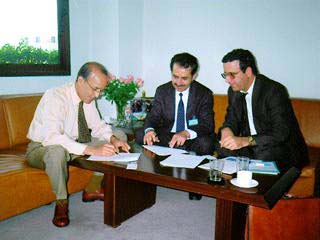
The following are samples of some JWU activities:
National Public Awareness Campaign.
With the participation of many Agencies and Non-Governmental Organizations, and the UNDP, an awareness network was established to make the public aware of the water shortage problems and how to ration the use of it. JWU established an in house committee to find ways and means to polish the image of the Undertaking and coordinate the awareness efforts with the established network. It is important to mention that a work plan has been designed and parts of it will be implemented in the coming years. The main points of this work plan are:
Also, the JWU Board of Directors decided to participate with municipalities and other organizations in the region to facilitate the work of the Solid Waste and Waste Water Treatment Committee that was established with the full support of the GTZ and the UNDP. The committee's main function is to look for the most efficient ways and means to dispose of solid waste in a safe manner.
Training
Jerusalem Water Undertaking realizes the importance of improving the capacity of the water sector employees in general and its human resources in specific. Keeping up with modern methods that meet international standards necessitates having appropriate training program in place, to meet the training requirements of the Undertaking. JWU sees itself in the near future as a regional training center in the Water and Waste Water fields. International organizations such as the World Bank, GTZ and CDG and UNDP are working with the Undertaking to develop a training concept and facilities that will benefit the Undertaking and the region as a whole.
CDG planned a training workshop that was held in Bethlehem in March of 1995 for which JWU was a facilitator. JWU professionals and other organizations in the West Bank and Gaza were invited to come up with a training program in the water and waste water fields. The outcome of the workshop was a comprehensive report on training in the fields of water supply and waste water management. Problems and training needs have been identified and a training program was developed.
GTZ on the other hand signed an agreement with JWU in which improving the management and staff skills is one of the results expected after three years.
JWU conducted a training program for staff from 6 West Bank villages. This training session, was funded by the UNDP and it required the participation of more than 20 management and staff members from JWU to conduct training lectures after work hours and on the job training for 6 weeks. The participants of this training session benefited greatly and UNDP was extremely pleased with the results of this training. A training booklet for technicians and accountants was published by JWU. It included the lectures, the training materials, diagrams, specifications and methods to be followed in managing the small scale water utilities. Another group from two villages also sponsored by the UNDP started training at the Undertaking in October 1995.
Additionally, JWU is constantly providing on the job training for graduates of educational and vocational institutions in the West Bank. These graduates gain the knowledge provided by the many years of experience the employees of JWU posses and go into the work market prepared in their fields.
JWU is also very keen on providing training for its own staff. During the last few years a number of its employees were sent abroad for administrative and technical training and many participated in courses sponsored by local universities and continuing education institutions, to enhance their knowledge and expand their know how.
JWU initiated and implemented a rotating employment program for 2-6 months periods to absorb some of the community un employed and provide training to the graduates of education and vocational institutions.
Workshops
During the last few years, JWU was a major contributor and participant in many workshops held locally and abroad. These workshops were sponsored by either local or international organizations and covered field such as integration of water and sewerage authorities, water resources management, rehabilitation of water networks, water authorities institutional development, public awareness, water cost, water saving and planning for the training needs of the water authorities in the area. In all events, JWU was chosen to participate in these workshops due to its favorable reputation and its wealth of technical and administrative knowledge and the readiness of its management and staff to contribute to the improvement of their organization.
Studies
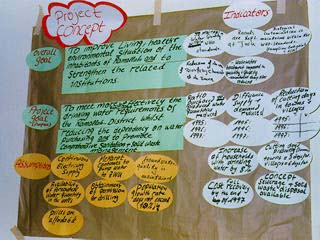
Due to its leadership position in the water aspects, JWU was involved in many studies in the last few years. These studies were either conducted exclusively by JWU management and staff, or with the help of local and international experts. The following is a sample of studies and a brief description of each one:
This study was initiated by the Jerusalem Water Undertaking (JWU) - Ramallah District with the aim of developing its institutional systems and plans through the revision of its organizational and salary structures as well as the introduction of new personnel policies and systems including job and employee ranking, performance appraisal and retirement plans.
Although the need for this study has been realized by JWU management for years, the unstable situation in the West Bank since 1987, did not make it possible to initiate and implement it until now. The study was initiated by the JWU General Manager with the approval of the Board of Directors. It was conducted by JWU employees under the direct supervision of the General Manager and with the final approval of the Board of Directors. Various aspects of this study, especially the job evaluation process, were carried out through the Job Description Committee which includes two members of the Board, the General Manager, an employee representative and the committee coordinator.
This study was conducted by JWU General Manager and El Bireh Municipality Chief Engineer with support from the UNDP. The main issue that this study dealt with, is the existence of an efficient and well organized framework for the management of water and sewerage in Palestine. This is an essential factor in the effort to conserve water resources and control usage and demand. The final revision of this study is available at the offices of the Undertaking.
JWU staff and local experts contributed and participated in three studies ( Water Resources Management, Water Saving and Water Cost ) that were funded and sponsored by THE INSTITUE MEDITERRANEAN DEL'AU STUDIES ( IME ). Copies of these studies are available at the offices of the Undertaking:-
This study dealt with the current water resources in the Palestinian Territory (PT) (e.g. the inland region of the West Bank and the coastal region of the Gaza Strip) and the ways and means to manage these resources and saving and rationing the use of water. The main focus of the study was JWU area of supply and the study dealt with the following issues:
1. The unaccounted for water percentage and components were analyzed.
2. The management of supply and demand was focused upon
3. The ways and means to reduce leakage and improve the efficiency of water supply in Ramallah area.
4. A list of solutions and priority action plan was proposed
This study intended to examine the water production cost at the JWU in order to reduce the cost of production and distribution as well as increase the efficiency of all technical, financial and administrative aspects of JWU. The study also intended to accomplish the following purposes:
a. To identify deficiencies in the present accounting and financial system and suggests ways and means to improve it, in order to serve the management in investment and managerial decision making.
b. To identify the inefficient areas of operations using standard financial ratios and water efficiency indicators.
c. To introduce a cost accounting system for the JWU to measure the cost of production, to plan projects activities, and to reduce cost.
d. To formulate a framework to articulate financial, cost and budgeting system using a unified chart of accounts.
e. To state the specific components of fixed and variable cost items to be used as a base to establish an annual flexible budget formula.
f. To identify new investment projects which may decrease the water cost and increase the efficiently of operations .
The following Studies were conducted by the General Manager of JWU and were distributed to the interested national and international bodies working in the water sector in Palestine:
This study was conducted by the General Manager of JWU with the objective of pointing out the main ways and means that will lead to improving the financial self sufficiency of Palestinian public service utilities with particular reference and emphasis on those operating in the water sector.
This paper focuses on the water resources in the region with specific details about the Palestinian water rights and why the Palestinian must insist on their water rights and not on water quantities or allocations. It also presents the outcome of the Jordanian-Israeli water agreement.
This study focuses on proposing the proper institutional framework which will suit the requirements and conditions of Palestine, since the existence of an efficient and well organized framework for management of water and sewerage institutions in Palestine is an essential factor in the effort to conserve water and control usage demand.
Other Activities
JWU staff participated and contributed to a variety of other activities in the region. The following is a sample of some of these activities:
The following is a sample of these programs:
Community Services and Cooperation
JWU continues to be a leader in community services and cooperation. The following are samples of some of the services JWU provides to the community:

