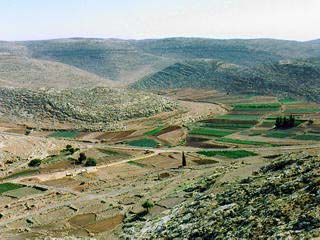
The Western Groundwater Basin of the West Bank is considered as one unit called the Nahr El-Auja-Tamaseeh Basin. Water is discharged seaward beneath the coastal plain. The annual renewable recharge of this basin is between 335-380 MCM. A small portion of the rainwater that seeps through the exposed parts of the Cenomanian and Turonian aquifers in the Western Groundwater Basin flows in springs draining the sloping aquifers - but most of the water reaches the regional aquifer and it is tapped by wells on both sides of the 1948 Armistice Line between the Palestinian Territory's West Bank and Israel - with the greater usage being now on the Israeli side.
From Israel's own reporting, it is stated that the high usage by the Israelis of the Western Groundwater Basin is causing the water level in this Western Basin to drop 0.79-1.03 meters/year. To keep the majority of the water of this aquifer for themselves, the Israeli government, who of course also controls the lands in the West Bank through its military forces and military laws, prevents Palestinian farmers (especially in the western half of the West Bank) from drilling new wells for agriculture and restrict rehabilitation and maintenance of their old wells.
Although most of the groundwater of the West Bank's Western Basin area is actually under the western part of the West Bank, these water resources are used in the water supply of Israel as mentioned above. The amount of water provided by this western basin of the West Bank supplies about 25% of Israel's total water supply through either natural discharge or by wells pumping within Israel. The overuse and misuse of this water basin by the Israelis is one of the most sensitive issues between Palestinians and Israelis.
The service area of the Jerusalem Water Undertaking (JWU) is partially located on this Palestinian Western Groundwater Basin. Despite the need for water in the area, the Israeli government did not allow during the 28 years of occupation any water resource development for JWU in this western part of the watershed.
Prior to the 1967 Israeli occupation of the West Bank, the Jordanian government did however drill five exploratory wells in the Western Basin in 1964 in order to test and monitor the availability of water in the area for the JWU. In fact, a pumping test was done on exploratory well No. 2 in the Shibteen area on May 6, 1967, only one month before the occupation. Since 1967, three of these exploratory wells have been capped and two are being pumped by the Israelis and these two wells serve about 22 villages and 6 Israeli settlements under the jurisdiction of the West Bank Water Department of the Israeli military government's civil administration and do not contribute in any way to the water distribution network under the jurisdiction of JWU.
JWU was supposed to utilize the Shibteen well field for the future demand of the central part of Palestine since it is obvious that the only water source left for fulfilling the demand is the Western Basin.
During the peace talks, the Palestinian negotiators insisted on their surface and groundwater rights in the West Bank, especially in the Western Basin.
EXISTING WATER SOURCES
Current Sources of Water for JWU from the Palestinian Eastern Aquifer
Table 4 Ein Samia Water Resources Breakdown
| Well No. | Year of Drilling | Coordinates | Total Depth (m) | Static Water Level | Capacity m3/hr | Pump Setting | Remarks |
|---|---|---|---|---|---|---|---|
| 1 | 1964 | 181.55/155.20 | 60 m | 37 m | 100 | 52 m | Hand dug well, 3m diameter |
| 2 | 1965 | 181.70/154.90 | 235 m | 154 m | 35 | 179 m | Abandoned |
| 3 | 1980 | 181.55/155.30 | 529 m | 198 m | 175 | 357 m | |
| 4 | 1990 | 182.75/155.85 | 616 m | 344 m | 60 | 471 m | |
| 2/a | 1994 | 181.70/154.90 | 251 m | 155.5 m | 165 | 225 m | |
| 6 | 1999 | 181.955/154.569 | 550 m | 150 m | 200-250 | 220 m | not yet drilled |

EXISTING EXTERNAL WATER SOURCES
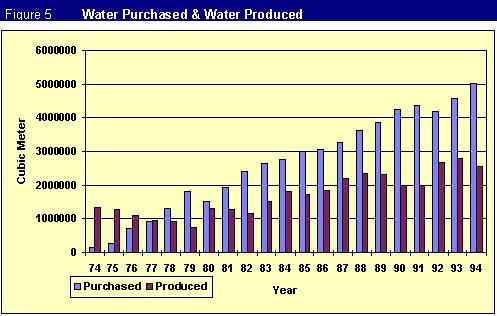
Table 5 Purchased Water in 1994
| Source | Annual Quantity in m3 | Connection Diameter | Connection Site |
|---|---|---|---|
| MEKOROTH | 4,282,566 | 16" | RAMALLAH |
| JERUSALEM | 636,281 | 6" | SHUFAT |
| JERUSALEM 2 | 88,397 | 3" | HIZMA |
| Total | 5,007,244 m3 | ||
It is important to mention here that at the present time, the Palestinian National Authority negotiators are busily and actively trying to regain control over the Palestinian water resources and to eliminate the dependency on the purchased water from the Israelis.
FUTURE PLANS FOR WATER SOURCES DEVELOPMENT
The following are the ongoing activities and future plans to overcome the water shortages in JWU's area of supply and to bring to an end the Undertaking's dependency on purchased water:
1. Well No. 2a at Ein Samia.
To replace the old irrigation well with new
higher yield Well: The drilling, civil works, electrical works,
pumping equipment and performance tests are completed. The Well
will be fully operational by December 1, 1995. Funding is from
the German Government through GTZ
2. Well No. 3 at Ein Samia.
To increase the capacity of the well: Procurement of higher
yield pump is in progress. The well will be fully operational
by December 1, 1995. Funding is from the German Government through
GTZ

3. Well No. 6 at Ein Samia
To drill a new well: In the planning stages. Studies completed,potential funding from the German Government through GTZ.
4. Develop a remote control and monitoring system to control the wells, pumping stations, and Reservoirs from JWU head office.
5. Prepare, design and conduct plans and studies for locating new wells.
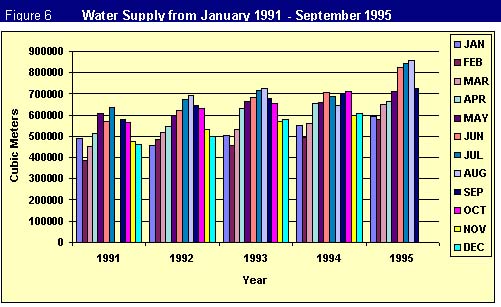
Table 6 Water Supply from January 1991 - September 1995
| 1995 | 1994 | 1993 | 1992 | 1991 | Month |
|---|---|---|---|---|---|
| 593940 | 548787 | 503446 | 455544 | 487036 | JAN |
| 580733 | 495108 | 457856 | 481982 | 382325 | FEB |
| 650988 | 562979 | 527900 | 517924 | 452359 | MAR |
| 664055 | 651057 | 629814 | 541776 | 511856 | APR |
| 707341 | 656265 | 663802 | 600336 | 608968 | MAY |
| 820681 | 704328 | 679585 | 621920 | 569595 | JUN |
| 842021 | 684622 | 712902 | 670495 | 632959 | JUL |
| 854559 | 643743 | 720463 | 687701 | 625863 | AUG |
| 724063 | 698286 | 675037 | 643891 | 582344 | SEP |
| not available | 706890 | 651284 | 631462 | 568603 | OCT |
| not available | 597629 | 569117 | 532079 | 475621 | NOV |
| not available | 606117 | 581216 | 498775 | 459361 | DEC |