
 Palestinian
Astronomical Society
(PAS)
|
Palestinian
Astronomical Society
(PAS) |
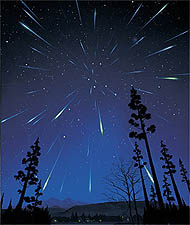
Above: Artist Shigemi Numazawa's rendition of a Leonid
meteor storm.
Traveling in parallel, the meteors appear to us to radiate from a spot
in the
constellation
Leo. © 1998 Shigemi Numazawa, Japan Planetarium Laboratory.
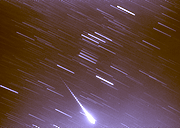
The Leonids are a meteor shower that appear to radiate out of the constellation Leo. A Meteor, also known as a "shooting star. All meteors appear as brief streaks of light moving a short distance across the sky. Some meteors move slow and some move fast. Here is a video of a bright, slow meteor. They enter Earth's atmosphere traveling at speeds of over 158,000 miles per hour (mph). A meteor that appears brighter than any of the stars and planets is called a fireball. The earth experiences about a dozen major meteor showers every year, for example, every August we experience the Perseids, every December we have the Geminids, and every November we have the Leonid meteor shower.. All meteor showers have been associated with the encounter of the Earth with the debris cloud of a parent comet. The meteor flux associated with the Leonid shower, for example, is normally about 15 per hour. A Meteor storms are relatively rare, occurring once every few decades. They are the very enhanced meteor flux experienced with the close passage of the parent comet. The most intense meteor storm on record is the Leonid meteor storm on November 17, 1966, when the peak meteor flux reached about 150,000 per hour.Because of this the leonids are know as the King of the Meteor Showers .
In the case of the Leonids the parent comet is named 55P/Tempel-Tuttle (click here for detailed info on this comet) and it makes an appearance in our skies every 33.25 years. Comets are composed of ice and dust. Every time a comet approaches the sun the ice melts and dust is released. Eventually the dust spreads completely around a comet's orbit, but most of the dust stays close to the comet. When Earth passes through the dense cloud of dust the result is a spectacular meteor shower or a meteor storm. Meteor storms produce several thousand meteors per hour.Since Tempel-Tuttle passed perihelion (closest point to the sun) on 28 Febuary 1998, the years 1998 and 1999 were expected to produce very strong displays. During 1998 the Leonids peaked over Europe with hourly rates of 250-300, while in 1999 astronomers are predicting an even better display over western Europe and the Atlantic .
In mid-November 1999 Earth will take a plunge through an interplanetary river. The river is a river of dust, sparse and thin, composed of sand bits and dust clods separated by miles of vacuum. For a few hours, many of these particles will tear into the Earth's upper atmosphere at a speed of 71 kilometers (44 miles) per second. Each will produce a momentary streak of light in the sky, a shooting star of the Leonid meteor shower.
The Leonid shower happens every year with a maximum hourly rate of 10-15 but this year should be quite a spectacle as the Earth passes through its tail soon after the comet has passed the Earth. During the years between the comets 33 year journey the earth passes through the remnants of the tail after it has long gone.
The storm power is measured by ZHR (Zenithal Hourly Rate) which is the number of meteors that a single observer would see per hour if the sky were dark enough for 6.5-magnitude stars to be visible and the shower's radiant were at the zenith.

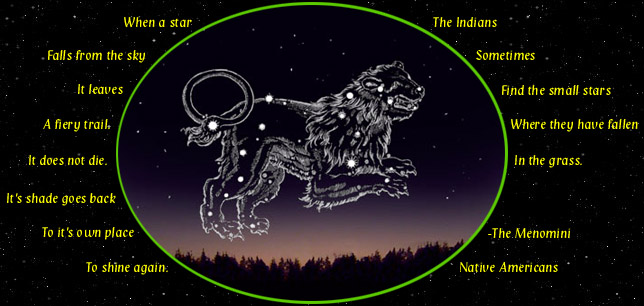
The Leonids have been well-observed
for over 1000 years. But strong interest in discovering the nature of meteor
showers really did not begin until the great 1833 display of the Leonids.
In the years following the 1833 display research increased and several
astronomers began looking for previous appearances of the Leonids and other
meteor showers among ancient and medieval documents. A significant addition
to our knowledge of the ancient and medieval Leonid displays came in 1958
when Susumu Imoto and Ichiro Hasegawa published a list of meteor shower
accounts obtained from Chinese, Japanese, and Korean historical texts.
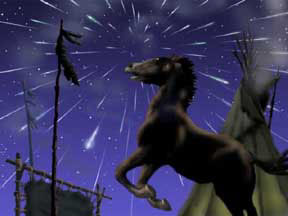
The image above was created by Eric
Young based on the numerous descriptions of
the 1833 meteor storm by various Sioux tribes
in the region around North and South Dakota.
Meteor Showers were neither known nor understood during the first half of the 19th Century. Thus, when Americans awoke during the twilight hours on November 17th, 1833, many thought Judgement Day had finally arrived.
Leonid Observations: 1833 to present
The night of November 12-13, 1833, not
only marks the discovery of the Leonid meteor shower, but sparked the actual
birth of meteor astronomy. During the hours following sunset on November
12, some astronomers noted an unusual number of
meteors in the sky, but it was the early morning hours of the 13th
that left the greatest impression on the people of eastern
North America. During the 4 hours which preceded dawn, the skies were
lit up by meteors.estimated that a thousand meteors a minute emanated from
the region of Leo. Newspapers of the time reveal that almost no one was
left unaware of the spectacle, for if they were not awakened by the
cries of excited neighbors, they were usually awakened by flashes of light
cast into normally dark bedrooms by the fireballs.Finally, noting that
an abnormal display of meteors had also been observed in Europe
and the Middle East during November 1832.
 |
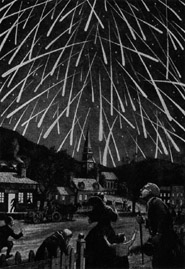
1833 Storm For More 1833 images Click Here |
 |
One of the more significant findings of the 1833 Leonid storm was the determination of the meteor shower's radiant. This was the first time a shower radiant had ever been pinpointed more precisely than a simple direction in the sky or even a constellation.Next, in November 1834, the Leonids reappeared and, although they were not as plentiful as in the previous year, they did demonstrate that some annual activity might be present from this region. In the years that followed, Leonid displays continued to weaken. The1833 storm was clearly rich in fireballs.
The Leonids of 1866
The expected
meteor storm occurred in 1866 as predicted, with observers reporting hourly
rates ranging from 2000 to
5000 per hour. The 1867 display had the misfortune of occurring with
the moon above the horizon, but observers still reported
rates as high as 1000 per hour, meaning the shower may have actually
been stronger than in the previous year. Another strong
appearance of the Leonids in 1868 reached an intensity of 1000 per
hour in dark skies.
The year 1867, marked an important
development in the understanding of the evolution of the Leonids. On December
19, 1865, Ernst Wilhelm Liebrecht Tempel (Marseilles, France) had discovered
a 6th-magnitude, circular object near Beta
Ursae Majoris. After an independent discovery was made by Horace Tuttle
(Harvard College Observatory, Massachusetts) on
January 6, 1866, the comet took the name of Tempel-Tuttle. Perihelion
came on January 12, 1866, afterwhich the comet
began fading so rapidly, that it was not seen after February 9. Orbital
calculations shortly thereafter revealed the comet to be of
short period, and, as 1867 began, Theodor von Oppolzer had more precisely
calculated the period to be 33.17 years.
The Leonids of 1899
Numerous confident predictions
were put forth that the Leonids would next be at their best in 1899, and
an early sign of
returning enhanced activity was detected in 1898, when hourly rates
reached 50-100 in the United States on November 14.
Predictions had been made and newspapers in Europe and America made
the public well aware that astronomers were predicting a major meteor storm.
Although the "storm" failed to appear, the Leonids did possess maximum
hourly rates of 40 on November 14---at least indicating some unusual activity.
Later investigations revealed the stream to have experienced close encounters
with both Jupiter (1898) and Saturn (1870), so that the stream's distance
from Earth in 1899 was nearly double that of the 1866 return.
The Leonids of 1932-1933
The Leonids returned to normal
in the years following 1903, with hourly rates ranging from 5 to 20 (average
about 15).
Despite having miscalculated the Leonid maximum in 1899, astronomers
began to make predictions for the next return---the
most likely date being 1932. Enhanced activity began early when, in
1928, maximum hourly rates reached 50 or more. During
1929, rates were lower, only 30 per hour, but moonlight was then a
factor.
The Leonids 1966
 |
|
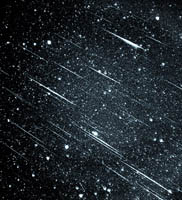 |
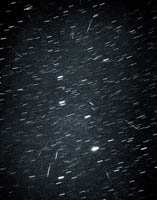
Only one true meteor storm has occurred during the modern age of easy astrophotography. On the morning of November 17, 1966, skywatchers in western North America were spellbound by an awesome flood of faint and bright meteors around 12:00 Universal Time. The storm of 1966 favored small, faint meteors up to 50 meteors per second were seen for about an hour! It seems that whenever 55P/Tempel-Tuttle is within a few hundred days of passing Earth's orbit, Leonid showers contain an above-average proportion of fireballs and bolides (bright meteors that flare or explode).
Comets are formed in the cold outer reaches of the solar system. When, for some reason, the orbits are perturbed, they come into the inner solar system, and in some cases, take paths which cross the orbit of the Earth.As the comet approaches the Sun, it begins to heat up, and the ice boils off, taking with it the rock and dust. This solid material follows roughly the same path as the comet. Hence, when the Earth later passes through the same region of space that the comet previously passed through, we encounter the debris cloud. The entry of the small pieces of rock into the Earth's atmosphere at high speeds causes them to burn up and in the process give off a flash of light. The flash of light is the meteor we see from the surface.
Ernst Wilhelm
Liebrecht Tempel discovered this comet on 1865 December 19. It was then
in the evening sky near Beta Ursa Majoris. He described it as a circular
object, with a central condensation and a tail 30 arcmin long. Horace Parnell
Tuttle (Harvard College Observatory, Cambridge, Massachusetts) independently
discovered this comet on 1866 January 6.
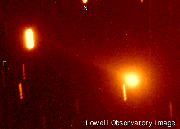
| Right : Photo of the Tempel-Tuttle Comet when the comet was 0.98 AU from the sun and 1.22 AU from the Earth. A faint tail can be seen extending to the upper left (the anti-solar direction ). The image shown here was obtained at the 42" Hall telescope at Lowell Observatory by Tony Farnham | 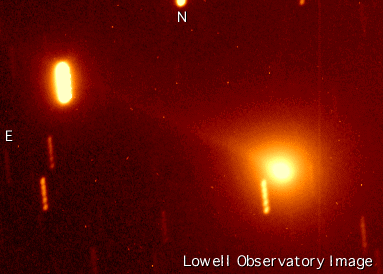 |
The duration of this
meteor shower covers the period of November 14-20. Maximum currently occurs
on November 17
Although the maximum hourly rate typically reaches 10-15, this shower
is most notable for producing greatly enhanced activity every 33 years---events
that are associated with the periodic return of comet Tempel-Tuttle. During
these exceptional returns, the Leonids have produced rates of up to several
thousand meteors per hour.
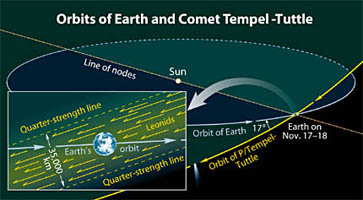
Above: The Leonid meteors and Earth orbit the Sun in nearly opposite directions, so they run into each other nearly head on. The meteoroid stream follows the orbit of periodic Comet 55P/Tempel-Tuttle, which is inclined only 17° to the Earth's orbital plane. The line of nodes is where the planes of the two orbits intersect.
Because of the gravitational influences of the planets, there has been a steady advancement of the line of nodes of Tempel-Tuttle. This basically means that the point where Earth intersects the comet's orbit occurs later every century. Therefore, the Leonids occurred in mid-October during the 10th century, late October during the 16th century, and mid-November during the 20th century.
Every year on about November 17th Earth's orbit around the Sun carries us though the Leonid meteor stream. In ordinary years we encounter little or nothing.
In 1997 the ZHR remained as high
as 80 for about 12 hours, though a bright waning gibbous Moon made this
difficult to determine. In 1998, two peaks occurred. The first
(and best looking) was about a day earlier than expected while the second
peak was right on time with scientific predictions. The first peak had
large meteor streaks (indicating larger dust particles) that were rather
impressive. Studies have shown that this was the result of the dust trail
created by the comet in 1899. The second peak was caused by the dust
trail from the 1966 passage of the comet. The 1899 dust trail consisted
of larger particles (the smaller particles had time to disperse), which
caused the larger meteor streaks.
 |
|
 |
On November 17 and 18, 1999, the
earth will pass through the tail of comet Tempel-Tuttle.This year , scientists
expect
a meteor storm to occur , that is , a great meteor shower which
produces thousands of meteors per hour.It is expected that the peak will
occur on November 18, at 04:08 Local Palestinian Time (02:08 UT),
and would show about 1500 meteors per hour by naked eyes. The peak will
last about 2 hours and the radiant is at high elevation in Middle East.Models
show that Earth will pass close to a trail of dust that was ejected in
1899, the same trail as responsible for the 1966 storms.The Middle
East is likely to experience the highest rates observable anywhere on the
Earth in 1999.
Will a storm happen ?
Will a storm happen this year ? Well, most scientists believe that there will be a storm but some believe that the storm will be in 2000 or 2001 .For example, it was expected that a Leonids' storm would occur in 1899, but a storm did not actually take place !! On the other hand, astronomers didn't expect a Leonids' storm in 1966, but a storm did occur, and about 200,000 - 1,000,000 meteors were seen by naked eyes, where it was the biggest storm ever recorded !! Some scientists expect that the peak ZHR in 2001 and 2002 are likely to be 10 to 20 times higher. The effect of the full moon in 2002 will probably make 2001 the best year for observed rates.
A vote on leonids.com shows that around 79% of the people believe that the Leonids will be better than the last and 17% said that it will be worse and 4% said that it will be the same.
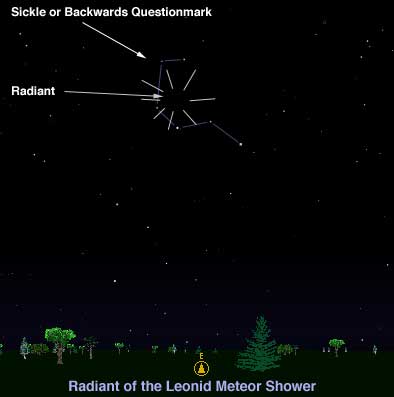
The point from where the Leonid
meteors appear to radiate is located within the constellation
Leo and is referred to as
the radiant. The radiant is located in the western portion of that
constellation in what is commonly referred to as the "sickle" or
"backwards question mark." The radiant rises around 12:30 a.m. local
time. Although a few Leonids can be observed prior to
this, more will be seen after it rises. At about 3:00 a.m. the radiant
is about 30 degrees above the horizon. The radiant location
with respect to the horizon is shown below:
The number of meteors you see depends heavily on your light pollution, the altitude of the shower's radiant, the size of your unobstructed view, and other factors. While gazing and waiting, you'll have plenty of time to find the limiting magnitude in the part of the sky you're watching -- the faintest star you can see with the naked eye
As always when meteor observing, you'll want warmer clothing than you
would expect, a reclining lawn chair to lie back in
comfortably, and of course a reasonably dark location with an open sky
view. By far the best way to take notes is to speak into
a tape recorder without taking your eyes off the sky, especially if meteors
become frequent. Bring a watch that you have
set accurately, and insert the time into your notes at least every
half hour -- more frequently if rates change rapidly.
If you miss the Leonids this time around, don't count on
another chance 33 years hence. The years 1998 through 2000 are probably
the last for several more 33-year cycles when a Leonid storm is even
possible (S&T: November 1996, page 74). A perturbation by Jupiter
in 2029 will tug the comet's orbit away from Earth, and not
until 2098 or perhaps 2131 will hopes for a Leonid storm again be
justified.
No matter how the shower performs or where you're located, the best
time to watch is from 1 or 2 a.m. local time until the
first light of dawn. This is when Leo has risen above the horizon
and is climbing high in the eastern sky. The shower's apparent radiant
point is within the Sickle of Leo at right ascension 10h 14m, declination
+22°. This isn't necessarily where to watch, however. The best direction
to watch is simply the darkest part of the sky, perhaps 45° to 60°
from the radiant if you have a choice. The important thing about the radiant
is its height above the horizon. The higher the radiant, the more meteors
will appear all over the sky.
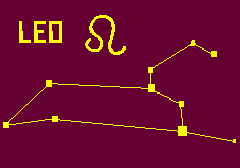
The Lion (also Great Lion, Leo major) is one of the constellations of the Zodiac. It comprises 77 stars that are visible to the 'unarmed' human eye.The brightest is Regulus (='Little King') at 85 light-years from Earth, the second brightest Denebola at 42 light-years. Eta Leonis, north from Regulus, looks weak, but it spreads a hundred times as much light as Regulus. This star is at a much greater distance from Earth: 1700 light-years. In the constellation of Lion and in its surroundings astronomers find a large number of galaxies like M65 and M66. Both have a beautiful spiral-form. They are at a distance of 20 million light-years. The constellation of Lion was already mentioned in the famous Almagest of the Egyptian astronomer Ptolemaios. Copernicus gave Regulus its name during the Fifteenth Century. A second lion-constellation is Little Lion (Leo minor), introduced around 1670 by the German astronomer Hevelius. Leo Minor can be found between Great Lion and Great Bear. This constellation consists of 24 visible stars, but no particular bright ones.
Showers of Leo:
There are a large number of meteor showers
assiciated with this constellation. The most famous are the Leonids. This
shower radiates from the region of gamma Leo and can be seen form November
14-20; the maximum can be observed on November 17th. Although the hourly
rate from 10 to 15 meteor seems to be small there is a cyclus of about
33 years with an enhanced activity. Other Showers include:
The shower of the Alpha Leonids was first confirmed by
Radio Meteor Project. The duration of this shower cover the period
from January 13th to February 13th.
From February 14th to April 25th the Beta Leonids are
active. The maximum takes place around March 20th.
Nearly at the same time - from February 2nd to March 19th - the Delta
Leonids can be observed. The maximum of the
activity peaks at February 22nd.
A rather weak shower are the Gamma Leonids, which are
active from August 14th to September 12th with a maximum
occuring on August 25th.
The meteor shower of the Rho Leonids seems to be non-existent;
yet it has been discovered by radio studies in the 1960's. It
seems to be "active" around March 14-15th.
The Sigma Leonids are another storm of doubt. Only one observation has been made.
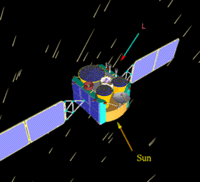
Meteors do not represent any real danger on Earth, since they are small grains of sand, generally in the range of 1 mm - 1 cm in diameter. All of which burn up, in fact, long before reaching the surface of Earth.The world's space agencies are nervously awaiting possible strikes to the more than 650 working satellites that currently orbit Earth. Many satellites, including the Hubble Space Telescope, will be carefully rotated to present their least vulnerable profiles to the potential sandblasting.
This new awareness is important
because our satellites, totaling more than 650 on orbit, form a vital infrastructure
for communications, weather and climate monitoring, navigation, national
defense, and astronomical research. When the last major meteoroid storm
occurred in the mid 1960s when we had few satellites.
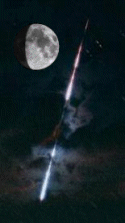
When the Leonid meteor shower strikes on the morning of November 18, 1999, our planet won't be the only place in the cross hairs. The Moon will also pass very close to the debris stream of comet Tempel-Tuttle. Here on Earth, space-borne meteoroids will plummet into the atmosphere and burn up, creating streaks of light called meteors.The vast majority of
| meteoroids will burn and disintegrate well before they hit the ground. The situation on the Moon, where there is no appreciable atmosphere, is different. Every bit of comet debris that rains down on our satellite will hit its surface. Some meteor enthusiasts hope that will create a different sort of display. Rather than streaks of light in lunar skies, there could be flashes of light on the Moon's surface each time a sizable meteoroid hits the ground.Last year, during the 1998 Leonid meteor shower, the phase of the moon was new. It was so close to the sun in the sky that observing faint lunar meteorite flashes was impossible. This year is different. During the 1999 Leonid shower the phase of the Moon will be just 2 days past first quarter. That means the moon will visible in the night sky during the early evening on November 17, and approximately 35% of the lunar disk as seen from Earth will not be illuminated by sunlight. There will be plenty of dark lunar terrain where flashes might be visible. Watching meteorites fall on the moon ... is within reach of (modest) amateur telescopes |
 |
Looking farther
ahead, Brian G. Marsden and Gareth Williams (Minor Planet Center)
and Donald K. Yeomans (Jet Propulsion Laboratory) have calculated the comet's
path through future perturbations. They find that as Comet Tempel-Tuttle
approaches the Sun toward a May 2031 perihelion, it will pass within 1.5
a.u. of Jupiter in August 2029. This encounter will divert the comet to
cross the Earth's orbital plane even farther inward. The distance from
the comet's orbit to ours will increase to 0.0162 a.u., the largest separation
since 1733.
Something similar happened
before the Leonid apparition of 1899. Comet Tempel-Tuttle made close
approaches to Saturn in 1870 and Jupiter in 1898. As a consequence, its
orbit was shifted to 0.0117 a.u. inside Earth's. Sure enough, the Leonids
in 1899 were conspicuous only by their absence. There's little improvement
at the following return in 2065; the separation
diminishes only slightly to 0.0146 a.u. Yeomans notes that "it will
be another century after the 1998-99 events
before significant Leonid meteor displays are once again likely."
Indeed, not until 2098, when the separation distance shrinks to 0.0062
a.u., or perhaps 2131, when for the first time since 1633 the comet crosses
our orbital plane slightly outside the Earth's orbit
(at a distance of 0.0089 a.u.), will any hopes for a Leonid storm again
be justified.
The Arab Union for Astronomy & Space Sciences (AUASS), the Institute of Astronomy & Space Sciences, and the Jordanian Astronomical Society, organize the 1999 Jordanian Leonid Meteors Conference, 12-21 November 1999.Many scientists and astronomy amateurs had been invited to participate in the conference and in the astronomical camping in the Jordanian desert to observe this shower from many countries including: Palestine , New Zealand , Northern Ireland , Australia, Netherlands , Germany , Australia , Iran, UAE , Syria , Singapore.
The palestinian Astronomical Society (PAS) will send a representative to attend the Conference and the Camp .For more information about the Conference and the Camp please visit the website of the Jordanian Astronomical Society.
Click Here to go to the leonids Image Archive
 Leonids
Live!
Leonids
in the Crystal Ball
International
Meteor Organization
Meteor Observing Guide
The
Leonid Meteor Outburst of 1997
Leonids on the Horizon
Leonid Sample Return Update
The
Ghost of Fireballs Past
The
1998 Leonids
Leonids
Sample Return payload recovered!
Early
birds catch the Leonids
A
high-altitude look at the Leonids
The
Leonid Sample Return Mission


All Rights Reserved , Copyright © 1999 Palestinian Astronomical
Society .
Jerusalem - Palestine.
