Marwan Tarazi, Director, Computer Center
Birzeit University, P.O.Box 14, Birzeit, Palestine
Tel:+972-2-998-2072
Fax: +972-2-995-7656
email: mtarazi@admin.birzeit.edu
ABSTRACT: The status of telephone networks in Palestine is currently undergoing significant changes in the wake of the Palestinian - Israeli Peace Agreement. The Palestinian Authority (PA) has been handed over the telephone networks in the PA areas. The areas that the Palestinian Authority has received is fragmented geographically and under partial Palestinian control. At the same time, the telephone networks that were once an integrated part of the Israeli telephone network are still under Israeli control for long distance and international connectivity. Separating the telephone networks is not a trivial task, and one that faces numerous obstacles and complications.
The outcome of the Palestinian-Israeli Peace agreement has created a new political/geographical entity dividing the West Bank and Gaza strips into three zones: Zone A, Zone B, and Zone C:
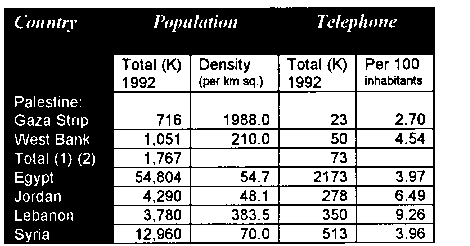
The Israeli occupation has done very little in the development of the telecommunications in Palestinian cities. The infrastructure that was handed over to the Palestinian Authority is in a poor state. This is despite the fact that Palestinians under Israeli occupation were paying income, VAT and other taxes to the Israeli government. The percentage of telephone lines per capita for Palestinian users is extremely low, 2.7% in Gaza and 4.5% in the West Bank as opposed to approximately 30% in Israel.
Obtaining telephones in Palestine has been extremely difficult historically. Applicants would wait for over 10 years before a telephone line became available for their household or office. Presently there is a waiting list of over 44,000 applications in Gaza and 50,000 in the West Bank. This is not taking into account people who do not apply knowing that there is almost no hope in obtaining a telephone line.
Israel has built the telephone networks and infrastructure outside the West Bank and Gaza. As illustrated in figure 4. all major exchanges were connected in areas outside the W.B. and Gaza, and connections to the international telecommunication systems were similarly located.
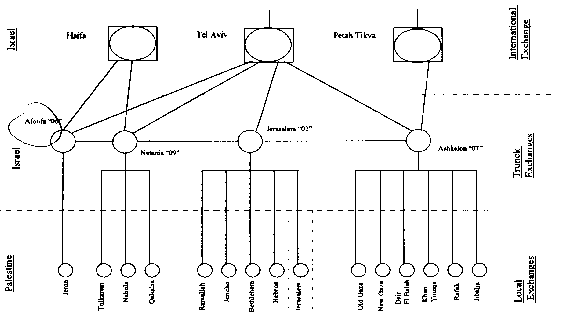
Above: The 15 nodes at the bottom of the image are the local telephone exchanges in (from left to right) the northern cities of the West Bank (Jenin, Tulkarem, Nablus, Qalqilia), the central and southern region of the West Bank (Ramallah, Jericho, Bethlehem, Hebron and Jerusalem), and the Gaza Strip (Old Gaza, New Gaza, Deir El-Baleh, Khan Younis, Rafah and Jiblia). The next level up is the main exchanges in Israel (Afula, Netania, Jerusalem and Ashkelon). Finally, the top level shows the main connection to the international telecommunications backbone (Haifa, Tel Aviv and Petah Tikva). Thus, the trunk and international switching and transmissions systems are part of the Israeli network. The transmission network consists of microwave links and limited fiber optic cable, ownership of which is disputed.
A fiber optic cable that was erected recently to act as a communications backbone for the Gaza Strip for example, ran outside Gaza bordering the Strip. A connection between Jabalia and the Gaza city for example, has to go outside the strip and then back into New Gaza. Therefore inter-city, or long distance, and international connections are under Israeli control, both physically and financially.
Some links exist directly between Palestinian cities, and the majority of these links use wireless microwave technology. The topography of the West Bank is hilly. To establish line of site between cities requires the positioning of the microwave towers on high hill tops. Unfortunately almost all high hill tops are occupied by Israeli settlements. A microwave link between Ramallah and Nablus for example must run from Ramallah to a settlement, then to another settlement on Mt. Jerzeem in Nablus, then through a cable to the Nablus switch.
To complicate things further, the local infrastructure within Palestinian cities was not developed or maintained and left in a grave state at the time it was handed over to Palestinian control. This has left the Palestine Telecommunication authorities with the following situation:
All three zones: A, B and C are part of the Palestinian telephone access areas, and it is the responsibility of the Palestinian telecommunications authorities to develop the telecommunication infrastructure of these areas. Being under Israeli control, however, requires that any development to be made in zones B and C will have to acquire Israeli authorization, and this is usually a complicated and frustrating operation.
Taking the status of leased lines as an example:
The following are options that can be used to build an independent Palestinian telecommunications backbone. These options face obstacles and complications:
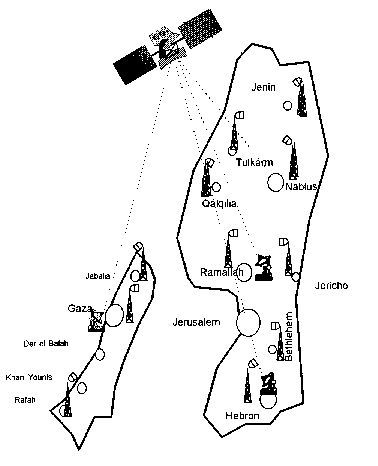
Even though all Palestinian long distance communications are under Israeli control and are integrated through the Israeli telephone networks, Israel continues to refuse leased line connections for Palestinians in the West Bank and Gaza strictly on political grounds. This situation is holding back networking for Palestinians on a national, regional and global levels. While at least 40,000 Israelis connected to the same network enjoy full Internet services mostly through institutions connected by leased lines, only a small fraction of Palestinians have Internet access through dial-up connections to Israeli service providers or to Palestinian service providers who are connected to Israeli service providers.
It will be a major challenge for the Palestine Telecommunications Company to develop an independent data network with Internet access to the PA areas.
Telephone services in Palestine will be conducted by the Palestine Telephone Company (PalTel), a private company. At present, the Palestinian Ministry of Communications is in the process of transferring the communications of the Palestinian Authority (PA) areas to PalTel. Within the next few months, PalTel will take over all telephone services in PA areas.
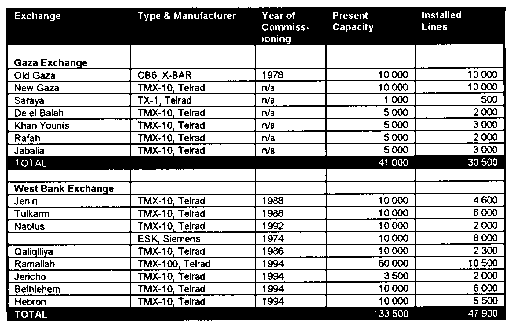
Note: The Gaza switches and the Nablus switches have been recently replaced by TMX-100 switches, and the Nablus TMX-10 switch has been move to Beer Nabala.
The table reveals the following information:
The short term objectives of PalTel, that are of importance to networking are:
The above plans of PalTel, if applied, will boost the development of networking in Palestine significantly. It will offer solutions to WAN connectivity, Internet access, quality of telephone lines, and availability of telephones. However, their task is expected to face continued obstacles and complications and will be heavily dependent on the political mood in the region.
While Palestinians are trying to build the infrastructure for a future Palestinian State, they are faced with obstacles in fundamental areas such as telecommunications.
The establishment of a data network in Palestine is an extremely pressing issue. Access to national and global information, and information exchange are key development al elements. Under normal circumstances, a data network utilizes the installed telecommunications infrastructure in a country. In our case, this seems to be difficult.
At the moment, all sectors seeking data networking are attempting to find working solutions. The academic sector has been trying to establish a research data network for the past few years with little success beyond achieving electronic mail connectivity. The Palestinian Authority has been trying to setup a limited satellite network for governmental information exchange, and that is moving at an extremely slow pace. PalTel is expected to be looking into some data networking solutions once they take over the telecommunications systems. All above sectors are facing the same problems and complications, yet they are all trying persistently to achieve work-around solutions for a difficult, yet extremely important situation.