
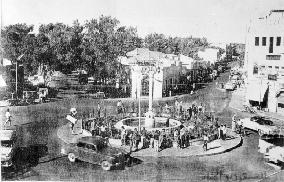
Once known as the 'Bride of Palestine,' visitors would come from far and wide to Ramallah for a taste of the good life. Higher and therefore cooler than Jerusalem, Ramallah was a popular summer resort and an escape from the summer heat. From around the beginning of this century its tree lined boulevards welcomed people from within Palestine as well as from the whole Arab world, entertaining them in style in its hotels, restaurants, and parks and with its festivals and orchestras. This photograph from the 60s shows the Ramallah Manara under Jordanian rule.

Tragically the Israeli occupation came and put an end to all this. The thriving commercial and tourist activity died. Later, during the Intifada, public shows of 'celebration' were felt to be inappropriate, placing any remaining social-life or night-life firmly on the back burner. These were years of mourning and protest.
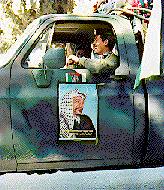
Today, still scarred by the occupation, many of the trees are gone, and the graceful round-about marking the Manara (the town centre) has been replaced by a higgeldy piggeldy mess of junctions. However, with the re-deployment of Israeli forces and the hand over to the Palestinian National Authority in December 1995 (see right), Ramallah is regaining some of her former spirit. The absence of major religious or historical sites in the city might not make it seem an obvious holiday destination but with its lively town centre, blooming restaurant scene and recently reopening hotels it is a good place to catch a glimpse of a live, working, and recently relaxing Palestinian city. Ramallah's proximity to Jerusalem and the other Palestinian towns and villages, together with its pleasant climate make it an ideal place in which to stay and base a visit.
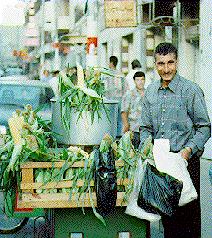
As well as hosting a myriad of street stalls selling the usual felafel, schwarma, kebabs, corn (see left), sit down cafes line the streets, and a number of roof top and outdoor restaurants stay open late into the night serving traditional Palestinian food, drink, and arguilas (hubble-bubble pipes) - sometimes to the accompaniment of local musicians and dancing. In contrast to the authentic flavour of these, is a fast developing 'cafe-society.' Ramallah now boasts a number of popular 'world-food' restaurants, cafes, and bars, amongst them Mexican, Chinese and Italian offerings. Ramallah is indeed worth visiting for the food alone.