
|
Dr. Raja Bahlul, an associate professor of philosophy, has been teaching Philosophy and Cultural Studies at Birzeit University for the past two years. He earned his B.A. in English Language and Literature from the American University of Beirut, and his Ph.D. in Philosophy from Indiana University. He taught for a number of years in the US and at Yarmouk University in Jordan before he came to Birzeit. His current research interests focus on social and political issues, such as democracy, feminism, and Islamic culture in relation to modernity. Dr. Bahlul will be conducting a course in the PAS program for international students in the next semester.
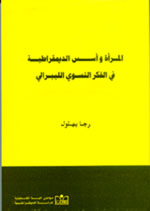
Muwatin, The Palestinian Institute for the Study of Democracy, has recently published a book by Professor Raja Bahlul. The book (which is in Arabic) is entitled Women and Democracy in Liberal Feminist Thought. The book is an accessible introduction to some of the basic concepts and problems to be found at the intersection of feminism and social-political philosophy in the liberal-democratic tradition. In additon, the author discusses some problems and questions that are relevant to Arab women’s lives in particular, e.g., feminism in relation to religion, Arab/Islamic culture, national struggles, and economic development. Islamic feminism: is THAT possible?People (like myself) who have only recently become acquainted with feminist thought, can rarely escape the feeling of being completely overwhelmed by the amazing scope and variety of ideas and approaches that are being discussed in feminist literature. There is Marxist Feminism, Socialist Feminism, Existential Feminism, Post-modernist Feminism, Psychoanalytic Feminism, Liberal Feminism, Radical Feminism, "Western" Feminism, "Third-World" Feminism, Feminism in Literature, Feminism in Anthropology , etc, etc. But for the majority of Arab and Muslim men and women who live and learn and work in Arab or Muslim countries, most of these schools of thought are just that, schools of thought, or intellectual fashions that have little to do with ordinary realities, and daily struggles. Moreover, people tend to be tend to feel uneasy in the presence of concepts such as "gender", "feminism", and some others, concepts which often have no clear synonym in the Arabic language. This circumstance often serves to emphasize the "foreignness" of the concepts in question, which in turn extends to the very issues which these concepts seek to clarify. Still, ever since the Modern Arab Renaissance began (at the turn of the 19th century), there has existed in Arab political and social thought something which is called "the women’s question" (qadiyyat al-mar'ah), which is a suitable term for referring to women's rights, personal status laws, women’s position in relation to traditional culture and customs, and other issues, which can be looked as avenues leading to feminist concepts and discussions, even when the word is not used. But how is the discussion to be conducted? It is often easy to adopt a "Western-grown" intellectual paradigm, say, Marxism, or Liberalism, and then use it to understand Arab men and women in their social world. But what I want to do here is to draw attention to the possibility of something that is "home-grown": a feminism that bases itself on Islam, and tries to defend women’s rights on the basis of an enlightened understanding of religion. Islamic feminism: is THAT possible? Some people will be quick to deny the possibility. As most people know, there is a long history of writing where Islam is presented as a religion that is irrevocably opposed, not only to women’s rights, but to democracy as well. This is not the place to contest such claims. What I would rather do in this short space is give some impression of the approach that is being used by writers (both men and women) who claim to find within an Islamic framework of thought a basis for talking about women’s rights in a meaningful, as well as contemporary way. It is best to begin with the statement of what al-Taher al-Haddad (Tunisian thinker who wrote in the 1920’s), takes to be the "essence" of Islam. The statement is a good reminder of the fact that many interpretations can be given for Islam (and for other religion, of course); that one should never fall into the error of thinking that the Fundamentalists have a monopoly over truth in matters of religion. Al-Haddad says: We must take into consideration the following important distinction. On the one hand, there is the message of Islam, which is its essence, its meaning. It remains eternal, just as the belief in the unity of God, the perfection of morals, the establishment of justice and equality between people, and everything that follows from these essentials. On the other hand, we have the contingent circumstances, and the firmly established ways of thinking that were to be found among pre-Islamic Arabs. These latter were not among the things which Islam aimed at. Hence every rule, regulation, or modification that Islam laid for these contingent matters remains as long as these matters remain. And if they cease, then their [Qur’anic] judgement ceases with them. And there is nothing in all of this which negatively reflects on Islam. This applies to such matters as slavery, slave girls, polygamy, and the like, matters which cannot even be considered to be part of Islam .(1) The idea of focussing attention on the "ethical" dimension of religion, rather than the letter of the laws, rules, and regulations, is an idea with a long history, and can be found in many different religious traditions. In the case of Islam, it continues to find advocates, as exemplified by the Egyptian feminist author Leila Ahmad, who distinguishes between what she calls "the ethical egalitarianism of Islam", and the practice of patriarchal marriage. She goes on to claim that "Had the ethical dimension of Islam been heard, it would have tempered the articulation of the law, and we might today have a far more humane and egalitarian Islamic law regarding women." (2) Understanding Islam along these lines bore fruit in the early part of the 20th century, when a reformer of the caliber of Muhammad Abdo dared to issue a fetwa (religious ruling) outlawing polygamy(3). It can still bear fruit in this and other areas relating to women’s rights. But a condition for this to happen is that Arab and Muslim women take an active part in studying and discussing religious texts. Matters of exegesis must not remain a monopoly of men, who cannot always be relied upon to produce interpretations that are favorable to women’s rights. This is a call that can he heard in many quarters now. Notable among them is the Algerian author Marnia Laqreq, who bemoans the fact that "… the leadership of the women’s associations rejects the religiose discourses without engaging their authors on their own terrain. The "political mosque" has eluded them, just as the secular political parties have given them only rhetorical support. As they stand now, the women’s associations cannot enter the political mosque to energize it with a feminist input because, to a great measure, they neglected to educate themselves in the language and history of Islam, which have become the monopoly of the religiose leaders. (4) Ideas like this are slowly finding their way to the consciousness of Arab and Muslim women who are concerned with women’s rights, but who are averse to conceptualizing their concerns in Western terms. They include such writers as the Farida Banani, Zeinab al-Ma'adi, and Khadija Sabbar. One can briefly illustrate the type of the discussion which they engage in by reference to debates about women’s right to work (outside the home), men’s right of leadership ("qiwama"), and even the mundane notion of the man being the "provider" for his home. Early on in her book Taqseem al-‘amal baina al-zawjain (Division of labor between spouses) Banani states the work of religious interpretation which the jurists engage in is nothing more than a "reading" of texts, and, like all "readings" of texts, it cannot be viewed as being "innocent"(5). She goes on to discuss the notion of "qiwamah", which is mentioned in Sura IV, 34 of the Qur’an: "Men have qiwamah over women, in so far as God has made one excel over the other, and in so far as they spend of their property." Banani derives "qiwamah" from an Arabic root which means ‘to take care of", or "to serve, to protect", rather than "to lead, to preside over".(6) Zainab al-Ma’adi, for her part, suggests a distinction between that which "holy’, or "sacred", and that which is "cultural". The former includes everything which is unambiguously stated in the Qur’an, leaving no room for interpretation, or diversity of opinion. Everything else, by implication, falls in the realm of the cultural, something which humans are free to change according to their circumstances. The author searches the Qur’an for verses that clearly say that the job market out there in the world is off limits to women, and she finds nothing to justify this opinion. Therefore she relegates the injunction against women’s work to the cultural realm, where it can have no binding force on Muslims.(7) Finally, it is interesting to look at the feminist meaning which Khadijah Sabbar injects into the concept of "infaq", which means "providing for the home". Being "provider for his home" is a basis for the supposed "leadership" role which the man has, according to the usual interpretation of Sura IV, 34. Sabbar does not contest the interpretation of the meaning of "qiwamah", as Banani does. But she does insist that "providing for the home" is not simply a matter of the monthly salary which the husband brings. It extends to include such tasks as helping with the housework, spending time with children, etc. To her such things are part of "infaq" (8) In conclusion, there is reason to belief that it is not impossible for one to voice feminist concerns, to defend women’s rights, on the basis or Islam, or certain interpretations of it, at least. (Religion in the end, is a matter of what people take it to be. It is not nearly as "hard" as mathematics or physics). There is a lot of work to be done in this area, and it is best done by Arab and Muslim women. In order to engage in this work, one need not think that Islam (or indeed any religion) is the best, or least objectionable intellectual framework for thinking about these matters. But we live in age where every school of thought, every intellectual orientation that one can think of, from Marxist Feminism, to Post-modernist Feminism, and everything between them, is subject to objections and criticisms of all kinds. There is no reason why some people, raising a banner of "Islamic Feminism" should not join the fray. If nothing else, people stand to learn from each other this way. Besides, this will help to dispel some of the evil stereotypes that surround the image of Arabs and Muslims in the West. Back to top |  return to society |
2.Leila Ahmad, "Early Islam and the Position of Women: The Problem of Interpretation", in Women in the Middle Eastern History, ed. Nikkie Kiddie and Beth Baron. New Haven: Yale University Press, 1991, p. 57.
3. Muhammad Abdo, The Complete Works, ed. Muhammad Amarah. (Beirut: al Mu’assasah al-Arabiyya li-alnashr, 1972), pp. 90-95.
4. Marnia Lazreq, The Eloquence of Silence: Algerian Women in Question (London: Routledge, 1994), p. 221.
5. Farida Banani, Taqseem al-‘amal baina al-zawjain. (Marrakesh: Manshurat Kulliyat al-‘Ulum al-Qanuniyya, 1993), p. 23.
6. Ibid., p. 35.
7. Zainab al-Ma’adi, al-Mar’ah bain al-thaqafi wa al-qudsi. (al-Dar al-Baida’: Matba’at al-Najah al-Jadidah, 1992), pp. 79-91.
8. Khadijah Sabbar, al-Islam wa al-mar’ah: Waqi’ wa Afaq. (al-Dar al-Baida’: Ifriqya al-Sharq, 1992), p. 33.