During Birzeit University's first semester of the 1994/95 academic year, around one-third of its 350 students from Gaza were not granted permission to attend any of the semester. Midway through the semester, Israel agreed to grant permission to around two-thirds of the students, on the condition that they signed a declaration saying they supported the current peace process. These students were to be "guinea pigs", their behaviour determining when and if any of the other 1,300 students from the Gaza Strip studying in the West Bank higher education institutions would be granted a permit, according to a 13 December 1994 letter from defence minister Yitzhak Rabin to Palestinian human rights and legal centre Al-Haq.
With 8,000 students graduating from Gazan high schools each year, a figure five times greater than the capacity of the Strip's only two universities, it is not a luxury but a necessity that these young people are granted access to West Bank institutions.
A Gazan student needs to hold concurrently no less than three separate permits to complete one semester, each with its own separate application procedure. The first, a magnetic identity card necessary for exiting the Strip, allows Israel to track by computer the exact dates an individual exits and re-enters to the Strip. The second permit is necessary for travel through the part of Israel between the Strip and the West Bank. Usually valid for only one or two days, it must be supplemented on arrival at the university by the third permit that allows residency in the West Bank. This permit is usually only valid for three months, whereas an academic semester is usually four months long and its renewal (a 'fourth permit') is far from assured.
The process is characterised, above all, by its arbitrary nature. Permits refused to students on 'security grounds' several times in a row may be unexpectedly granted and permits are often refused to students with no record of security offences. Valid permits are often confiscated by soldiers at checkpoints or cancelled en masse in the name of 'security' when Israel seals off the Occupied Territories, such as after the October 1994 kidnapping of Cpl. Nahshon Waxman and Tel Aviv bus bombing.
Families have literally been divided by Israel's policy, with students frightened to return home to Gaza during university holidays in case they cannot return to their studies. 32-year-old Emad Sharif, an employee in Birzeit University's Electrical Engineering department has been separated from his wife and six-month-old baby daughter since late summer 1994. Emad is from Gaza while his wife is from the West Bank, a sociology student at Birzeit. Despite repeated applications to their respective Civil Administration offices, Emad remains trapped in Gaza, his wife in Ramallah unable to visit each other.
For students who are denied permits, the inducement to carry on their education without consent from Israel is great. Students hang onto the axles of cement lorries and hide in trucks carrying fruit and other goods to exit the Strip, swim around the border into Israel, or bluff their way across the quieter border points using Egyptian identity documents. Students already at the university travel to and from their homes nervously avoiding checkpoints. Such students are considered by Israel as 'illegally' continuing their education and are therefore in danger of detention, large fines (currently 450 NIS) and in some cases, torture.
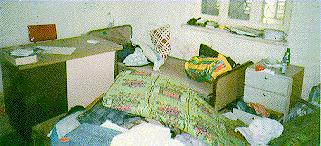
Left: Debris after a night time raid on student apartments in Abu Qash, April 12th 1995. The most recent raid, which did not only include Gazan students exclusively, took place on the night of the 19th/20th June 1995, during the weeks of final exams. 11 students were under interrogation during this period and many others, on hearing news of the raid, fled to the mountains around the university to hide. Photo provided by students.
Nine large-scale night time raids of Gazan students' apartments
have taken place so far since January 1994. Albert Aghazarian,
director of public relations at Birzeit University, believes that
Israel intentionally makes use of the students' tenuous status
in the West Bank to target and manipulate individuals it wishes
to harass or use for its own ends. A February 1995 publication
of the Human Rights Action Project (HRAP) at Birzeit entitled
MAKING EDUCATION ILLEGAL Students from the Gaza Strip: Israeli
restrictions and international reactions, the most comprehensive
report on the issue to date, includes the case of a Birzeit student
- 'Faisal' - that illustrates this conclusion;
Faisal was arrested at a checkpoint outside the university in the wake of the blanket cancellation of permits following the 19 October 1994 bombing of a municipal bus in Tel Aviv. Despite the immediate intervention of university officials at the scene, Faisal was taken to the interrogation wing of Ramallah Prison to be interrogated by agents of Shin Bet, the Israeli security apparatus. Faisal had previously been arrested, fined and deported to Gaza for a permit violation earlier in the year.
The agenda of the Shin Bet officers was to recruit Faisal as a collaborator, providing them with information about political activity and individual activists at the university. They offered money and permits to study if he agreed. When Faisal refused, the officers called up his file on the computer and threatened to rape his mother and sister. He was beaten until his arm broke and one of his eardrums was damaged.
The senior Shin Bet officer then commanded the other officers to leave the room and took out his gun. While removing all the bullets except one, he said, "You only have one choice, to work with us. If you don't I will kill you." Showing Faisal the remaining bullet, he closed the chamber and spun it, telling him, "You have three seconds to agree to work for us. Do you want to pray to Allah before you die?"
Counting to three, the commander pointed the gun at his head and pulled the trigger, but the gun clicked on an empty chamber. Repeating his threats, he pulled the trigger again with the same result. Faisal was eventually fined and released, having his magnetic identity card confiscated, on the condition he return to Gaza. The severity of his injuries necessitated medical treatment however, delaying him for a few days, after which Faisal decided to remain in the West Bank to complete his studies. His house was raided about a month later, and even though he had been sleeping on the roof to avoid detection, he was discovered and deported back to Gaza rather than detained for a longer period, on the condition that he withdrew a complaint he had filed against the Shin Bet about his mistreatment.
For Gazan students, the existence of the many and varied international human rights covenants and accords that Israel has signed means nothing. From the hundreds of examples of the selective enforcing of human rights law that history has sadly given us, it is clear that the international community follows a different agenda. Until it fulfils its declared responsibility to discipline countries contravening these covenants, consulting the oppressed rather than relying on information from the oppressor, such violations will continue ad nauseam.
Focus for action: the permanant struggle for academic freedom - also from Birzeit Newsletter No. 26.
MAKING EDUCATION ILLEGAL Students from the Gaza Strip: Israeli restrictions and international reactions - Available on the Birzeit Web site!