A recurrent theme throughout the history of Birzeit University Newsletters has been the issue of academic freedom. Looking back through past issues, one is confronted with headlines such as: "Birzeit University reopens closed" (July 1982); "Military closes campus" (February 1984); "Double closure: double burden" (May 1984); "Report scores army abuses" (January 1985); "Birzeit protests closure" (April 1985); "Double travel ban" (July 1985); "Administrative detention" (October 1985); "Student Council President detained" (February 1986); "Army gunfire wounds three" (May 1986); "Students under fire" (February 1987); "Foreign students beaten, detained" (October 1987); "Year of closure, year of violations" (March 1989); "Birzeit still closed" (September 1991); "Bring all the deportees home!" (March 1993); and "Academic operations crippled by closure" (September 1993).
In this post-Oslo accord era, one is tempted to believe that the days of Israeli violations of academic freedom and human rights are drawing to a close, but a look at the situation, particularly evidence collected by the Human Rights Action Project (HRAP) at the university, tells another story.
In the wake of the September 1993 Oslo accord between the PLO and Israel, HRAP reported 192 students and staff were detained in seperate incidents during 1994.
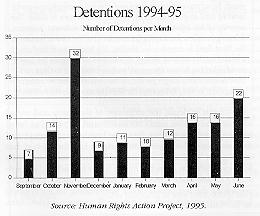
Left: Chart showing detentions from September 1994 until June 1995. The horizontal axis shows the months, as described in the previous sentence. The vertical axis shows numbers arrested, rising in gradiations of 5. Supplied by the Human Rights Action Project.
The figure of 192 arrests in 1994 represents the second highest number of detentions
since records began ten years ago. Similarly, since January 1994,
as many as nine violent night-time raids have been carried out
by the Israeli military on student apartments. One student was
wounded by gunfire as he ran away in fear.
Although the recent events can be considered to be human rights violations, Birzeit University believes them to additionally violate of internationally-accepted standards of academic freedom. Harassment of students during exams
Students in danger of arrest for seeking to study without 'permission' from Israel (see Gazan students article in this issue, hyperlink below) are often unable to concentrate on their studies. In the fortnight of final exams many students ran for the mountains after Israeli army raids on student homes on the night of 11/12 June 1995 resulted in the detention of 11 students. The students, who spent a night in the mountains, bringing back memories of similar events in April 1994, arrived for their exams the next day at the university looking haggard after a poor night's sleep.
The harsh travel restrictions that afford students this tenuous legal status have resulted in a numbers of serious problems for both students and staff in the current academic year.
For the second consecutive summer, a delegation of staff and students from Birzeit's Institute of Archaeology were invited by the Jordanian Yarmouk University to participate in an archaeological excavation in Jordan. This opportunity provides the students with essential field experience and a hands-on knowledge of archaeology. Israeli military law required these students to apply for permission to travel abroad. When each student returned to his home district to apply, two were refused permission and a third was informed that he would only be granted permission to leave the country for either one or nine months, not for two as required for the programme. In the end the trip was cancelled largely because several permits were still outstanding as the travel date came and went, despite appeals from the university to the Israeli offices responsible for granting the permits.
Similarly, student Ahmad Abu Laban, a fourth year student in the faculty of arts and an active member of the student council, was selected and given a scholarship to represent Palestinian students at an International Student Week in Ilmenau, Germany. Students were set to gather at the symposium held from May 28th until June 4th to discuss issues of common interest and exchange ideas. Ahmed's request for a laissez passez (travel document) was turned down by the Israeli authorities, who claimed he presented an unspecified "security risk". In the summer of 1993, Ahmed had experienced similar problems but had managed to secure his document after the intervention of numerous human rights organisations. This year, he was eventually forced to inform the Ilmenau committee that he was unable to attend.
Birzeit University reaffirms that the denial of travel permission to staff and students at the university, and the harassment of students during their final exams, is illegal under international law. The university asks all its friends worldwide to express concern about the issues related in this newsletter to:
Israeli Minister of Defence Fax: +972-2-664-838 or +972-3-691-7915.
New report on Gazan students shows continuing violation of academic freedoms - also from Birzeit Newsletter No. 26