The Birzeit University Centre for Environmental and Occupational Health Sciences has been attempting to tackle the widespread regional problem of pests that damage agricultural crops in the face of Israeli restrictions on the movement of training and outreach staff. Yet the pests that destroy crops are free to cross borders and checkpoints, leaving the economic livelihood of all peoples in the region, including Israelis, at risk.
The Centre for Environmental and Occupational Health Sciences (CEOHS) was established at Birzeit in 1982, in the words of director Ramzi Sansur, "in an environmental vacuum." Realising that there was a need for foundational research into the state of Palestinian industry and agriculture, the Centre began a series of investigations into what problems the environment faced in the West Bank and Gaza Strip.
"We found," says Sansur, "that agriculture played a critical role in the national economy, whereas industry occupied a relatively minor place." The CEOHS therefore began to look at the agricultural industry, finding that pesticide use threatened both the Palestinian environment and its agriculture future.
Pesticides consist of up to as much of 40% of a local farmer's agricultural budget, and are sold to the farmers by Israeli suppliers and their agents in the West Bank. Sansur does not mince his words, "Profit is the driving force behind the sale of pesticides, not need."
The irresponsibility of the pesticide suppliers is evidenced by the lack of instruction they offer to farmers who, according to Sansur, "really have no knowledge of what they are dealing with." This, coupled with the fact that labelling is often in Hebrew, has led many into a mentality that, "if one drop per litre of water is good, ten drops is better". These pesticides kill off the "natural enemies" of plant pests as well as the pests themselves. The pests that survive have often built up a resistance to agrochemicals and have freedom from these natural predators to reproduce at will. As a poster in the CEOHS proclaims, "Natural enemies are our allies."
An agricultural scientist that visited the CEOHS last year did some field research in the Jordan Valley, looking for natural enemies of the white fly, a pest that has been reaping destruction among tomato crops. With the heavy use of pesticides in the area, among the highest in the world, the agriculturist was unable to find any significant amounts of the fly's natural enemies. When he returned to the university, he briefly spent time searching in the area around the campus, which is not agricultural land and therefore, where no pesticides are used. He found many of them.
The "solution" when confronted with a resurgence of pests, in the eyes of many farmers, is to use more pesticides. In the short term this may work, but in the long term there are heavy costs to pay in environmental damage and a real threat to human health.
The danger lies in the fact that around 40% of the pesticides used (a minimum of 1,300 in the West Bank in 1992) are chemicals whose sale or use has been banned or severely restricted by governments according to organisations such as the US Environmental Protection Agency, the Pesticide Action Network and the World Health Organisation. Indeed, even as late as 1992, Israel still permitted the use of DDT (see box on facing page), internationally recognised as highly dangerous due to its marked and harmful carcinogenic residue that persists in the environment for years after use. The head of the two-year-old environmental department of the Israeli Civil Administration (the body responsible for administrative matters in the Occupied Territories) used to advocate the use of DDT in the Jordan Valley until the CEOHS exposed this. In the last two years, however, Israel has become more constructively active in environmental matters.
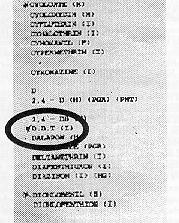
Dichloro-diphenyl Trichloroethane (DDT) has been internationally
recognised since the late 70's and early 80's as highly dangerous
due to its marked and harmful residue that persists in the environment
for years after use. Israel still permitted the use of DDT even
as late as 1992.
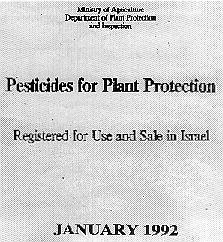
Above: The 1992 Israeli government document from the Department of Plant Protection and Inspection in the Ministry of Agriculture, showing continued use of DDT (entry on list circled) as late as 1992. The 1994 edition no longer had the entry for DDT, use of it having bee prohibited in 1993.
Selected countries and final dates of prohibition of the use of DDT in agriculture:-
Argentina (1972); Canada (1978); China (1982); Cuba (1970); Cyprus(1976); European Community (1988); Spain (1975); UK (1984); Hungary (1968); Norway (1970); Sweden (1975); USA (1981).
Sansur describes Israeli pesticide suppliers as participating "in a conspiracy and a cover-up of the horrible effects pesticides have on human health and the environment." One of the most popular chemicals, Methamidophos, was registered in the 1991 Consolidated List of Products Whose Consumption and/or Sale Have Been Banned, Withdrawn, Severely Restricted or not Approved by Governments published by the UN Department of International Economic and Social Affairs as having been severely restricted by some countries as early as 1982. Methamidophos causes "delayed peripheral neuropathy" - in other words, the nerves in feet and hands are damaged, causing a loss of sensation over time.Other examples include Maneb, which is mutagenic (causes mutation), teratogenic (interferes with the foetus and can cause birth defects) and carcinogenic.
"The real solution," says Sansur, "is a regional integrated pest management programme. We, the Palestinians, cannot solve this problem by ourselves. Neither can the Jordanians, Egyptians, Syrians or Israelis. We are all dependent on a regional solution." Nadi Farraj, an agronomist working in the CEOHS , put it bluntly: "Insects don't have borders," he says, "they go wherever they please."
Integrated Pest Management (IPM) is an ecological solution to the problem with a history of 30 years of successful implementation in both agricultural and urban settings. It aims to avoid the traps of conventional chemical pest control such as: pests developing resistance to pesticides; the indiscriminate killing of natural enemies of pests; harmful residues; health hazards; the costly administration of pesticide regulation; the depletion of natural resources, as pesticides are usually made from non-renewable fossil fuels; and the cost of expensive agricultural chemicals to small farmers. The aim of IPM is not to cease the use of pesticides, but to use them "wisely", according to Sansur, "This way we avoid the failure of the agricultural industry in the long term, economic loss in the long term, damage to human health in the long term. All we lose is short term financial gain. You can carry out successful agriculture with a wise use of pesticides."
The CEOHS began preparation for the first stage of its IPM programme in 1991. "The only first stage we could carry out under the present political conditions," Sansour points out, "was to begin holding 'Safe use of pesticides' courses for local farmers in the Jordan Valley, including instruction on how to dose, the use of protective clothing and teaching on the value of natural enemies." The course focused on the major agricultural areas in the Jordan Valley, the north of the country and the Hebron area in the south. To date, the programme has trained 400 individuals working in the agricultural sector, including 50 women. Training for the farmers is given by three employees of the CEOHS, all with a practical background in agriculture: Nadi Farraj, an agronomist from Bethlehem, trained in Khadouri College near Tulkarm and described by Sansur as, "one of the encyclopaedias of Palestinian agriculture"; Mahmoud Hammad, also an agronomist who was trained in the Soviet Union, whose dialogue-style method of teaching is very popular with the farmers and has resulted in a significant amount of useful feedback for the Centre; and Hanan Halaweh, a graduate of An-Najah University in Nablus, bringing with her agricultural engineering skills and a "dynamism" that has worked very well in the courses she runs for women. "All three," Sansur says, "complement each other very well and this is extremely important." The IPM programme at Birzeit has been funded and assisted by a variety of organisations including: the International Arid Lands Consortium through the auspices of the University of Illinois; ANERA; CCFD; ASSP; and the Mennonite Central Committee (MCC).