Unfortunately, the IPM programme has suffered some setbacks since the Israeli closure of the Occupied Territories in March 1993. Permits for the outreach workers began to be refused, preventing them from travelling to Gaza to begin a series of "Safe use of pesticides" courses there.
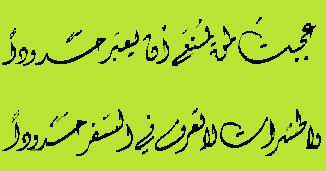
Left: An original work of proverb-style Arabic calligraphy by student Mohammed Abu Obeid, produced for this newsletter. The text reads: "I wonder at how human beings are banned from crossing borders when insects do not know borders in their travels."
Nadi Farraj was able to travel to the United States in May 19
to participate in an important conference entitled, "Organising
IPM Extension Programmes." However, Mahmoud Hammad was unable
to get permission from Israel to go. Attempts to secure permits
individually and through representations by Birzeit University
and by Mr. Walid Sadek, member of the Israeli Knesset and Israeli
Deputy Minister of Agriculture, have proved fruitless.
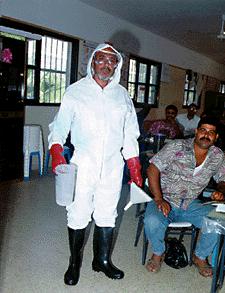
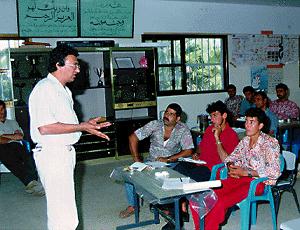
Above left: The CEOHS's Nadi Farraj, giving a 'Safe Use of Pesticides' course to farmers in Qalqilia, in the north-western tip of the West Bank. Denial of permits to staff members have seriously affected their ability to carry out these important training courses.
Above Right: A farmer demonstrates practical safety clothing for use when spraying pesticides. Photos by Yasser Darweesh.
The usual reason for denying Palestinian permits - "security" - really makes no sense in light of the reality of the problem that both Israeli and Palestinian farmers are facing. One example of this is the flower thrips that arrived on Israeli imports from Holland, which have destroyed the Palestinian fava bean crop. Israel itself does not grow fava beans, but now the thrips have begun to attack the Israeli flower crops. Three years ago the existence of the thrips was first noted but agriculturists knew nothing about them. One-and-a-half years later, there has been major damage, giving some idea of the speed with which this can take place. With all the agricultural sectors in the region standing to lose out, the only ones to gain out of this kind of policy will be the pests themselves.
The Union of Physicians and Dentists commissioned the CEOHS to undertake a survey of all drinking water wells in the West Bank. In 1990, the Centre signed a contract with the Jerusalem Water Undertaking/Ramallah District to perform a long term survey of water quality in their network, the largest in the West Bank, covering four metropolitan areas and 52 villages.
The CEOHS regularly monitors the biological and chemical content of water from 170 sampling stations in the West Bank, and has recently opened a satellite station in Gaza.
Pharmaceutical testingPharmaceuticals have been produced locally in the Occupied Territories since 1967, and until the late 1980s were not subjected to any form of control. Emulations of foreign drugs account for about half the market. There are five times the number of generic medicines available in the Occupied Territories than the recommended number on the World Health Organisation Essential Drugs List.
CEOHS takes random pharmaceutical samples from across the Occupied Territories and works with Palestinian Authority and the United Nations Relief and Works Agency (UNRWA), the latter of whom is the largest prescriber of pharmaceuticals in Palestine, to ensure that drugs meet rigid quality control standards.
Accredited by the PAThe Centre was recently accredited by the Palestinian Authority as an official laboratory. The PA also invites funders who wish to support the work of the laboratory to write to:
Ramzi Sansur, Director, Centre for Environmental Occupational Health Sciences, Birzeit University, P.O. Box 14, Birzeit, West Bank, Palestine.
Tel: +972-2-998-2102 Fax: +972-2-998-2166 E-mail: rsansur@ceohs.birzeit.edu