
"Everybody has the right to liberty and security of person. No one shall be subjected to arbitrary arrest or detention." Article 9--International Covenant on Civil and Political Rights
On any given day during the past ten years about 10 Birzeit University students could have been found in prison as a result of an order issued by an Israeli military officer. The order does not contain charges or explanations. It does not have to be ruled upon in a court. Rather, Israeli military law permits a military commander to imprison a Palestinian for a renewable period of up to 12 months for reasons of protecting public security. This procedure has been come to be called "administrative" detention, as the detainee is detained by an administrative procedure without court involvement.
British mandatory laws--the Defense Emergency Regulations--continued to be employed by Israel after 1947; in 1970 these laws formed the basis of new military orders authorizing Israeli military commanders to order persons detained. For a brief period between 1982 and 1985, Israeli military officials ceased issuing administrative detention orders. The practice resumed in the summer of 1985 and has been used continuously since that time.1
This procedure stands in direct violation of international human rights standards which guarantee to every person freedom from arbitrary arrest or detention, as well as the right to a "fair and public hearing by an independent and impartial tribunal, in the determination of his rights and obligations of any criminal charge against him" (Universal Declaration of Human Rights).
Local human rights organizations work in coalition to address, document, and lobby against the ongoing imposition of administrative detention. Particular emphasis had been placed in recent years on the practice of issuing consecutive detention orders against a detainee. Israel currently holds a total of 370 administrative detainees in its prisons. Of these, 92 have been detained for between 6 months and 4 years as a result of consecutive orders.
In recent months, the prisoners have organized to protest the violations of their basic rights, they have protested in particular the absence of fair appeal courts and the practice of renewing detentions indefinitely. Birzeit commerce student Najeh Madi was transferred into isolation and then taken for interrogation as a result of his leadership role in demanding basic rights.
In the past 12 months 21 Birzeit students have been subjected to periods of administrative detention of between 3 and 18 months. As of 1 September, Israeli authorities held 12 students in administrative detention in the Megiddo Prison.
Political Science student Ali Rabia' was detained in October 1995 and has been held since that time without investigation, charge or trial. The latest detention order issued against him ends on 8 November 1996. If he is released in November he will have spent more than a year in prison. Ali also was imprisoned without charge from late February through June 1995. In the 21 months between February 1995 and November 1996, Ali has been ordered in prison all but 3, despite the fact that he has never been charged.
On Thursday, 4 July 1996, Israeli military authorities issued a one-year administrative detention order against Birzeit engineering student Ahmad Ibrahim Said of Nablus after subjecting him to 50 days of interrogation in Ashkelon Prison. The issuance of year-long administrative detention orders was only re-permitted in February 1995 with the issuance of Israeli Military Order 1424. Ahmad is the first Birzeit student since then to be ordered detained for 12 months at one time; other students like Ali have been detained by consecutive sentences for up to 21 months.
The practice of detaining students without charge or trial stands in direct violation of their most basic rights. The increased use and prolongation of administrative detention stands as an affront to the spirit of the Oslo Accord which pledged to moving toward the release of all political prisoners.
Footnote 1- Playfair, Emma. Administrative Detention in the Occupied West Bank. Ramallah: al-Haq, 1986.
On 7 July, Birzeit University graduated its eleventh class, including 650 students in four faculties. In his speech to the graduates, President Hanna Nasir expressed solidarity with all prisoners and reasserted the university's commitment to its students from Gaza:
"I would like to take this opportunity to send my greetings to our students detained in prisons, wherever the prisons may be. We reassert to them that we will do everything possible to ensure their release and their return to their classes with their colleagues where they belong. I also salute the students from the Gaza Strip--this sector that has suffered tremendously from the arbitrary practices of the occupation which have impeded their arrival to the West Bank for study. We unequivocally reject such practices that seek to divide parts of one people. The university shall pursue its efforts to bring Gaza students, West Bank students, the Palestinian Galilee students, Jerusalem students, and diaspora and exiled students to meet on the university grounds, so that the people will be united in the university just as this university is united with the people."

As of September 1, 1996 there were 57 Birzeit students and no staff in Israeli prisons. Two detainees are female. One student was under interrogation. On September 1, 12 students were administratively detained, without charge. There were 10 students and no staff detained in Palestinian prisons.
The following students are in administrative detention. The information is listed in the following order: Name (ID number); hometown; year started studies at Birzeit University; date arrested; date released; length of detention order.
Abdallah Safadi; Amjad Shehadeh; Ayman Awwad; Ayman Yaghi (arrested and released since March) Hussein Shaheen (arrested and released since March); Wa'el Abd al-Qader; Yunis Ayyash; Ziad Zaghal

During the 1995-96 academic year approximately 60 Gaza students beat the odds, circumnavigated the many obstacles and graduated from Birzeit University. For many of the students this marked the completion of a lengthy endeavor, marked by at least one trip to prison (for studying without 'permission'), and at least one ride in a vegetable truck, cement mixer, or other specialized get-you-out-of-Gaza vehicle. Their accomplishments seemed especially noteworthy at the end of a year marked most of all by a profound absence of permits. When graduation day arrived many graduates found themselves (not surprisingly) stuck in Gaza unable to participate in the graduation ceremony, others found themselves marooned in the West Bank with no way home. More than one was heard to remark, "Now what?" considering the distant, sandy strip of land seemingly forever beyond their reach.
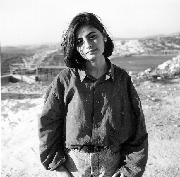 When all was said and done the Birzeit Registration Office (ever loyal to the Gaza students) calculated and tabulated, listed and re-listed, and determined that a mere 334 Gaza students remained on the rosters, their graduations pending the freedom to study. With the acceptance by the university of 62 brave new Gaza students for the new 1996-97 academic year, the first semester approached with an expected grand total of 396 Gaza students ... and, as usual, no permits.
So, the campaign continues--Academic Freedom First. Despite rolling on for over a year, the campaign still pushes forward the same three demands: standardized and transparent permit application procedures, written rejections, and the granting of special status to academic permits.
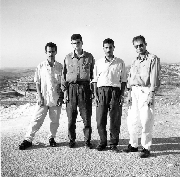 In a quick review, for anyone who has just joined our efforts: The campaign focuses on three goals, in addition to the immediate issuance of permits for all students, lecturers, and employees. First, the campaign calls on the Israeli authorities to adopt, publish, and follow standardized and transparent permit application procedures--with timelines and deadlines. Secondly, the campaign calls the issuance of written rejections by Israeli authorities, to enable legal appeals to denials of permits. Finally, in an effort to end the ongoing practice of canceling permits for "security reasons" without relation to the events of the academic year such as exams, the campaign called for "academic permits" allowing students to reside in the West Bank for the duration of the academic term.
 A final word on the Israeli citing of "security" as a reason to deny permits to Gaza students, lecturers, and staff. These young people and lecturers pose no more of a security risk studying and teaching in the West Bank than any other West Bank resident. They do not wish to travel to Jerusalem or Tel Aviv. The West Bank, where their universities are located has been sealed off from these areas by a series of checkpoints since March 1993. It is much to the advantage of the peace process that young people are educated and given a sense of optimism for their future. They are the emerging Palestinian generation who will decide the future course of this same peace process.
So, its not too late to join the campaign. In fact, there has been no better time. Write letters to Israeli officials on behalf of the Gaza students. Contact the diplomatic representatives of Israel in your country, ask them why the government has not facilitated the higher education of Gaza students, and why they have blocked the passage of Gaza professors and employees of Palestinian universities in the West Bank. Raise the points of the campaign.
Learn more about the campaign and get involved at the Academic Freedom First Website.

In the summer of 1995, I received a scholarship for a six-week summer course at Paul Valery University in Montpelier, France, and I was invited to participate in a conference on peace in Holland and Belgium. To travel, I had to apply for an Israeli laissez-passer. The "competent authority" (actually the Israeli intelligence service) refused to give me a laissez-passer without giving any reason. They also prevented me from traveling through Jordan.
One year elapsed and we Palestinians became able to have our own passports which allow us to go to more than 80 states including the Europe Union. This summer, 1996, I was invited to Athens to represent Palestine in a multilateral youth exchange between North and South Mediterranean countries, and to participate in a voluntary work camp in Italy. On the sixth of July I packed my bag and set off from Ramallah toward Jordan for my flight to Athens.
On the Allenby Bridge (the passage between Palestine and Jordan which is controlled by Israel) I was stopped. I had not expected that shackles and a blindfold were waiting for me. I was informed by an Israeli intelligence agent that I was wanted for interrogation; I did not know why. I sat seething with resentment, since this was the only thing I could do. I remained befuddled and speechless bearing in mind that to be in an Israeli jail is not opprobrium, as all Palestinian people take pride from being in Israeli jails. I was transferred, with my hands and feet tied and eyes blindfolded, to a concrete dungeon in the basement of the interrogation center in al-Jalameh prison near Haifa.
The conditions in dungeons are indescribable to those who have never experienced them. When you are (God forbid) in a dungeon, you realize there exists an abyss between what you experience and what people outside understand it to be like. No windows. Depressing. Disgusting. There are two strong iron doors to every dungeon. Abysmal and squalid conditions constituting a gross infringement of the sanctity of human rights. Detainees are put on small and uncomfortable chairs specially constructed for torture, with their hands and feet tied together and bound to the chair. Then there are the dirty sacks put over their heads, "de rigueur" for torture, along with the very loud and noisy music all day long to keep you from sleep.
This is the worst thing in this situation. Detainees are not allowed to sleep more than 5-7 hours per week, on Saturday night. So, every week is the same throughout the interrogation period, a timeless eternity that you know can be extended to several months.
During this time we detainees are interrogated by thoroughbred interrogators in the heart of their bastion, who intimate they know everything about us. We do not bat an eyelid when we face them. Sometimes they act casually, giving us chances to "hobnob" as if we were friends, but it only stands in stark contrast to the contempt in their faces. Some of them pretend to be more mellow. Detainees with a desperate need to see a doctor are not allowed to unless they are brought to the brink of death in another kind of pressure on a detainee to confess. Words cannot describe what it feels like in interrogation and torture.
After 50 days, I was taken from the interrogation section and moved to Megiddo prison where I waited out the last two weeks of the two month sentence handed down to me by a military judge in a military court. Then I was released. All of these procedures devastate hopes of seeing a just and lasting peace. It must be taken into consideration that freedom, dignity, reciprocal understanding and respect must underpin relations between those who have been enemies. "True peace is not merely the absence of tension. It is the presence of justice."
The difficulties faced by students and staff invited to participate in advanced studies, exchange programs, conferences, or work camps have provided a common theme throughout the history of Birzeit University. As Mohammed points out in recent months most Palestinians have been able to obtain passports issued by the Palestinian National Authority. Israel, however, continues to control all points of exit and to impose restrictions on travel.
In June, three students were invited to participate in the multilateral youth exchange in Athens described by Mohammed. Not one of the three students traveled without first resolving "security" issues. In the end they each traveled in a separate direction, only learning in Athens that one of the threesome had been arrested en route.
The harassment touches people from all parts of the university population. An employee of the Public Relations Office--who travels regularly--suddenly found himself blocked from all angles for "security reasons". Two graduates traveling to Norway for masters studies in Physics and Economics found their first challenge of higher education at the door of the Israeli intelligence service. Only one has been allowed to leave the country, the other cannot travel for "security reasons".
As this newsletter goes to press, nine Birzeit students are marking the end of their sixth month of detention by the Palestinian National Authority (PNA) without charge or trial. Their detentions have pushed the Human Rights Action Project (HRAP) to seek new avenues to advance the rule of law in the emerging situation.
On Wednesday, June 26, a committee of Palestinian lawyers, in conjunction with HRAP submitted a petition to the Palestinian High Court in Ramallah on behalf of ten Birzeit University students, detained at that time for more than 100 days in the Ramallah prison without charge or legal proceedings. The petition called on the Palestinian Minister of Interior and Attorney General to state the legal basis of the detentions or to release the students immediately.
After more than three months of planning, the petition marked the first habeas corpus petition dealing with political prisoners in the West Bank since the transfer of power to the PNA and the opening of the Palestinian High Court in Ramallah. HRAP intended that the petition open an opportunity for the independent Palestinian Judiciary and the PNA as a whole to affirm and safeguard the rule of law and the importance of due process in Palestine. The lawyers chose to take the case against the highest officials because of a lack of clarity in the delineation of jurisdiction between the branches of the security forces.
The Palestinian High Court, an independent Palestinian court, sits in both Ramallah and Gaza and has the authority to review the legality of detentions among administrative matters.
The advocates--including Ahmad Sayyad (Mandela Institute for Prisoners), Akram Samara, Ali Ghuzlan, Elia Theodory (Human Rights Action Project), Khadir Shkeirat (LAWE--The Palestinian Society for the Protection of Human Rights and the Environment), and Marwan al-Khatib--argued that their clients were arrested and detained illegally without charge or legal proceedings and continued to be held by virtue of an irresponsible use of power and, therefore, should be released without delay.
Security officials of the PNA arrested 21 students and 1 staff member during March 1996. The ten students in this case were arrested on March 3 or 6 and have been detained since that time in the Ramallah District Prison. From the beginning all detentions were marked by an absence of judicial review. No warrants were issued for the arrests. The detainees were not charged with any offense, nor did they appear before a judge to have the period of their detentions or the basis of the investigations against them reviewed. Both the civilian and the military prosecutors asserted that the detentions did not fall under their authority.
In a pre-trial hearing on the same day, a three-judge panel sitting in the Palestinian High Court in Ramallah received the petition and required that the Minister of Interior and the Attorney General provide the legal basis for the detentions within eight days. After several delays the state responded to the petition on July 25 arguing that the High Court does not have jurisdiction over the case, and that the detentions were not illegal (no charges were, however, presented to the court). A five-judge panel convened on July 31 to hear the arguments of the two parties.
On Sunday, August 18, a five-judge panel of the Palestinian High Court handed down a unanimous decision declaring the protracted detention of the 10 Birzeit University students illegal and ordering their immediate release.
"[W]e find that the arrest of the plaintiffs in Ramallah Prison since March 1996 and until now happened without any legal reason and took place in the absence of procedures and in contravention of the rule of law which gives us the power to accept this case and to find the arrest of the plaintiffs illegal. Release them immediately." (Case No. 96/25)
The High Court immediately issued release orders for each of the students which the lawyers delivered to the Ramallah Central Prison. Officers in the prison officially received the release orders on Sunday afternoon, signing and stamping each one, and then prepared the students' identity documents. The students' lawyers were initially informed that the releases would take place by the end the day. By September 12, however, only five of the ten students had been released.
All sectors of Palestinian society, including all local human rights organizations, welcomed the important legal precedent and urged the immediate implementation of the decision, and, tangentially, the immediate release of all prisoners held without charge. Despite widespread support, both inside and outside the PNA, the decision of the court was not implemented as required by law. In a move possibly related to the case, the senior judge for the case Hon. Amin Abdel-Salaam was dismissed from his post in the weeks following the ruling.
The university protests the failure to implement the direct orders of the High Court which undermines efforts to establish the rule of law and therefore the foundation of a democratic state in Palestine.
On June 6, 1996, Birzeit University leaped onto the so-called information superhighway with the launch of its own website. The site, developed jointly by the Computer Center and the Public Relations Office, contains information about Birzeit University, its history, academic programs, research centers, and facilities. It includes a continuously-updated archive of press releases, as well as a compilation of many publications released through the Public Relations Office. The Human Rights Action Project has also joined the fray with publications, and campaign information. Check out the following sites on the WWW:

1. Join the Gaza students in their trek toward graduation. Join Academic Freedom First--The Gaza Students Campaign.
Send a message to the Human Rights Action Project asking to be added to the action list. Write letters to Israeli prime minister Binyamin Neytanyahu, likud1@likud.org.il, encouraging him to take one step toward a just and lasting peace by solving the Gaza students issue. (fax no: +972-2-664-838)
2. Write letters to students in administrative detention.
Send letters to the students detained by the Israeli authorities without charge or trial. Address the envelope to the full name of the detainee, Megiddo Prison, Israel. If you have extra time, send a letter to the Military Commander of the West Bank calling for respect for the right to liberty and security of person. (fax: +972-2-997-7326)
3. Visit Birzeit University.... on the Web!
Surf the Net regularly for updates and information about the human rights situation for Palestinians. In addition to the Birzeit University site, http://www.birzeit.edu, check the Human Rights Section of Birzeit University's Complete Guide to Palestine's Websites, http://www.birzeit.edu/palarc, to see who else is on-line and working for Palestinian human rights.
Birzeit Human Rights Archive
Human Rights Action Project Home Page
Birzeit University Archives