
Birzeit University
Human Rights Record
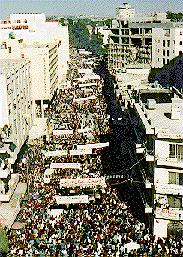
Following months of negotiation Palestinian president Yasser Arafat and the late Israeli prime minister Yitzhak Rabin signed the Israeli-Palestinian Interim Agreement on the West Bank and the Gaza Strip ("Oslo II") in Washington, DC, on September 28, 1995. The agreement covered major points of the interim phase, including the redeployment of Israeli troops out of most Palestinian cities (not Jerusalem or Hebron), free and universal elections for a Palestinian Legislative Council, and the release of Palestinian political prisoners. The Israeli military redeployed, beginning in Jenin--moving out of the city center and taking up new positions on the outskirts of the town. The Palestinian Authority assumed responsibility and began work. One-by-one newly-autonomous islands of "Area A" began to take shape--Jenin, Qalqiliya, Tulkarem, Nablus, Bethlehem, and Ramallah. All of Area A comprised approximately 3 percent of the West Bank. (Above left: Celebrations in Ramallah).
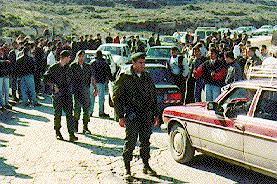
The remaining 97 percent remains either subject to joint patrol (Area B) or to exclusive Israeli jurisdiction (Area C). The Israeli military continues to operate in Areas B and C. In a move that has been repeated in other cases, Birzeit student Wa'el Abd al-Qader was arrested from his home in a village in Area B on 26 December and placed under administrative detention. Birzeit University is located in Area B and Israeli soldiers continue to patrol the roads surrounding the university. Most notably, Israeli soldiers have established a new outpost at the intersection between a new settler bypass road (cutting through land belonging to villagers from Surda and al-Bireh) and the main Birzeit-Ramallah road. The intersection lies immediately adjacent to the border marking the edge of Ramallah. (Above right: Israeli checkpoint on the Ramallah-Birzeit road).
Between October and February, Israeli authorities released approximately 1,650 Palestinian prisoners. By and large, releases did not follow the Oslo II agreement which provided guidelines as to which prisoners would be released. Thus, the releases did not bring about the full rejoicing they might have. Annex VII specified that all women, old and young people, and prisoners in poor health would be released. A total of six Birzeit students were released as a result of the political process.
As of February, some 3,300 prisoners remained under detention. The prisoners have been transferred to prisons inside Israel as the prisons and detention centers of the West Bank have been closed or handed over to the Palestinian Authority. The move to incarcerate all prisoners inside Israel, even if understood as a result of the political negotiations, violates the basic rights of the prisoners and their families. Article 76 of the Fourth Geneva Convention stipulates, "Protected persons accused of offenses shall be detained in the occupied country, and if convicted they shall serve their sentences therein."
Approximately 50 Birzeit University students remain under detention by the Israeli authorities. Throughout this period the Israeli military continued carrying out arbitrary detentions--25 of the 29 students arrested since September were subsequently released without charge or placed under administrative detention.
From 4 to 14 March, Israeli authorities placed the eight main towns and 465 villages of the West Bank under siege, banning all residents from leaving their hometown--and paralyzing all sectors of Palestinian life, including higher education. Israeli authorities also closed by military order three universities and at least seven educational and research institutions. The measures of collective punishment came in response to a series of suicide bombings in Jerusalem, Tel Aviv, and Ashkelon by supporters of the extremist Islamist opposition in which almost 60 persons were killed. The Palestinian Authority and many Palestinianian institutions condemned the use of terror against civilians and the tragic loss of life.
Almost ninety percent of Birzeit University's students, faculty, and staff come from areas outside Birzeit village and were blocked from traveling to the university. Eleven days of classes and work were missed, causing major disruption to the academic calendar. A number of international cooperation projects scheduled to take place at the university were abruptly canceled, including: a training program for Palestinian journalists planned with the Finnish Association of Journalists, a workshop on water management planned with the German government, and a conference on music in Palestine planned with UNESCO and the Palestinian Ministry of Culture. In addition, major construction projects at the university ground to a halt causing significant financial loss to both the contractor and the university.
Adding further strain, on Tuesday, 12 March at 2:00 pm the university received a bomb threat over the telephone from a man claiming to belong to "a Jewish organization". He said that a bomb was planted on the university campus and scheduled to explode within 20 minutes. The university took general cautionary measures and evacuated the buildings, fortunately the phone call turned out to be a hoax.
During the siege, the university issued a press released stating, "The university is disturbed that the present actions of Israel vis-a-vis the Palestinian population remain unchallenged. Although one condemns terror, irrespective of its motives, the solution of this phenomenon should lie in speeding the process of peace so that the Palestinians could attain their legitimate political and human rights. Only then will the roots of terror and violence be eradicated."
While the university community has resumed its work and studies at this time, it has done so only after almost two weeks of disruption and with an important sector, the Gaza students, missing. Birzeit University notes again that the use of illegal and collective punishments has a severe negative impact on the entire population and has been shown in the past to be counterproductive.
In the middle of March 1996, there were 46 Birzeit students and no staff detained in Israeli prisons. Two detainees are female. One student was under interrogation. There were 13 students and 1 s taff member detained in Palestinian prisons.
During the period under review, Israeli authorities continued to place persons under administrative detention--detention without charge or trial--and to renew administrative detention orders despite the signing and implementation of new accords in late September. In a number of instances, Israeli forces undertook extensive search and arrest campaigns on the eve of redeployment from Palestinian cities. On 20-21 December, at least 14 persons were arrested in Bethlehem and Ramallah and placed under administrative detention for between three and six months.
In this period, Israeli authorities ordered seven students administratively detained. In addition, the detention of Abdel-Razeq Yassin Farraj was extended into a fourth period, and of Uthman Al-Qadi into a second period. Five students have been released from administrative detention since July. Most administrative detainees are now imprisoned in Megiddo Prison in the lower Galilee.
In January the Human Rights Committee met to discuss the role of HRAP in this period of transition. The committee discussed a number of issues in the realm of human rights including academic freedom, rights of detainees, and relations with the Palestinian Authority and its police and security forces. With respect to detentions, all committee members emphasized the importance of monitoring the emerging situation and encouraging the establishment of proper procedures and full respect to protect the due process rights of any detainee.
During this period, however, the Palestinian Authority did not make provisions for access of legal counsel to the prisoners. Palestinian officials claimed that as the prisoners did not have charges and were not being mistreated it was not necessary for the lawyer to see them. The Human Rights Committee intervened on numerous levels in an effort to facilitate visits by the lawyer to the students, and will continue to work for improved procedures.

At approximately 6:00 pm on 7 October 1995, Birzeit student Mohammed Musa Abu-Shaqra, 21, died at Ketsiot Military Detention Center, allegedly while being interrogated by other detainees. Accordin g to the autopsy report, the death came as a result of severe external violence resulting in internal bleeding, which in turn led to shock, the actual cause of death.
Mohammed was the third of three Palestinian prisoners to die in one month in Israeli detention facilities. Following his death al-Haq and the Mandela Institute expressed grave concern, stating that ` `it has been convincingly proved that the three deaths occurred as a result of the use during interrogation of severe physical violence. The deceased were interrogated by other inmates in the same p rison because of allegations that they had collaborated with Israeli security agencies."
The Birzeit University community united to mourn Mohammed's death and to protest the circumstances in which it took place. In addition, HRAP has sought avenues to promote respect for life and prohi bition on torture at all levels of society and in all circumstances.
In June 1995, the Palestinian Authority published regulations concerning search and detention. Since then al-Haq, the West Bank affiliate of the International Commission of Jurists, has been holding workshops for members of the police and military about their duties and obligations with respect to the regulations.
When al-Haq approached HRAP about the possibility of hosting a session for the university community, the project agreed. In December, Khalid Batrawi came to talk about the regulations. Khalid opened the seminar with a positive review of the regulations, noting that they comply with international standards and, if followed, will protect the rights of citizens. He impressed upon the audience the importance of having an informed citizenry who can monitor the implementation of the regulations in society.
The regulations require police to obtain a written warrant from the general prosecutor before carrying out any search or arrest. There are exceptional cases where arrests might be conducted without a warrant, but a warrant must be obtained as soon as the detainee arrives at the police station. In all cases the detainees must be brought before the general prosecutor or the judge within 48 hour s of arrest. In no circumstance may searches be conducted without a warrant. Furthermore, at least two well known individuals from the residential area must be present during the time the search is conducted.
On 11 January 1996 the Israeli High Court of Justice rescinded an injunction banning the use of physical force (in particular violent shaking) in the interrogation of Palestinian detainee Abd al-Hali m Belbaysi on the grounds that he was likely to have information concerning planned attacks against Israelis. The judges said they were not giving permission to use steps beyond those acceptable und er the law and Landau guidelines. Human rights organizations have long considered these guidelines to permit the use of torture.
Torture and ill-treatment are banned under international human rights law regardless of the charges against a suspect. The court's ruling stands in clear and direct violation of the most basic tenen ts of international and humanitarian law, as well as Israeli penal law.
In November 1995, HRAP hosted three Danish doctors who carried out a pilot study on the neurological effects of the Israeli practice of violently shaking detainees during interrogation. The doctors c onducted physical and psychological examinations on 30 students. While the results of the study have not been published, hosting the doctors provided an important opportunity for HRAP to raise awareness at Birzeit about physical and emotional effects of torture.
A coalition of Israeli human rights organizations has been conducting a similar medical study in an effort to provide evidence of the danger of physical pressure in interrogation. While coalition members adamantly oppose torture in all circumstances and regardless of long-term effects, it was decided in the face of decisions such as the one mentioned above that medical evidence of long-term damage may be more persuasive in the Israeli judicial system.
"Everyone has the right to freedom of movement and residence within the borders of each state." (Article 13) "Everyone has the right to education." (Article 26)
At the beginning of the first semester of the 1995-96 academic year, when it became evident that the Israeli authorities would again deny the Gaza students permission to begin their studies on time, the Human Rights Action Project (HRAP) launched Academic Freedom First, the Gaza Students Campaign. This campaign, with the endorsement of the Palestinian Council for Higher Education, invited frie nds and colleagues to join in protesting the ongoing violation of the Gaza students' right to education.
The campaign focused on three goals, aside from the immediate issuance of permits for the students. First, the campaign called on the Israeli authorities to adopt, publish, and follow standardized a nd transparent procedures--with public timelines. Secondly, the campaign called for a halt to the ongoing Israeli practice of issuing permit rejections verbally to the Palestinian Regional Civil Aff airs Office "the Liaison Office") in Gaza and the issuance of written rejections by Israeli authorities. Without a written record, cases cannot be investigated or, when appropriate, appealed. Fi nally, in an effort to end the ongoing practice of cancelling permits in the middle of the academic term the campaign called for "academic permits'' allowing students to reside in the West Bank for the duration of the academic term.
Academic Freedom First has received enthusiastic participation worldwide. HRAP informed the local and international press, diplomatic representatives, and local and international NGOs about the ongo ing violation by the Israeli authorities and the agenda of the campaign. At the same time, HRAP began a concerted effort to facilitate a solution to the impasse. Working in consultation with the Liaison Office in Gaza, the project officially petitioned the Israeli Civil Administration and the Israeli Coordinator of Activities in the Occupied Territories to publish official procedures for reque sting and receiving permits, and to provide all students from Gaza wishing to study in the West Bank with permits without delay.
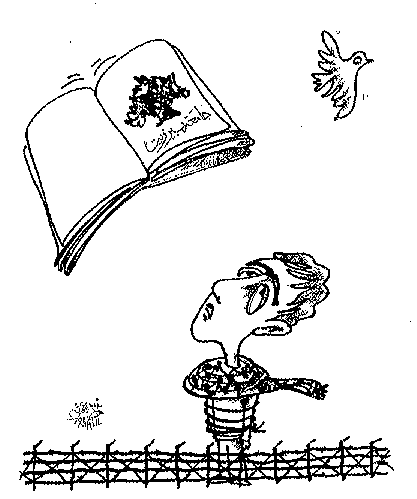
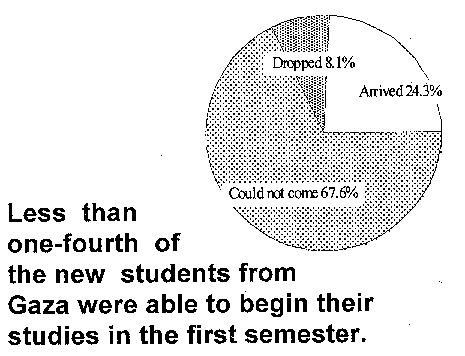
Despite all efforts, the semester passed quickly--without permits. The deadline for new students from Gaza to arrive at Birzeit University passed on Saturday, 21 October. The university determined that after this time it would be exceedingly difficult for new students to compensate for the time missed. The administration agreed to make an exception to regular procedures and to allow these students to begin their studies second semester, rather than requiring them to defer their education for a full year. Less than one-fourth of the new students from Gaza were able to begin their studies with their fellow Birzeit students from the West Bank and other parts of the world.
In November, the project renewed contacts with local human rights organizations, and convened a meeting to discuss possible legal avenues to resolve the issue. The legal committee met before the end of November and decided to send a letter to the Israeli State Attorney's Office petitioning them to intervene to resolve the matter. Adv. Eliahu Abram from the Association for Civil Rights in Israel prepared the intervention, outlining the history of the problem and the issues needing to be resolved. The State Attorney's Office replied that they would address the matter as soon as possible.
As students approached the winter holiday (23 December-1 January), the situation looked as bleak as it ever had. Finally, on 28 November, two months and 10 days after the semester began, 82 of Birzeit's 102 female Gaza students and 13 of Birzeit's 282 male Gaza students received the first permits to be issued this year.
During the third week of December, over three months into the semester, more than 300 of Birzeit's 370 registered students from Gaza were finally issued permits to reside and study in the West Bank. In addition, the Liaison Office in Gaza released a list of students whom the Israeli authorities had declared banned.
Many people agreed these permits were issued in response to ongoing international pressure for a resolution of the issue, topped off by the petition to the Israeli State Attorney.
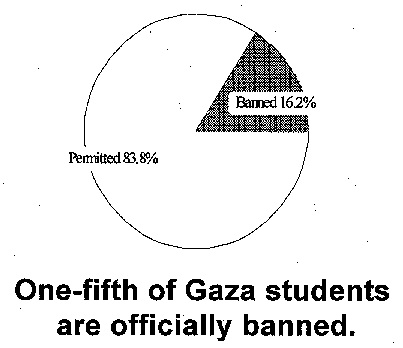
The list of banned students included approximately 18 percent of Birzeit's Gaza students (58 students). Almost one-fifth of the students have been declared forbidden to get permits without explanation or avenue for appeal. A number of the students listed have received permits as recently as last semester and have never been arrested or been aware of a security file against them. Some students were issued with the magnetic identity card indicating a security clearance late last summer. Others have been "banned" for longer periods but have no arrest or security records. The right of every student to education cannot be randomly violated--each student has the right to know the charges against him or her, and to appeal them.
In March, as part of Israeli retaliatory measures following a series of attacks on Israeli cities in which some 60 people were killed, all Gaza student permits were revoked and all students in the West Bank were ordered to turn themselves in to the Israeli military for transfer to Gaza. To date, no clarification has been provided about the application procedures, or when/if the students will be permitted to resume their studies.
The Palestinian Council for Higher Education noted at this time, ``Harassment of students who happen to come from Gaza illustrates well the backwards premise of "guilty until proven innocent" that has characterised Israel's recent pursuit of security objectives.... As all students must undergo a rigorous security check prior to being issued permits in the first place and are subsequently requi red to travel between the West Bank and Gaza in groups coordinated by the Regional Civil Affairs Office in Gaza, the targeting of these students cannot be considered a legitimate security concern and must be seen as arbitrary and punitive."
In the coming period, Academic Freedom First will continue to campaign for the right to education of all Gaza students. If you would like to join the campaign, contact the HRAP.
TAKE ACTION!!
Birzeit Human Rights Archive
Human Rights Action Project Home Page
Birzeit University Archives