
Birzeit University Human Rights Record
``Everyone has a right to education.'' (Article 26) ``Everyone has the right to leave any country, including his [or her] own, and to return to his [or her] country.'' (Article 13) Universal Declaration of Human Rights
Ten years ago, the university reported on widespread violations by Israeli military authorities of academic freedom at the university. Some violations affected the institution as a unit, such as military-ordered closures, censorship of books and periodicals, restrictions on the travel of faculty, and discriminatory taxation on educational materials. Others affected individuals through restrictions on freedom of movement, administrative detention and detention without charge, as well as physical and psychological maltreatment. In the decade following the publication of this report, Birzeit and its staff and students have continued to experience many of the same violations.
Israeli authorities have declared and enforced "borders" on educational opportunities. Indeed, some restrictions have become so routine that it might be easy to overlook them. In the face of the recent and ongoing political process, an expectation has been put forth that these kinds of violations should be disappearing or, at least, diminishing. Indeed it seems in everyone's interest to facilitate and promote academic opportunities. Nevertheless this year, particularly this spring, as members of the community prepared to take part in educational opportunities in the Middle East, Europe, and North America, the impediments were numerous.
On a regular basis, Birzeit classes are denied the required permits to undertake educational opportunities. For example, architecture classes are denied permission to study important architectural landmarks in Jerusalem and other parts of historic Palestine. This has forced students of Islamic architecture to complete their studies without visiting Jerusalem, a city that houses one of the most dense collection of buildings from the Mamluk period in the world. For years Birzeit geography students have been restricted from exploring the geographical riches of the region--from the plains of the coast, to the craters in the Negev desert, or the heights of the Golan.
Birzeit researchers face weekly limitations on their movement and continual hassles in obtaining permits. In one example such restrictions have severely hampered a program of the Center for Environmental and Occupational Health Sciences (CEOHS). Since 1991 the center has been working to address regional issues surrounding the control of agricultural pests. The project has involved ongoing research, participation in international training programs, and, perhaps most importantly, the organization of training seminars on safe pesticide usage and pest control in the occupied territories. The ongoing denial of permits to staff members has severely curtailed their ability to offer and participate in seminars.
Mahmud Hammad works as an agricultural engineer at CEOHS. Mahmud's work involves travel throughout the West Bank and Gaza. In past years, Mahmud had been able to obtain the obligatory travel documents with only a standard amount of difficulty. In March 1994, Mahmud applied at the Israeli Civil Administration for a permit to enter Israel and was refused. Surprised, Mahmud appealed the rejection through numerous channels--without success. Israeli authorities never have to explain or provide documentation for a rejection.
In April 1995, Mahmud was accepted to participate in a short course on integrated pest management at Illinois State University. The Mennonite Central Committee in Jerusalem agreed to fund his participation in the course. Mahmud applied to the Israeli Civil Administration in Ramallah for permission to travel and was rejected. Again, the rejection was appealed through numerous channels without success.
The restrictions affect all of the academic disciplines. For the second consecutive summer a delegation of students and staff from Birzeit's Institute of Archaeology were invited by Yarmouk University to participate in an archaeological excavation at 'Ain Ghazal. This opportunity provides students with essential field experience and hands-on knowledge of archaeology.
According to Israeli military law, young men under the age of 26 are required to apply for special permission to travel to Jordan. If they do not receive the necessary permit before leaving they may be prevented from returning. As required, each of the male students went to their home districts to apply. Two were refused permission. A third was informed that he could either travel for one month or nine, but not for two as required by the program.
Appeals were launched on behalf of the students, numerous letters were sent to various departments and officers to try to facilitate the program. Yet in the end, too many barriers arose in the path. Among other matters, the absence of some permits several days after the group was to have travelled led to the cancellation of the trip.
Frequently, the Human Rights Action Project or others succeed in intervening on behalf of faculty or students. The German organization DAAD awarded Dr. Abdul Aziz Shawibkeh (Physics) a fellowship to undertake cooperative research with his colleagues at the Max Planck Institute in Germany. Israeli authorities issued a travel document to Dr. Shawibkeh in mid-June and he began to arrange for his visa and airline ticket. On June 24, Israeli soldiers at a checkpoint outside Bethlehem confiscated Dr. Shawibkeh's travel document. For the next two weeks Dr. Shawibkeh looked for the confiscated document. The offices of the Israeli authority in Bethlehem, Hebron, and Ramallah denied having the document to return. After soliciting the intervention of the Office of Coordinator of Activities in Tel Aviv, the Hebron office suddenly found the permit and returned it to Dr. Shawibkeh. He was able to travel to Germany two weeks after the research was to have begun.
Successful appeals were also launched on behalf of a number of students, all of whom had been refused permission to travel even though they had been selected and awarded scholarships for travels in Europe. The regularity of cases like these clearly illustrates how randomly rejections are issued. When the traveller knows channels through which to appeal a decision, and does so, what was impossible becomes possible. On what basis are such decisions made? What are the standards? Who decides?
Access to education in the fullest sense must be considered a foundational issue, essential for nurturing and developing a responsible and informed Palestinian citizenry. For this reason it has been named by the world community as a basic, universal right. The failure to allow, even to facilitate, opportunities for Birzeit faculty, staff, and students to participate in all kinds of academic opportunities stands in direct violation of this right and of the right of Palestinians to build their state and society. Call on Israel to support full academic freedom in fulfillment of its obligations as a signatory of the Universal Declaration of Human Rights.
``No one shall be subjected to torture or to cruel, inhuman or degrading treatment orpunishment.'' (Article 5) ``No one shall be subjected to arbitrary arrest, detention or exile.'' (Article 8) Universal Declaration of Human Rights
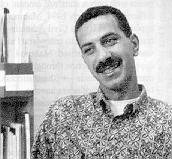 On 16 May 1995, Israeli prison authorities released Birzeit sociology
student Khalid Farraj from Ramallah Prison without charge after
eight continuous weeks of harsh interrogation. In 1995, more than
67 percent of persons detained from the Birzeit community have
been released either without charge or charged only with studying
without a permit. One in three of the persons detained underwent
or are undergoing interrogation at the hands of Israeli military
officials.
On 16 May 1995, Israeli prison authorities released Birzeit sociology
student Khalid Farraj from Ramallah Prison without charge after
eight continuous weeks of harsh interrogation. In 1995, more than
67 percent of persons detained from the Birzeit community have
been released either without charge or charged only with studying
without a permit. One in three of the persons detained underwent
or are undergoing interrogation at the hands of Israeli military
officials.
Khalid was arrested from his home on Mother's Day--March 21. At about 8:00 in the evening, two civilian cars--a Mercedes and a Peugeot--pulled into Jalazon Refugee Camp near Ramallah and drove directly to Khalid's house. Some 12 undercover agents working for a "special unit" piled out of the cars and surrounded the house before an Israeli army captain known as ``Muslih'' called out over the megaphone for everyone--``big and little''--to come out of the house. Captain Muslih ordered Khalid, by name, to exit last with his hands on his head.
Khalid exited the house, one step at a time, to be taunted by the officer. "How are you Khalid? ... How are you Khalid? ..." By now some 300 soldiers had entered the refugee camp and placed a siege on the entire area. After detaining Khalid, the undercover agents entered his house and began searching. For four hours they searched the house and the car--breaking furniture, turning things upside down, confiscating books and photographs. The security agents shouted and ordered people to move about the house and yard; one agent hit Khalid's sister who was pregnant with twins.
It was near midnight when they took Khalid, along with his brother Abdel-Nasir, Birzeit student Fawzi Abu Ras and Fawzi's brother Walid, to the Ramallah prison. Khalid and Abdel-Nasir's brother Abdel-Razeq (also a Birzeit student) was placed under administrative detention in May 1994. He remains in detention without charge. (Details on page 4.) On the occasion of Mother's Day 1995, their mother had three sons in prison.
Captain Muslih put Khalid directly into the interrogation wing of the Ramallah prison. While Abdel-Nasir, Fawzi, and Walid were released in a matter of days, this was the beginning of eight long weeks for Khalid.
This was the ninth time Khalid had been detained. He was first arrested in 1985 at the age of fourteen and has spent some two and one-half years in detention without charge. The project lawyer Elia Theodory immediately began efforts to visit Khalid in prison.
Due to a series of orders by the military banning all visits, Theodory saw Khalid for the first time only on 30 March at a bail hearing. Theodory was prevented from speaking with him on this occasion. Theodory applied to visit with Khalid on 4, 7, and 11 April--each time he was shown a prevention order and sent away.
At a later date, Khalid described his routine during these days and weeks. Khalid reported that he had been under continuous interrogation by the General Security Service (GSS) seven days a week--night and day--since the time of his arrest. His interrogators chided him with the rhyme, "Tahqiq layl w'nihar, hatt al-inhiyar" (Interrogation night and day, until the breakdown). Once every 4-5 days, he was permitted to sleep for 3-4 hours.
Sunday through Thursday he underwent interrogation in Ramallah, on Friday he was transferred to the Russian Compound in Jerusalem where he remained (under interrogation) until Sunday when he was returned to Ramallah to begin the cycle anew. Throughout this routine, a soiled hood was placed over Khalid's head. The GSS interrogators forced him to balance on a small chair with uneven legs and, at one point, tied him to the chair with a rubber hose for six hours. The interrogators subjected Khalid to extreme variance in temperatures, from hot to very cold.
At the end of the second week of interrogation, Khalid reported fainting from exhaustion. His guard poured cold water over his head to arouse him. A senior officer saw Khalid's condition and ordered that he be taken to the prison clinic. In the clinic, the nurse examined him, and poured more cold water over his head.
These physical conditions were accompanied by nonstop interrogation by rotating teams of agents. He was told repeatedly that his interrogation would not stop until he "made a confession". GSS agents ordered him to "confess" telling him the interrogation could continue forever, without limits. They declared, "You will look at death, but you will not die."
The first meeting between Khalid and Theodory took place on Thursday, April 20--a full month after his detention. At this point no charges were presented against him, nor any evidence of illegal activity.
Even a month later the interrogators had not been able to force Khalid to make some "confession". Because they did not have independent evidence against him, they had no charges to make. At last the military judge ordered that Khalid be released.
The case against him, as is most often the case in the detention of Palestinian political prisoners, hinged entirely on the ability of the GSS to force Khalid by physical and psychological pressure to "confess". This practice stands in clear violation of basic tenants of the Universal Declaration of Human Rights and other conventions to which Israel is a signatory. Israel must be reminded that such actions do not go unnoticed and must cease for real peace to develop.
The harassment did not stop with Khalid's release. Shortly after he was released, Khalid planned an afternoon trip to Jericho. Khalid travelled from Ramallah down to Jericho, only to be stopped at an Israeli checkpoint at the entrance to the "autonomous zone". Israeli soldiers at the checkpoint detained Khalid, along with a friend, for hours, questioning them and examining their identity cards. In the end, they were informed that the Israeli military had banned them from entering Jericho-an area supposedly under the jurisdiction of the Palestinian Authority.
"Everyone has the right to freedom of opinion and expression, this right includes freedom to hold opinions without interference and to seek, receive and impart information and ideas through any media and regardless of frontiers." (Article 19) Universal Declaration of Human Rights
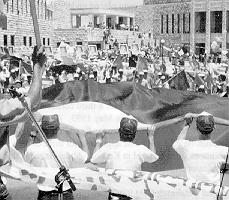 Birzeit students held elections for the student council on 24
May 1995. The election time brings great festivity and excitement
to campus as students experience basic elements of freedom and
practice their right to hold and express opinions as they choose.
This year's election followed active campaigns by student groups
on campus--including a debate, a multitude of signs and banners,
rallies with dramatic sketches, music, and dancing. The election,
based on a system of proportional representation for the first
time, illustrated the diversity of opinions on campus and was
heralded a great success by all.
Birzeit students held elections for the student council on 24
May 1995. The election time brings great festivity and excitement
to campus as students experience basic elements of freedom and
practice their right to hold and express opinions as they choose.
This year's election followed active campaigns by student groups
on campus--including a debate, a multitude of signs and banners,
rallies with dramatic sketches, music, and dancing. The election,
based on a system of proportional representation for the first
time, illustrated the diversity of opinions on campus and was
heralded a great success by all.
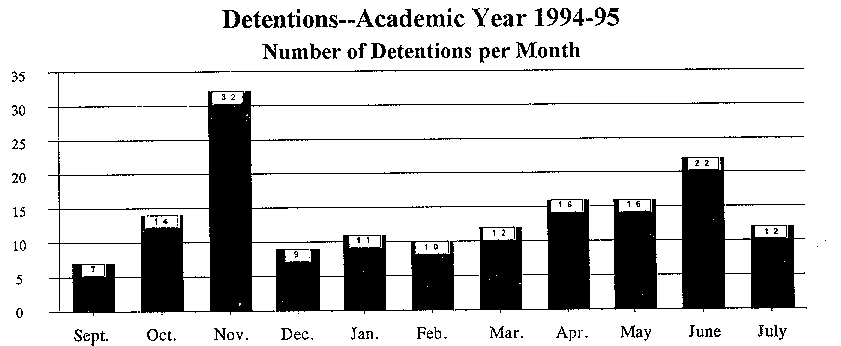
At the end of July 1995, there were 66 Birzeit students and no staff detained in Israeli prisons. One detainee is female. Eleven students were under interrogation.
Since 1970 the Israeli authorities have implemented a policy of administrative detention, under this policy persons are placed under detention without charge or trial. Such a policy stands in direct violation of basic, internationally accepted standards of human rights. These standards have been articulated in Article 10 of the Universal Declaration of Human Rights and Article 9 of the International Covenant on Civil and Political Rights.
During the period under review, 1 staff member and 8 students were administratively detained in Ketsiot Military Detention Center in the Negev (Ansar III). One staff member and 5 students were released from administrative detention since the publication of the last issue of the Human Rights Record.
No new students were placed under administrative detention during this four-month period; however, two students had administrative detention orders renewed. According to Israeli military order consecutive administrative detention orders can be issued against a detainee indefinitely.
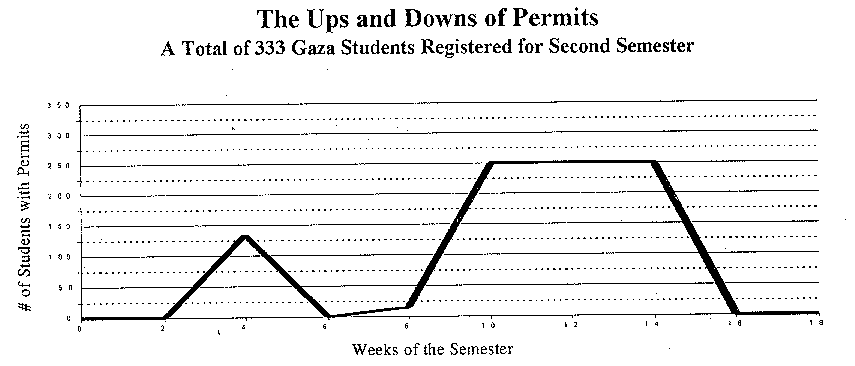
The second semester provided no relief for students from Gaza. While permits were somewhat more forthcoming for lucky students, they were also cancelled more frequently than ever. In addition, the fortifications at the Erez Checkpoint, the main exit from Gaza, were made more obtrusive. Twenty-five students spent time in prison this semester for studying without a permit. As the students looked ahead to the summer semester, all indications suggested that the permit problems will continue.
Take time today to make your opinion known. Focus on the issues highlighted in this edition of the Human Rights Record including the following:
If you want additional information, or detailed case studies about individual students or staff, please contact the Human Rights Action Project.
Photocopy this newsletter and give copies to your friends and colleagues. Write letters to your local newspaper about the ongoing violations of human rights and the urgent need to declare respect for human rights as one of the foundations of the political negotiations. Peace must be built on secure footings.
Some fax numbers you might find helpful:
Mr. Yitzhak Rabin, Israeli Prime Minister and Minister of Defense (fax: +972-2-664838)
Mr. David Liba'i, Israeli Minister of Justice (fax: +972-2-285438)
Military Commander of the West Bank (fax: +972-2-998-2626)