
Birzeit University Human Rights Record
In 1994, 190 students and 2 staff members were detained by Israeli authorities. This represents the second highest number of students detained in any year in the university's history, topped only by the 1987-88 academic year in which more than 200 students and staff were detained. The number of detentions in 1994 is higher than the numbers recorded during the height of the intifada.
In a further indication of the arbitrary nature of these arrests, 40 percent of those detained were subsequently released without charge. Arrests continue at a rate of 10 per month into the first three months of 1995.
This matter must be viewed with particular concern in light of the ongoing political process and the hopes that human rights violations would have subsided. The cases followed by the Human Rights Action Project (HRAP) illustrate that systematic violations of basic human rights continue to be carried out by Israeli authorities.
In the course of 1994 HRAP focused particular attention on matters including: the continuance of torture and ill-treatment of Palestinians in detention; the erratic and discriminatory denial of permits to study in the West Bank to Gazan students; the frequency of large-scale nighttime raids on student homes and the destruction of property during such raids; and the ongoing use of administrative detention. A number of these violations are discussed at greater length in this issue of the HUMAN RIGHTS RECORD.
Birzeit University repeatedly protested and continues to protest the targeting of students and staff and the ongoing violations of human rights. Respect for basic rights as defined in the Universal Declaration of Human Rights, as well as numerous other international charters to which Israel is a signatory, is integral to fostering a democratic atmosphere and genuine peace.
In the one and one-half years since the signing of the Declaration of Principles by the PLO and the Israeli government on September 13, 1993, the Birzeit community has continued to be subjected to a wide range of human rights violations and harassment from Israeli authorities. Below is an incomplete list of incidents involving the Birzeit community in this period. Others are detailed in this issue of the HUMAN RIGHTS RECORD.
| New detentions June 1994 - March 1995 (138 total) NUMBER OF ARRESTS IN PERIOD UNDER REVIEW |
|
|---|---|
| June | 17 |
| July | 21 |
| August | 7 |
| September | 7 |
| October | 14 |
| November | 32 |
| December | 8 |
| January | 11 |
| February | 10 |
| March | 11 |
At the end of March 1995, there were 66 Birzeit students and 2 staff detained in Israeli prisons, one of whom is female; 7 of the students were under interrogation.
Since May 1994, 13 students and 1 employee have been served with administrative detention orders. All have been detained in Ketsiot military detention center in the Negev (Ansar III). Administrative detention (AD) is imprisonment without formal charge or trial, and is illegal under Article 10 of the Universal Declaration of Human Rights which prohibits arbitrary detention.
The following students were administratively detained during the period under review:
Israeli restrictions on the freedom of movement and the right to an education have been highlighted in the last several issues of the HUMAN RIGHTS RECORD and remain a major concern. The March 30, 1993, closure of the occupied territories that denied West Bank and Gaza Strip identity card holders entry into Israel or annexed Arab East Jerusalem continues. The resultant permit system is characterized by bureaucratic hassles, lengthy delays, and arbitrary refusals. The issuance of permits has been connected to the political negotiations, rather than to individual cases or rights. Birzeit students and staff are caught in such difficulties at every turn.
Albert Aghazarian, Director of Public Relations, has estimated that the average Gaza student spends approximately 15 hours waiting in line at various Israeli Civil Administration offices each time they must apply for the three necessary permits. The handover of partial responsibility to the Palestinian Authority had eased this process somewhat from 22 hours. Nevertheless, the power to issue and cancel peremains entirely with the Israeli authorities. In the first two months of the second semester of the 1994-95 academic year permits have been cancelled two times. With each cancellation students are forced start from the beginning, once again.
During the first semester, all Birzeit students from Gaza were denied permission for the first half of the semester. Midway through the semester, Israel agreed to grant permission to about two-thirds of the students on the condition that they sign a declaration of support for the political negotiations. The remaining one-third of the Gaza students were never granted permission to attend the university. No reasons were provided to explain why so many students were denied permits.
Gaza students are not the only ones affected by permit difficulties. Students and staff from the southern part of the West Bank or from villages immediately around Jerusalem repeatedly find themselves undertaking long and expensive journeys so as to reach the university without passing through Jerusalem. For example, a new student from Sawahreh village near Jerusalem recently reported to HRAP that to reach the university each day he leaves home at 6:00 am (to arrive for an 8:00 am class) and does not return to his village until 6:00 pm, having spent more than four hours travelling. When is he supposed to study?
The right of Birzeit students to access their university is not negotiable and by international law may not be subject to political processes or the will of the occupier. Articles 13 and 26 (respectively) of the Universal Declaration of Human Rights, signed by Israel in 1991, state: ``Everyone should have the right to freedom of movement and residence within the borders of each state,'' and ``Everyone should have the right to education.''
Making Education Illegal: Students from the Gaza Strip--Israeli Restrictions and International Reactions. A Special Report by Nigel Parry. January 1995 (In Arabic & English).
In 1994 Birzeit students experienced at least six nighttime raids on their apartments in villages near the university campus. These raids illustrate another aspect of the ongoing, systematic violation by the Israeli authorities of Birzeit students' right to an education and to freedom of movement between their homes and the university. This continues a long- standing pattern of harassment of Birzeit students and constitutes yet another phase to the ongoing campaign to deprive students of their rights. The vast majority of the students detained in these raids have been released without charge.
In each raid large numbers of Israeli soldiers and undercover
agents moved into the neighborhood surrounding student housing.
The Israeli forces not only arrested students, but also searched
the apartments in a manner causing extensive property damage in
their homes. Students have reported destruction and removal of
textbooks and class notes, in addition to breakage of furniture,
windows, and other household items.
| RAIDS OF STUDENT HOMES IN 1994 | ||
|---|---|---|
| DATE | VILLAGE RAIDED | NUMBER ARRESTED |
| 11 Jan | Birzeit | 10 |
| 28 Apr | Abu Qash | 29 |
| 29 Jun | Birzeit | 9 |
| 13 July | Birzeit | 15 |
| 10 Aug | Birzeit | 9 |
| 27/28 Nov | Birzeit & Ramallah | 4 & 18 |
`No exceptional circumstances whatsoever, whether a state of war or a threat of war, internalpolitical instability or any other public emergency may be invoked as a justification of torture.'' UN Convention against Torture and Other Cruel, Inhuman or Degrading Treatment or Punishment (Part 1, Article 2/2)
On November 14, 1994, the front page of the Israeli daily the JERUSALEM POST carried an article on torture entitled, ``Restrictions on GSS Use of Force Eased for Three Months.'' The article announced a decision by the ministerial committee that oversees the General Security Service (GSS), the arm of the Israeli military authorities responsible for the interrogation of Palestinian detainees, to relax existing ``restrictions'' on the use of physical pressure.
Since 1987, the use of torture and ill-treatment by the GSS has been guided by the Landau Commission report which allows for ``the exertion of a moderate measure of physical pressure'' under ``exceptional circumstances'' in interrogation. However, the well- documented systematic use of psychological and physical pressure in interrogation belies the notion of ``exceptional circumstances'' and directly violates interna-tional law. The cycle of violence that serves as a catalysts for decisions such as the one described in the above- mentioned article can only be halted by respect, rather than violation, of basic human rights.
At the time of the announcement, Birzeit student Ahmad Ibrahim Sa'id reported to HRAP that his interrogators told him they had ``removed their gloves'' after receiving clear orders from Israeli defense minister Yitzhak Rabin to ``interrogate him without limitations''. Ahmad was hooded and forced to stand up for periods up to 18 to 20 hours a day and was deprived of sleep for an entire week. Ahmad's interrogation lasted five months.
Earlier in the year, student Hani Muzhir was arrested and denied access to a lawyer for 28 days. Hani revealed in a court hearing that he was being tortured under interrogation and subsequently gave an affidavit stating that he was denied sleep for nearly one week, subjected to severe position abuse, food deprivation, threats to his life, and physical abuse.
Student Munqith Jenaida, arrested on 13 July, was interrogated for 28 days in al-Fara'a detention center, Munqith told Israeli human rights organization B'Tselem, ``I did not get lunch or supper while I was in the closet.... It went on for the whole thirty (sic) days of my detention--from the closet to solitary to interrogation. If it was time [to eat] and I was in the closet, I would miss the meal because no food is brought into the closet.''
Munqith spoke with B'Tselem in conjunction with their November 1994 report, ``Torture during Interrogations: Testimony of Palestinian Detainees, Testimony of the Interrogators''--B'Tselem's fifth publication on the issue since 1991. Human Rights Watch/Middle East also documented the prevalence of torture and ill-treatment in their June 1994 publication, Torture and Ill-Treatment: Israel's Interrogation of Palestinians from the Occupied Territories.
Victories when fighting such a flawed system are rare. HRAP lawyer Elia Theodory tries to make the different divisions involved in cases accountable to each other. In the military court system, the GSS is required to report on interrogations to a judge in order that she or he can assess if further periods of detention may produce new evidence.
Student Abd al-Nasir al-Qaysi was taken for his second remand hearing, 21 September; documents relating to his interrogation were submitted by the GSS to Judge Yossi Shapiro. Denied access to them, Theodory asked the judge to sign and date them.
Eight days later, at the next remand hearing, the GSS again submitted secret material to the judge and requested an extension of Abd al-Nasir's detention for the purpose of further interrogation. The dated and signed documents revealed that no new information had been discovered since the last hearing. Judge Shapiro lambasted the GSS saying, ``I will not accept this. Are you making fun of the court?''
The GSS claimed to have additional material and were given leave to bring it during a court recess. They took Abd al-Nasir to an interrogation room and spent the next one and one-half hours interrogating him, according to Abd al-Nasir, ``using every method.'' When the interrogators failed to get a confession Abd al-Nasir was released without charge.
``[T]his latest killing brings the number of summary executions and willful killings since ... 1988 to 167. Willful killing is an international crime, ... a grave breach of the Fourth Geneva Convention.'' Al-Haq Press Release #71
On May 31, 1994, at approximately 5:30 pm, an Israeli undercover unit shot and killed Birzeit student Abdel-Men`em Naji in the Al-Ram neighborhood north of Jerusalem. Abdel- Men`em's companion, Zuheir Radwan Farrah, was also killed in the attack. Abdel-Men`em had been classified as `wanted' by the Israeli authorities since February for his alleged part in an ambush that left one Israeli General Security Services (GSS) agent dead.
According to investigations conducted by fieldworkers from Al-Haq and the Palestine Human Rights Information Center (PHRIC), the two men were followed by undercover soldiers dressed in civilian clothing afterthey disembarked from a bus onto the main street of Al-Ram. One of the under-cover soldiers called out to Abdel-Men`em and Zuheir, who turned around and began to walk toward the soldiers. As they did so, one undercover soldier opened fire, shooting both men repeatedly in the head.
According to a press release issued by Al-Haq on 2 June, another soldier supplied the first with a larger weapon when his pistols were emptied of bullets and he continued to shoot the men as they lay prone on the ground. An eyewitness to the incident told PHRIC: ``The Israeli agents were very happy, hugged each other and raised their fists in a victory salute.'' The bodies of Abdel-Men`em and Zuheir were then undressed, photographed, and put in the back of an army jeep. Eyewitnesses told both Al-Haq and PHRIC that the men were unidentifiable because their heads had been shattered by multiple bullets.
At the time of the killing, neither men posed any threat, nor were they given any opportunity to surrender. No attempts at arrest were made by the Israeli undercover unit. Instead, the two unarmed men were gunned down in the street in another example of the use of unjustifiable lethal force by Israeli special units who, with the sanction of the Israeli military command, operate according to policies of ``shooting to kill'' and ``shooting on sight.'' It was a clear case of a premeditated street execution carried out by a death squad operating under official sanction.
The May 1993 report of the New-York based human rights organization Human Rights Watch/Middle East, A License to Kill: Israeli Undercover Operations against ``Wanted'' and Masked Palestinians, further documents evidence, taken from the testimonies of soldiers, to suggest that undercover units are regularly used to carry out premeditated assassinations.
Such willful killings, including the execution of Abdel-Men`em, violate Israel's obligations under Article 46 of the Hague Regulations and Article 43 of the Fourth Geneva Conventions, which prohibit all ``measures of such a character as to cause physical suffering or extermination of protected persons....'' These include ``measures of brutality whether applied by civilian or military agents.''
Extra-judicial killings constitute a grave breach of the Fourth Geneva Conventions; as such, the Israeli authorities must investigate and prosecute those responsible for such deaths. Israel should also be called on to disband the special units used to carry out such executions.
HRAP is on-line. If you would like to receive press releases and newsletters on-line, please send us a message. The project's address is hrap@admin.birzeit.edu
Under the auspices of HRAP, Birzeit University has provided legal aid to university students and staff since 1978. In addition to insuring access to legal advice and representation, the project has been an important source of solidarity and support for university members suffering from repressive measures.
In 1993, after reviewing how best to continue to provide this service to the Birzeit community, HRAP decided to place Ramallah-based lawyer Elia Theodory on retainer as the official lawyer of the project. From the beginning, Theodory was familiar with the project and with the needs of the clients, as he had represented a number of students and staff, and had excellent experience with the military courts. In November of that year, Theodory assumed his post as ``HRAP lawyer'' and the relationship has been a great success from every perspective.
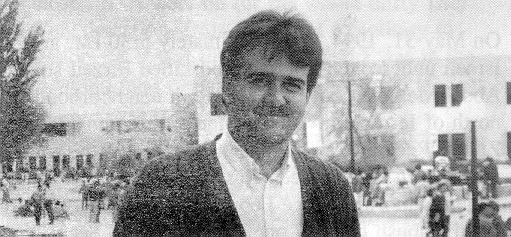
Theodory, originally from Jerusalem, studied at the Beirut Arab University. After completing his law degree, he undertook a two-year practicum in the office of Raja and Fuad Shehadeh in Ramallah before working with Jawad Boulous for an additional two years. In early 1994, Theodory established an independent practice also in Ramallah.
As lawyer to the project, Theodory is responsible for the provision of legal services and legal representation to Birzeit students and staff. This includes visiting detainees, especially those under interrogation, representing Birzeit members at all court sessions, and working with HRAP to intervene in cases of torture or other breaches of human rights.
Theodory also advises members of the Birzeit community subject to forms of harassment other than detention such as deportation, house demolition, and restrictions of freedom of movement. He follows each case from the time of detention (or inception) until the case is closed.
Theodory holds office hours at the university once a week. His popularity with the student community is evidenced by the number of students who drop by the Public Relations Office during his office hours to meet with him, as well as just to visit.
Help Birzeit University in the struggle for the protection of Palestinian human rights and add your voice to those who protest the human rights violations of the Israeli government.
Birzeit Human Rights Archive
Human Rights Action Project Home Page
Birzeit University Archives