 Brief Information
Established in 1976, the Adult Learning Department holds regular training courses for teachers and develops educational materials and techniques for the literacy program in the West Bank and Gaza. The Program also provides agricultural extension and family life development education, and conducts social and educational studies, mainly geared towards reducing illiteracy.
Established in 1982, the Center for Environmental and Occupational Health Sciences (CEOHS) began performing its important work due to the absence of any governmental regulatory body.
The Center's Agricultural project has forged meaningful ties with Palestinian farmers through its courses on the "Safe and Effective Use of Pesticides." The program was first implemented 7 years ago, after an extensive campaign of surveying and monitoring farmers throughout the West Bank and Gaza. It seeks to reduce pesticide levels as much as possible.The program has trained over 500 farmers to date, and has also provided them with protective clothing in order to reduce exposure to dangerous chemicals.
Within the CEOHS is the newly established Food Quality Control Unit (FQCU). The FQCU has been officially accredited by the Palestinian Standards Institute to test all kinds of food, bottled water, and other drinks, locally produced, and imported. It is now working with many Palestinian ministries and local food production factories.
The Water and Waste Unit of the department works with local and international health organizations in order to conduct long-term surveying of water sources in the West Bank. The CEOHS regularly monitors the biological and chemical content of water taken from any of 170 sampling stations in the West Bank, and its satellite laboratory in Gaza.
Many pharmaceutical drugs have been manufactured in the West Bank since 1967, but until the late 1980's, were not subject to any controls. The Pharmaceutical Unit was established in order to test these drugs, and ensure that they meet quality control standards. CEOHS has been accredited by the Palestinian Ministry of Health as the official pharmaceutical and chemical quality control laboratory for the Palestine National Authority.
The Continuing Education Department (CED) is an extension unit which was established in 1991, with the aim of serving the Palestinian community's needs for technical assistance and training. CED's primary objective is human resource development.
Through its many programs, the CED seeks to strengthen managerial, technical and service skills. Special emphasis is placed on providing training for women, and on the promotion of their involvement in the modernization and development of society.
The Department has recently conducted successful training programs for women working in community organizations throughout Palestine. It has also established a year-long diploma course which allows community counsellors to upgrade their practical skills.
The CED conducts many courses in the fields of computer technology, management, education, language training, and specialized skills needed for local industry.
Check out the CED homepage
The program was started in 1996 as a means of producing engineers--in both the public and private sectors, who will be fully equipped to solve Palestine's serious problems of water shortage and pollution. The program currently offers a Master's of Science in Water Engineering.
The Development Studies Program (DSP) at Birzeit university was established in 1997 as a specialized policy and research-oriented program for development issues which link the academic and policy-making communities. The DSP grew out of the University-affiliated Human Development Project which produced the first Human Development Profile on Palestine in 1997.
DSP coordinates with local institutions and international agencies on projects requiring research expertise in the development field such as conferences, workshops, and symposia.
The DSP endeavors to provide and interpret developmental concepts and frameworks which will aid in understanding the political, economic, social changes now taking place in Palestinian society and in promoting sustainable development planning. The Program also aims to raise public awareness of developmental issues in order to improve individual and institutional capabilities, to enable and empower the community to contribute effectively to the development process.
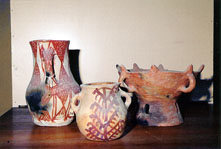
In November 1998, the University launched the Ethnographic and Archaeological Gallery. The Gallery was inaugurated with a display of 200 amulets from the collection of Tawfik Canaan (1882-1964), which were gathered by the Palestinian scholar and physician between 1905 and 1947. The Gallery is the product of the hard work and careful planning of the Birzeit University Founding Committee for the Development of Cultural Heritage. The Committee is comprised of members of several Birzeit University faculties.
The Founding Committee for the Development of Cultural Heritage stresses the educational importance of these projects, which, like the committee, are closely linked to the University's faculties. The Committee hopes that the Gallery will eventually blossom into a full-scale museum.
The Graduate Program in International Studies offers an interdisciplinary MA, which is earned through the study of its four cognate fields of international history, politics, economics, and law.
Those who have been, and those who are currently involved in this program are, for the most part, professionally active in areas of Palestine's evolving relationship with the international system.
The MA in international studies makes it possible for these students to pursue their careers with new perspectives, and a greater mastery of their working environment. Alternatively, they can pursue their studies in their chosen area of specialization towards a PHD at a university abroad.
The staff, alumni, and students of the program have together created Birzeit's International Students Association, which is devoted to the discussion of significant international issues and the formation of policy critiques and proposals. The program is currently transforming itself into an Institute of International Studies, in coordination with sister institutions in the Arab world, Europe, and North America.
The Birzeit University Human Rights Action Project was founded in 1977 by a group of faculty who were concerned with the growing number of human rights violations against Birzeit University students and staff by the Israeli military authorities. Working on a volunteer basis, these faculty members accompanied students who were summoned by the military authorities, attended military courts where students or staff were on trial, attempted to secure legal representation for those detained, and began to alert the international community about violations against the University.
In 1980, with the cooperation of various University departments, the project acquired a full-time staff member in charge of seeking legal assistance and documenting violations. Since its founding, the Human Rights Action Project (HRAP) has followed the case of every Birzeit student and staff member detained by the Israeli military authorities, and has also monitored cases of restriction orders, house raids, deportation and denial of freedom of movement and travel as they relate to university and academic activities.
HRAP also documents violations against the University itself, including army raids, closures, and other violations.
Check out the HRAP homepage
The Institute of Community and Public Health began in 1978, as an answer to the pressing need in Palestine for independent research, planning, and health education. The Institute's work aims at assisting communities and institutions in improving their health conditions and services, in-line with local needs.
It is also part of a broader social movement, which aims to assist in restructuring and rehabilitating the Palestinian health care system according to changing health care realities and people's needs. Within this framework, the Institute views health as a crucial component of national sustainable development.
The Institute regularly conducts scientific research and community projects, which include: a drive to find low cost ways of screening children and infants for diseases; research of anemia among women in a community near Ramallah; research of violence among high school-age teens; research into urban health, and workers' health problems.
Underlying all of the Institute's work is an intention to link academic / university life to the development of the Palestinian community. This motive has closely tied the Institute to many NGO's-both local and national. The Institute is divided into seven units: training, education, teaching, epidemiology, children, management and administration, and a Resource Center. These units work together through a number of means: policy and operational research; the offering of a post-graduate diploma in Primary Health Care; and a Masters degree in Public Health; community education; and training, both in the Institute, and in the field.
Check out the ICPH homepage
Birzeit University established the Institute of Law (IOL) in 1993 in order to contribute to the evolution of legal structures and the rule of law in Palestine. The establishment of a Palestinian administration, and Palestinian exercise of legislative activity in the framework of the present political process, have created a need for a venue in which academics and professionals may think systematically and creatively about the challenges facing legal institutions in Palestine, and contribute to building them.
Due to the constitutional and legal history of the West Bank and Gaza, legislation in Palestine urgently needs review and the individuals whose function is to study, control or implement them need to upgrade their skills. The IOL offers several courses as well as a Masters degree, and is also a partner, with the Women's Studies Center, and the Development Studies Department in the "Gender, Law, and Development" graduate program. It is also a formidible research unit, and has established a comprehensive Palestinian law library.
The research projects which the IOL has been responsible for include a collection of all legislation enacted in Palestine since the Ottoman period, and a database containing all current Palestinian legislation.
Check out the Institute of Law Homepage
The Birzeit University Media Center, established in 1996, offers an academic program leading to a Bachelor of Arts degree in Journalism, a Bachelor of Arts degree in Radio, and a minor in Media Studies The Media Center also offers diplomas for short and long-term courses lasting between 6 and 12 months in print and radio journalism. The BZU Media Center is the only such center in the region to have a student operated radio station that broadcasts to the local community. This station began broadcasting in June 1996.
The Center has the following five units: Academic Programs Unit, Media Resource Unit, Print Journalism Training Unit, Radio Training Unit, Music Recording & Sound Engineering Unit.
The Center also has an in-depth program for journalists already working in Palestinian newspapers in cooperation with The Swedish Institute for further journalism training (FOJO). The program is funded by SIDA, the Swedish International Development Agency. Short-term radio training programs were launched at the Birzeit University Media Center in 1996. The first was the Finnish Broadcasting Corporation funded radio training program. Today it offers training in radio techniques, radio drama & acoustics.
The second main radio program, funded by the German H. Boell Foundation, awarded diplomas to 16 young Palestinian radio journalists, all of whom are now working in the field.
In September 1998, the Media Center launched a new project, this time in downtown Ramallah. The Palestinian Media Resource Unit, which is a gathering place for professional journalists in the country, offers a long list of services for Palestinian journalists and international journalists working locally.
Check out the Media Centre Homepage
Established in 1987, the Palestinian Institute of Archeology (PIA) began as Birzeit's Department of Archeology (founded 1977). The PIA is the first Palestinian Institute to offer an integrated BA program in order to train students in the discipline of archaeology.
The Institute has conducted excavations and surveys at various sites throughout the West Bank. It conducts analysis of material remains and has a substantial reference collection and library.
Aside from being the only full fledged Women's Studies department in Palestine, the Women's Studies Center is one of two such programs in the entire Arab world. The Center maintains strong connections to the Palestinian community at large, and regularly facilitates discussion between students, community members and political figures.
The Women's Studies Program has developed an interdisciplinary core curriculum of eleven courses, encompassing such diverse areas as political theory, psychology, and the history of women's social movements. The WSC has also put together a library comprised of material dealing with women's issues, and it has a special educational fund for women.
The WSC regularly releases reports, and is at work on the completion of the ten-volume series, "Palestinian Women: a Status Report."
Brief Information Index
Birzeit Homepage