|

 Places to Visit
Cultural Centers
Palestinian
Cities To Visit
|
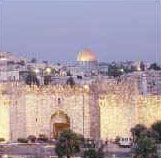 Jerusalem
Archaeological evidence indicates that
Jerusalem existed 4000 years ago. The city appears to have
been founded by a Canaanite-Amorite god, named Shalem. For
most of the last 2000 years it has been depicted at the centre
of most global maps and known by some as "The Navel of
the World." There is probably no other city in the world
that has been a more sacred symbol in world history. A sacred
city to followers of the three monotheistic faiths,
Jerusalem's unique beauty lies both in its diversity and
complexity. The impressive walls surrounding Old City host a
cosmos of religious and historical significance: the Dome of
the Rock (the site of the Prophet Mohammed's Ascension), the
Via Dolorosa, the Calvary, the Holy Sepulchre, and the Western
Wall. The Dome of the Rock has been immortalised in thousands
of works of art, found in many Arab homes. For Palestinians,
Jerusalem is the capital of their state in the making and has
remained the spiritual apex of their identity.
|
|
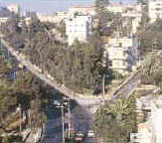 Ramallah
 is known as the "The
Bride of Palestine." Situated 900 metres above sea level,
its pleasant climate has made it an ideal resort for
Palestinians seeking relaxation during the hot summer months.
Before the Israeli occupation of the city (1967-1994),
visitors from Lebanon, Jordan and Saudi Arabia were among the
many frequenters of Ramallah's resorts, restaurants and
hotels. In the 1990's Ramallah became the base for many
international agencies operating in the country. Like many
towns and cities in Palestine, Ramallah has a mixed
Muslim-Christian population and is host to a large number of
Palestinian refugees who have been driven from their homes in
1948, the year of Al-Nakbah, marking the establishment to the
state of Israel . Its population is generally considered quite
cosmopolitan and consequently Ramallah is the capital of
nightlife in Palestine.
|
|
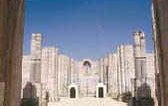 Nablus
At a site near the ancient Canaanite
settlement of Tell Balata, the Romans founded the city of
Flavia Neapolis (New City) in 72 AD, later named Nablus (636
AD). According to ancient folklore, the biblical Adam was
formed with the clay from Mount Gerizim, near Nablus. John the
Baptist baptized early Christians in the nearby springs. The
city's rich history includes rule by Romans, Greeks, Arabs,
Persians and Ottomans. Nablus is home to many well-known
Palestinian poets and writers. The merchants, its famous
dessert (Kinafa), and its Turkish baths.
|
|
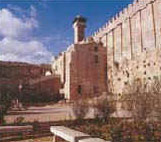 Hebron
Archaeologists have unearthed artefacts
that indicate human settlement in the Hebron region since
around 2000 BC. The Arabic word for Hebron is al-Khalil which
means "friend" in reference to the grand Patriarch
of Monotheism, Abraham (Ibrahim in Arabic). Thus, the city's
Ibrahimi Mosque, Abraham's burial place, is central to
Hebron's history and religious life. In addition to being the
burial place of the father of Monotheism it is also the burial
ground of the biblical Sara, Isaac, Rebecca, Jacob, Leah,
Adam, and Eve (who lived out their days here after their
expulsion from Paradise). The district enjoys lush
agricultural land and magnificent natural scenery. Although
the presence of illegal Israeli settlements both in and around
the city has created tensions between settlers and
Palestinians, Hebron is a very hospitable place for visitors.
|
|
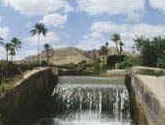 Jericho
 is an
oasis in the desert. The oldest continuously inhabited human
settlement on earth (10,000 years) and the lowest (some 200
metres below sea level), Jericho is rich in date palms,
tropical fruits and vegetables, medicinal plants and spices.
In Roman times Mark Anthony gave the town as a gift to
Cleopatra. During the Crusader era, the sugar industry thrived
here. The Arabic term for Jericho is Riha (scent), because of
its wide variety of fragrant flowers. The majestic Hisham's
Palace was built during the Islamic Era. However, nature is
the most impressive monument in Jericho, including the Mount
of Temptation, which is the site of Jesus' forty-day fast and
his refusal of vanity. Under Palestinian rule, the town has
once again taken on the role of a vacation resort.
|
|
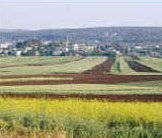 Jenin
Jenin is the name
of both a city and a district It is home to Burqin and
Zababdeh, two towns that date back to Byzantine times. Burqin
is where Jesus Christ is thought to have healed lepers and
Zababdeh was one of the many locations where Mary and Joseph
rested on their way to Bethlehem. Today, Jenin is a
picturesque town surrounded with gardens of carob, fig, and
palm trees. The district has some of the richest agricultural
land in Palestine.
|
|
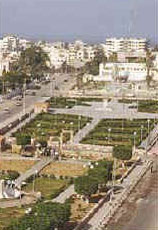 Gaza
Strip
Once inhabited by the Canaanites, Egypt
ruled the coastline for centuries before it became the chief
port of the seafaring Philistines (Filistines). Throughout
much of modern history, it has been an important commercial
centre, and is now on its way to retrieving its former
position as the crossroad for Africa, Asia and Europe. The new
airport and seaport (the latter still under construction) are
part of the district's development under Palestinian rule.
Gaza's beaches are among the most beautiful on the whole
coastline. Both public and private investment in upgrading
tourist facilities along the coastlines' hotels and
restaurants has been substantial. The upgrading of the area's
agricultural capacity, which includes the export of such
winter crops as oranges and strawberries, has also given a
boost to the Gazan economy. Among the many tourist attractions
and sites of historic significance in Gaza are the Great
Mosque of Omar (built over the Philistine Temple which was
destroyed by Samson), the Fourth Century Byzantine Church of
Saint Porphirius and the Thirteenth Century Islamic Fortress
at Khan Younes. In Deir al Balah there exists a famous
cemetery dating back to the Bronze Age, and a Hellenic
monastery built in 372 AD. The Gaza Strip is also known for
its friendly people and its delicious seafood.
|
|