|
|

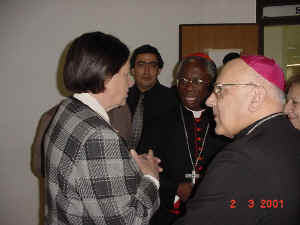
Cardinal Arinze Visits Bethlehem University
March 2, 2001
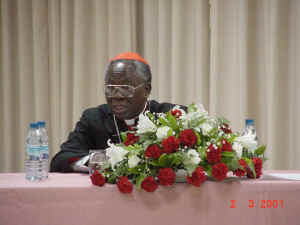
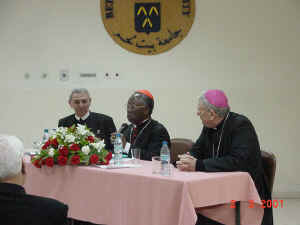
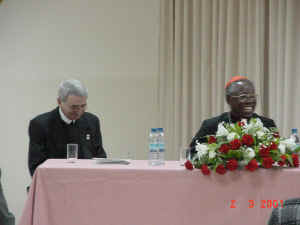
Cardinal Francis Arinze, President of the
Pontifical Council for Inter-religious Dialogue, visited Bethlehem
University on Friday, March 2, and gave a presentation on "The
Role of the University in the Islamic-Christian Dialogue."
The Cardinal is active in promoting inter-religious
studies and dialogue, in order to further mutual understanding and
respect. Originally from Nigeria, Cardinal Arinze came to know both
the Moslem way and the Catholic way because he worked and lived
alongside his Moslem compatriots.
His message is unique because he draws from his
boyhood experience growing up in a predominantly Moslem community. He
speaks about coexistence, and asserts that all believers are the
children of God. He is also the recipient of the prestigious Gold
Medal from the International Council of Christians and Jews.
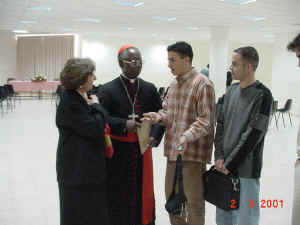
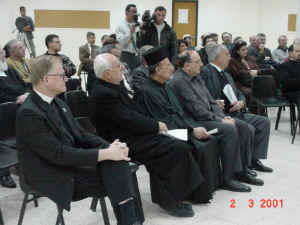
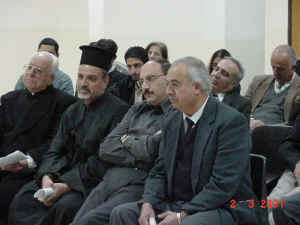
The presentation was delivered to an audience of
approximately 100 people consisting of guests from the local
community, the Bethlehem University faculty and staff, the De La Salle
Brothers, and a number of school principals. Most notably, H.B.
Patriarch Michel Sabbah also attended.
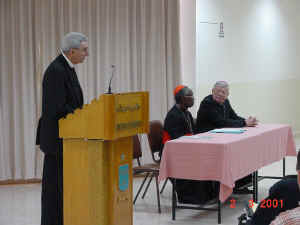 Brother
Vincent Malham, FSC, President-Vice Chancellor of the University
welcomed warmly Cardinal Arinze and stated that this is indeed a great
day. He added that since its founding in 1973, Bethlehem University
distinguished itself on fraternal relations between Christians and
Moslems. He also stated that the University is honored by this visit
and he thanked Cardinal Arinze sincerely for it. Brother
Vincent Malham, FSC, President-Vice Chancellor of the University
welcomed warmly Cardinal Arinze and stated that this is indeed a great
day. He added that since its founding in 1973, Bethlehem University
distinguished itself on fraternal relations between Christians and
Moslems. He also stated that the University is honored by this visit
and he thanked Cardinal Arinze sincerely for it.
The University' s Chancellor, H.E. the Apostolic
Delagate welcomed Cardinal Arinze, and thanked him for his
encouragement, collaboration and support.
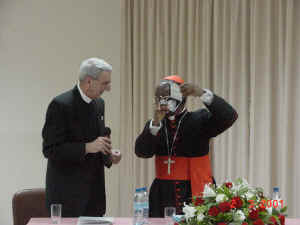 This
visit, and the presentation, highlights the role of Bethlehem
University in promoting religious tolerance and respect. The
University is under the administrative supervision of the De La Salle
Brothers, and the only Catholic institution of higher education in
Palestine, yet no less than 60% of its students are Moslems. Cardinal
Arinze's message on religious tolerance came to an audience who
appreciated very much his talk and his ideas. A lively debate ensued,
and Cardinal Arinze responded in a way creating a pleasant and lively
atmosphere and rapport with all participants. This
visit, and the presentation, highlights the role of Bethlehem
University in promoting religious tolerance and respect. The
University is under the administrative supervision of the De La Salle
Brothers, and the only Catholic institution of higher education in
Palestine, yet no less than 60% of its students are Moslems. Cardinal
Arinze's message on religious tolerance came to an audience who
appreciated very much his talk and his ideas. A lively debate ensued,
and Cardinal Arinze responded in a way creating a pleasant and lively
atmosphere and rapport with all participants.
Following is the presentation made by Cardinal
Arinze:

The Role of the University in the Promotion of
Interreligious Dialogue
Francis Cardinal Arinze
President, Pontifical Council for Interreligious Dialogue
March 5, 2001
Bethlehem University
-
A Theme of Great Relevance
As we enter the third millennium, we cannot but note that growing
religious plurality is one of the remarkable dimensions of life in
our times. Christians, who constitute one-third of the world
population, live and work side by side with Jews, Muslims, Hindus,
Buddhists and people of other religious convictions in Damascus,
Bangkok and Seoul; in Melbourne, Wellington and Port Moresby; in
Cairo, Accra and Pretoria; in Rome, Berlin and Lisbon; in New
York, Toronto and Brasilia. Here in the Holy Land we have the
extraordinary and centuries-old presence of Jews, Christians and
Muslims, with places sacred to their religious traditions.
People of various religions interact. They meet one another. They
see the necessity to build a more harmonious society, to dialogue
and to share religious, social and cultural values. Interreligious
collaboration is not an option. It is a necessity.
 A
university, as a community of scholars and students, cannot be
outside the discourse. I am, therefore, happy to be invited by
this renowned seat of learning to propose to you some thoughts on
"The Role of the University in the Promotion of
Interreligious Dialogue." A
university, as a community of scholars and students, cannot be
outside the discourse. I am, therefore, happy to be invited by
this renowned seat of learning to propose to you some thoughts on
"The Role of the University in the Promotion of
Interreligious Dialogue."
We shall first examine the importance of objective information on
the religions and of the role of the university in disposing
students to live with religious plurality. The right to religious
freedom had to be defended, while religious fanaticism and
indifferentism are to be shown to be untenable. Some universities
are linked to particular religions and therefore some special
orientation is expected of them. A word has to be said about what
the university can do to safeguard both the need to meet other
believers and the right to share one's belief. We shall close with
a consideration of the university contribution to religious
collaboration for the promotion of peace.
-
University True to Its Name
To fulfill well its role in the promotion of interreligious
dialogue, the university should first of all be true to its
identity.
A university is an academic public forum, a community of students
and teachers in search of truth, a crossroads where many currents
of thought meet. A good university should shine forth as an
academic community dedicated to the protection and advancement of
human dignity and of a people's cultural heritage through
research, teaching and various services offered to the local,
national and international communities.
A university, therefore, should be a center where objective
research and information are pursued, where free speech is
respected and where academic courage and honesty do not allow
people to sweep facts and figures under the carpet.
Society has also expectations of the university in the way of
responding to some of the needs of that society. A university
should not forget to be at the service of its surrounding
community. The promotion of interreligious dialogue is one of the
needs of society where the university is expected to make a
significant contribution.
-
Objective Information on Religions
 One
of the services which a university should offer is objective
information on the various religions, especially the religions
prevalent in the region where the university is situated. In
religious matters, many people are not correctly informed. They
may have inherited prejudices in their religious community against
people of other religions. They may be misled by religious
propaganda sometimes transmitted by some mass media. Or they may
be simply unaware of what others believe. And quite a number of
people are not even clean on the beliefs, rites and codes of
conduct of their own religion! One
of the services which a university should offer is objective
information on the various religions, especially the religions
prevalent in the region where the university is situated. In
religious matters, many people are not correctly informed. They
may have inherited prejudices in their religious community against
people of other religions. They may be misled by religious
propaganda sometimes transmitted by some mass media. Or they may
be simply unaware of what others believe. And quite a number of
people are not even clean on the beliefs, rites and codes of
conduct of their own religion!
And yet, religion is a very important dimension of life. In the
various religions, people are seeking answers to those major
questions which concern and accompany human earthy existence.
Examples are the purpose of human life, the nature of moral good
and evil, the road to happiness, the explanation of suffering, the
fact of death and what people can know about what follows it.
Above all, people ask questions about God, the Creator, the
Ultimate Reality (cf. Nostra Aetate, 1; Catechism of the Cath.
Church, 28).
The University should not ignore this deep desire of the human
heart. Without trying to turn every student into a professional
theologian, the university should have serious courses on the
major religions, especially those to be found in the area where it
is situated. Occasional colloquia in which experts from differing
religions take part and the students are exposed to healthy
interaction between them will also be helpful. Objectivity and
fairness in stating beliefs and histories of religions should be
insisted upon, as befits a university worthy of the name.
Some universities will find it possible to have a definite faculty
of theology on one religion with which the university is
particularly associated.
-
Form Students to Accept Religious Plurality
 Religious
plurality, as earlier stated, is a fact in the world of today. The
only question that remains is what attitude people will adopt in
front of this reality. Religious
plurality, as earlier stated, is a fact in the world of today. The
only question that remains is what attitude people will adopt in
front of this reality.
A particular person may be unhappy with this situation. The person
may wish that everyone, at least in that country or region, had
only one religion. Since this is in fact not the case, the
reasonable thing is that that person should seek an acceptable
formula for living with this fact.
Force or pressure is not an acceptable means for promoting
religious unity, whether that force be political, economic, moral,
physical or otherwise. In any case, a religious position arrived
at as a result of force, is not a worthy offering to be made to
God. Religion should well up from the human heart as a free
response to God's love.
Universities train people who are likely to occupy positions of
leadership in society. It is a blessing for a society if its
universities not only inform but also form citizens who appreciate
that one has to live in peace, harmony and collaboration with
other people, including those of different religious persuasions.
It universities do not help in finding answers to religious
bigotry and group myopia, would we not be justified in thinking
that such universities have failed in one of their
responsibilities?
Moreover, it can be added that religious diversity is not the only
kind of plurality to be found in society. There are also
diversities that are ethnic, cultural, linguistic, political and
ideological. Respect for religious diversity can be indicative of
respect for other differences.
-
The Right to Religious Freedom
 After
the right to life, the next dearest of all human rights is the
right to religious freedom. "This freedom means that men are
to be immune from coercion on the part of individuals or of social
groups and of any human power, in such ways that in matters
religious, no one is to be forced to act in a manner contrary to
his own beliefs. Nor is anyone to be retrained from acting in
accordance with his own beliefs, whether privately or publicly,
whether alone or in association with others, within due
limits" (Vatican II, Dignitatis Humanae, 2). After
the right to life, the next dearest of all human rights is the
right to religious freedom. "This freedom means that men are
to be immune from coercion on the part of individuals or of social
groups and of any human power, in such ways that in matters
religious, no one is to be forced to act in a manner contrary to
his own beliefs. Nor is anyone to be retrained from acting in
accordance with his own beliefs, whether privately or publicly,
whether alone or in association with others, within due
limits" (Vatican II, Dignitatis Humanae, 2).
Only if people are free will they be able to bear full personal
responsibility before God for all their actions. This principles
leaves intact the duty of everyone to look for religious truth
and, having found it, to embrace it.
The right to religious freedom is based on human dignity. It comes
from God the creator. It is not a concession from Governments,
societies or other associations. It therefore follows the human
person everywhere. It is valid in all countries aand should be
freely exercised everywhere. The United Nations Organization
recognized this in paragraph 18 of its 1948 Universal Declaration
of Human Rights. "It is never lawful for anyone to force
others to embrace the Catholic faith against their
conscience" (Canon 748, par. 2), says Catholic Canon Law.
"No compulsion is there in religion" (S 2.256), says the
Qur'an.
A university is an ideal institution which should share these
values and help to propagate them. It is obvious that respect for
this right is an obligatory road to meaningful interreligious
harmony and collaboration.
Let it be added that to uphold the human right to religious
freedom is not the same as encouraging a supermarket of religions.
Every individual is bound to look for God's will in matters
religious, and to follow it when it has been found. There is a
worrying growth of sects, new religious movements and
pseudo-religious groups which tend sometimes to trivialize the
fundamental right of every human being to be left that freedom of
conscience and action necessary for fully responsible human
religious choices.
-
Religious Fanaticism
Some people go to extremes in matters religious. They assume a
rigid or extremist position which they assert as the only
legitimate form their religion should take. Sometimes they say
that that is the original shape of their religion and that all
their coreligionists are bound to return to that form.
 Some
religious extremists go further and demand that their religion
should be the only one to be allowed in their country or region.
And they do not hesitate to invoke the force of the law or to
resort to physical violence in the pursuit of their vision. Some
religious extremists go further and demand that their religion
should be the only one to be allowed in their country or region.
And they do not hesitate to invoke the force of the law or to
resort to physical violence in the pursuit of their vision.
A university can help to meet such tragic situations, or, better
still, to prevent them altogether from ever taking place. By its
inbuilt ability to promote multiple discourse, mutual listening
and courage to look facts in the face, a university has a crucial
contribution to make. It should help to cure those who seem to
write over their threshold: "Don't confuse me with
facts."
Religious extremists have to be helped to realize that no matter
how sincere they might be, sincerity is not the ultimate criterion
for truth. Every teacher of arithmetic knows this. The correct
answer to a mathematical problem is one, the objective one. All
the students who arrived at wrong answers may indeed be sincere,
but that does not thereby prove them right. No one has the right
to violate the rights of other people or to do violence to them,
all in the name of a religious stand. A university is an ideal
institution to help eradicate religious fanaticism and all the
harm it brings.
-
Religious Indifferentism
Another error from which a university should help people guard
themselves is religious indifferentism. It is a subtle error and
one that can look attractive to some academicians.
 The
religious indifferentist refrains from commitment to any religion,
or regards religion as an optional matter if not even a cause of
tensions and divisions. The answer is that we human beings are
creatures. We owe to God adoration, praise, thanksgiving,
expressions of repentance for sins, and requests for what we need.
This is what genuine religion is all about. It is not optional. It
is obligatory. It is a debt which we owe to God, our Creator.
Moreover, true religion teaches love of God and love of neighbor
and helps to resolve conflicts rather than cause them. It is,
however, true that people who have other agendas - political,
ethnic, economic or simply greedy selfishness - can exploit and
abuse religion to start or exacerbate conflicts. Religious leaders
should help their coreligionists to analyze situations of
conflict. The
religious indifferentist refrains from commitment to any religion,
or regards religion as an optional matter if not even a cause of
tensions and divisions. The answer is that we human beings are
creatures. We owe to God adoration, praise, thanksgiving,
expressions of repentance for sins, and requests for what we need.
This is what genuine religion is all about. It is not optional. It
is obligatory. It is a debt which we owe to God, our Creator.
Moreover, true religion teaches love of God and love of neighbor
and helps to resolve conflicts rather than cause them. It is,
however, true that people who have other agendas - political,
ethnic, economic or simply greedy selfishness - can exploit and
abuse religion to start or exacerbate conflicts. Religious leaders
should help their coreligionists to analyze situations of
conflict.
Let it be asserted, therefore, than an attitude of religious
indifference is no proof of a sophisticated or liberal culture.
Life without religion is like a journey without a purpose, like
soccer without goal posts. A person without religion is basically
disoriented in life, has not come to terms with the reason for
human earthly existence, has not the most secure matrix, locale
and anchor for moral laws and values, is lacking a firm reference
point for duties towards the neighbor, and is in difficulty to
offer a viable and humanly enriching attitude to disappointment,
sickness and death. Religious indifferentism is therefore not to
be recommended.
A university should be able, by sound philosophy and reasoning not
necessarily peculiar to any one religion, to share these deep
convictions with its students. It is a question of appreciating
that we human beings are God's creatures and therefore owe him the
debt of religion. Without this conviction, not only is
interreligious dialogue not thinkable, but a clear religious
allegiance has not even begun.
-
Additional Role of a University Linked with a
Religion
Many universities are not linked with any particular treligion in
their history or foundation. Some religious communities, however,
have founded universities. Such universities should be true both
to the identity of a university as everywhere understood, and to
the religious vision of the community in question.
 A
Catholic university, for example, as a university, should be
efficient, respectable and attractive in its cultural milieu. As
Catholic, it should create a climate that is inspired by the
Catholic faith. With reference to interreligious dialogue, it
should share and spread the attitude of the Church towards people
of other religions, guide Christians to appreciate whatever is
good, noble or true in other religions as coming from the Holy
Spirit, and encourage Christians to meet other believers and
collaborate with them to promote harmony, justice and peace and
defend family and cultural values (cf. Nostra Aetate, 2). A
Catholic university, for example, as a university, should be
efficient, respectable and attractive in its cultural milieu. As
Catholic, it should create a climate that is inspired by the
Catholic faith. With reference to interreligious dialogue, it
should share and spread the attitude of the Church towards people
of other religions, guide Christians to appreciate whatever is
good, noble or true in other religions as coming from the Holy
Spirit, and encourage Christians to meet other believers and
collaborate with them to promote harmony, justice and peace and
defend family and cultural values (cf. Nostra Aetate, 2).
A Catholic university should also introduce Christian students
into a clear theological synthesis of their faith and strive to
develop a theology inspired by faith in Jesus Christ to underpin
the effort to meet other believers and dialogue with them.
If a university is linked with Islam or with another religion, its
faculty of theology or religious studies will be expected to offer
a similar service.
A university linked with a particular religion, should respect the
religious freedom of those lecturers and students who belong to
other religions. This will include leaving them free to practice
their own religions and to be better informed on them.
-
Dialogue and the Spread of One's Religion
This paper has pleaded for the role of the University in the
promotion of interreligious dialogue. But it is also true that a
person sincerely convinced of a faith shoul dwant to share that
religious conviction with other people. How does the university
reconcile the desire to collaborate with other believers with the
wish, or even the duty, to spread one's religion.
The methods adopted in spreading one's religion must however be
worthy and acceptable. The dignity and freedom of the person to
whom it is proposed should be respected. It would be wrong, for
example, to entice a poor student to my religion with a study
bursary, or to promise employment or promotion to someone if that
person would join my religion. That would be proselytism. It is to
be condemned. But if the freedom of the other is fully respected,
then everyone should have the right to propose a certain religion
to all who freely listen. St. Paul felt the duty to spread the
Gospel of Jesus Christ. He said to the Corinthians: "Not that
I do boast of preaching the Gospel, since it is a duty which has
been laid on me; I should be punished if I did not preach it"
(I Cor. 9:16).
The Catholic Church regards both dialogue and proclamation as
elements in the entire apostolate of the Church. They are
interchangeable. Each has its own characteristics (cf. John Paul
II: Redemptoris Missio, 55). They should be complementary because
the better one can dialogue with people of other religions, the
less difficulty it will be to present one's religion to them.
A University should help to clarify these concepts, to encourage
people to share ideas of them, and to dispose them to a peaceful
and friendly approach to both dialogue and the spread of one's
religion.
-
Interreligious Collaboration for Peace
It is true that the major thrust of religion is on the vertical
dimension: on attention to God manifested in adoration, praise,
thanksgiving and petition. But religion does not forget the
horizontal dimension, the attention to one's neighbor, to one's
duties in society and in the world. One of the major areas in
which religions around the world know that they should contribute
is in the promotion of justice and peace. Here the university can
help.
The university should put before its students the great values of
peace and the heavy demands it makes on people to build it up and
to maintain it. At the same time the horror and devastation
brought by war should be another impulse towards peace.
"Nothing is lost by peace. Everything can be lost by
war," said Pope Pius XII in his August 24, 1939 Radio-message
just before the outbreak of the First World War (in Discorssi e
Radio message di SS.Pio XII, vol. 1, p. 306).
The university can stress the role of religions, singly and
together, to promote peace. Religions can inform their followers,
inculcate the virtues of justice, love, self-restraint and respect
for the rights of others, and help people overcome greed, pride,
hatred and the desire for vendetta. Genuine religion can appeal to
the human heart for conversion as just outlined. Then the weapons
of destruction will fall from the hands of the belligerents.
The key place of justice, as the obligatory road to peace, has to
be stressed by the university. Unless we respect the rights of
other people and allow them to have what is due to them, there
cannot be peace. The university has to keep on reminfding humanity
of the indispensable need for justice as one of the pillars of the
building called peace.
A university, as one of the best cultural heritages of humanity,
is in a position to share such convictions among people across
religious frontiers.
Respected President, Deans, Professors, other Staff and Students
of the University of Bethlehem, I greet you. I thank you for the
excellent work you have been doing under difficuly circumstances.
Yours is the privilege to dedicate time and talent to the pursuit
of high values. Among your manifold contribution to the good of
society, is also the promotion of harmonious relations between
people of differing religious convictions. May God give you, and
all university people worldwide, the grace and strength to answer
this call with uncommon competence, admirable perseverance and
constant joy.
|