
Noble Sancutary Online Guide
Glimpses of History
Muslim Jerusalem
The Dome of the Rock
The Al-Aqsa Mosque
Other Structures in the Noble Sanctuary
Information on the
Noble Sanctuary CD-ROM
Go To Home Page
Glimpses of History
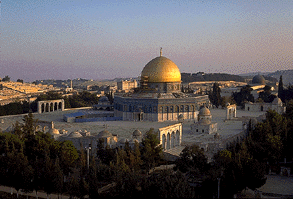
The beauty and tranquillity of the Noble
Sanctuary in Jerusalem attracts thousands of visitors of all
faiths every year. Many believe it was the site of the Temple
of Solomon, peace be upon him, destroyed by Nebuchadnezzar in
586 BC, or the site of the Second Temple, completely destroyed
by the Romans in 70AD.
For Muslims the area has a special significance, as the site
of the Prophet Muhammad's Night Journey, peace and blessings
be upon him, and as the first qibla (direction of prayer) for
Islam.
The Night Journey
In the ninth year of the Prophet's mission, about 620 AD, Muhammad
rose in the middle of the night to visit the Sacred Mosque in
Makkah. After a time of worship he fell asleep near the Ka'aba.
The angel Gabriel came to him and woke him from his slumber.
He led the Prophet, peace and blessings be upon him, to the edge
of the sacred Makkan mosque. Awaiting them was al-Buraq, a white
winged beast "whose each stride stretched as far as the
eye could see." Muhammad mounted al-Buraq and sped northwards
with Gabriel to Al-Aqsa Mosque in Jerusalem, the Furthest Mosque.
When they reached Jerusalem the Prophet dismounted and prayed
near the Rock. Abraham, Moses, Jesus and other prophets, peace
be upon them all, gathered together to pray behind him. Muhammad
was presented a vessel of wine and a vessel of milk. The Prophet
chose the milk and Gabriel said, 'You have chosen the true religion'.
The Prophet then embarked on the ascension (Miraj)
in which he, peace and blessings be upon him, received the command
to pray five times a day and the revelation encapsulating the
beliefs of Islam:
"The Messenger believes in what was sent down to him from
his Lord. And the believers; each one believes in Allah and His
angels and in His books and His messengers. We make no division
between any one of His messengers. And they say: We hear and
we obey. Oh Lord, grant us Thy forgiveness; unto Thee we return."
Qur'an II/285