| Palestinian National
Authority Official Website Settlement |
Israeli Settlements in 1996
Introduction
The United Nations adopted a number of resolutions related to the measure
undertaken by Israel in the Occupied Palestinian Territories to change the geographic and
demographic realities. Many international resolutions were issued demanding Israel to stop
its measures and illegal actions. Resolution Number 2851 adopted by the 26th General
Assembly session on 20 December 1997 states that, "Recalling Security Council
resolutions 237 of 14 June 1967 and 259 of 27 September 1968 as well as other resolutions
of the United Nations..... strongly calls upon Israel to rescind forthwith all measures
and to desist from all policies and practices such as: (a) The annexation of any part of
the occupied Arab territories; (b) The establishment of Israeli settlements on these
territories and the transfer of part of its civilian population into the occupied
territory." As for the city of Jerusalem, the UN General Assembly and Security
Council adopted several resolutions demanding Israel to withdraw its decision of unifying
the city under the sovereignty of Israel. Among these resolutions are resolutions 2253 of
1967 and 2254 of 14 July 1967 which call for canceling all the measures taken in East
Jerusalem and stopping any kind of action which might lead to changing the status of the
city.
Increase in the Number of the Israeli Settlements and Settlers
By mid 1992 the number of Israeli settlers in the West Bank and Gaza Strip
reached 107,000. Most of them live near the green line and Jerusalem city and some live in
farther areas. The increase in the number of the settlers occurred in the urban
settlements located near the large cities since most of the settlers work inside the green
line and commute everyday. About 70% of the settlers work in the West Bank and 46% of them
work in public services; about 34% of them work in the agricultural and industrial
sectors. The ideologies in the settlements differ from one to another; some have mixed
ideologies, secular and religious, some are completely secular and some are religious.
About 57% of the residents live in mixed settlements, 12% live in secular settlements and
31% live in closed religious settlements. The building of settlements in and around
Jerusalem and near the green line did not stop when the Labor Party formed the Israeli
government. By the end of 1996, the number of the settlers increased to 150,000. When the
Likud party formed the government, it started a new policy which aims at destroying the
peace process by starting to build in the areas where settlement construction was frozen.
The establishment of 84 type "A" settlements was announced; 35 new decisions
were taken to expand the settlements. Bulldozers started the largest operation of land
leveling and construction started; at the same time the government took a decision to
revise the peace agreements which are already signed. This gave the settlers a green line
to start expanding the settlements and building all over the West Bank. The government
started using its previuos statements which say that Jerusalem is the eternal capital of
Israel; old projects were renewed. The government decision to establish the new Har Homa
settlement is a breach violation of all the international laws and norms as well as a hard
blow to the bases and guarantees on which the peace process was built. Har Homa is
considered one of the largest settlement projects. In the first stage it will be able to
hold 30,000 settlers and the number will reach 100,000 settlers in the final stage. Jabal
Abu Ghneim (Har Homa) is located to the south of Jerusalem and overlooks the Palestinian
cities of Bethlehem and Beit Sahour. The area of the confiscated land reached 1,850 dunums
and the area of the master plan is 2,056 dunums. The project aims at:
Sealing the southern entrance of Jerusalem and blocking the continuation of the city with its Palestinian surrounding and thus preventing any future connection of the city with the rest of the Palestinian land.
Isolating the Palestinian areas located within the boundaries of Jerusalem municipality which should be subject to the negotiations of the final stage. With the establishment of Har Homa settlement, the settlement belt around the city will be completed and so the city will be out of the domain of negotiations.
Causing unbalance in the demography of the city in favor of the Israelis.
Establishing a number of tourist hotels and small industrial zones to
compete with Bethlehem which will badly affect the Palestinian tourism sector.
A number of decisions, which reached 35, were announced to expand the West
Bank settlements; 84 national priority settlements types "A" and "B"
will be established. The total costs of the national priority settlements types 'A"
and "B" will reach 150 million dollars.
Settlement During 1996
No doubt that there was a new turn in 1996, especially during the rule of
the Labor government, in relation to land confiscation and seizing. As a result, new
concepts and a new geographic and demographic reality appeared in preparation for the
final stage of peace negotiations. To achieve this, the Israeli practices have taken
several forms including:
1. By-pass roads
2. Land confiscation
3. Military closure
4. Master plans
5. Separation line
6. Quarries
7. Settlement expansion
First: By-pass Roads
The area of the land confiscated or seized under military orders to be used for public projects in 1996 reached 1,127 dunums and 198 square meters. The following table shows the location and areas of land confiscated and the number of the military orders under which they were confiscated.
No. |
Location |
Area in Dunums |
Number of Military Order |
Purpose |
1. |
Hebron |
7 |
T/40/96 |
construct Road No. 35 |
2. |
Hebron |
not known |
T/36/96 |
construct Road No. 35 |
3. |
Samou' |
275 |
B/41/96 |
construct a by-pass road to the south of the village |
4. |
Ras Karkar, Janieh, Mazra'a Qibliyeh |
7.538 |
T/37/96 |
construct a road |
5. |
Halhoul |
90 |
T/24/96 |
construct Road No. 35 |
6. |
Beit Kahel, Halhoul, Hebron |
150 |
5/1/96 under Land Law (seizing land for public purposes) No. 321 for 1996 |
construct Road No. 35 |
7. |
Kufr Qaddoum |
44.25 |
T/17/96 |
construct a security road surrounding Qadomim settlement |
8. |
Bitounia, Ein Arik |
150 |
T/21/96 |
construct a by-pass road |
9. |
Bethlehem, Beit Sahour |
106 |
T/27/96 |
construct a by-pass road |
10. |
Samou', Dhahriyeh |
300 |
5/4/96 under Land Law (seizing land for public purposes) No. 331 for 1969 |
construct a by-pass road |
11. |
Janieh, Mazra'a Qibliyeh |
38 |
T/35/96 |
construct a by-pass road |
12. |
Jeeb |
4 |
T/43/96 |
construct a by-pass road |
13. |
Bireh |
8 |
T/44/96 |
construct a by-pass road |
Second: Land Confiscation
The total area of land confiscated in 1996 under military orders or seized
for a period of 1-5 years to be used for different purposes reached 113.3 dunums.
The following table shows the areas of land confiscated or seized, their location and the number of military orders under which they were confiscated or sealed.
No. |
Location |
Area in Dunums |
Number of Military Order |
Purpose |
1. |
Deir Istia, Qira |
33.6 |
T/11/96 |
|
2. |
Maslama, Siniria |
37 |
T/18/96 |
|
3. |
Ezariyeh and Abu Deis |
17 |
T/18/96 |
Military |
4. |
Masha |
12.5 |
T/34/96 |
establish a security fence around a settlement |
5. |
Ramin, Beit Lid |
1.98 |
T/34/96 |
establish a military camp |
6. |
Nahalin, Beit Ummar |
11.25 |
T/32/96 |
military purposes |
7. |
Deir Dibwan |
7.8 |
T/22/96 |
establish a security belt |
Third: Military Closure
Large areas of West Bank land were sealed under military order number
S/1/96 issued by Ilan Biran, the Israeli military commander. The order does not specify
the exact area of the land, but according to the maps attached to the military order, it
is more than 170,000 dunums.
Fourth: Master Plans
The following table shows the master plans for Israeli settlements
announced in 1996.
Date |
No. of Master Plan |
Area in Dunums |
Name of Settlement |
Purpose |
28/1/1996 |
1/3/220 (project No. 220/3) |
not known |
Giv'at Ze'ev |
not known |
9/2/1996 |
604/1 |
20.9 |
Almog |
not known |
26/2/1996 |
168 |
1,389.94 |
Kadim |
build 1,700 housing units |
26/2/1996 |
138 |
1,417.83 |
Janim |
build 1,700 housing units |
28/7/1992 (work started on 29/11/1996) |
214/3 |
630 (confiscated in 1982) |
Haradar |
build 750 housing units |
Fifth: Separation Line
The following table gives the number of military orders, the location of
land confiscated to establish the separation line and its area.
Number of Military Order |
Location |
Area of Confiscated Land in Dunums |
T/6/96 |
Irtah village |
40 |
T/10/96 |
Ni'lin village |
541 |
T/1/96 |
Tulkarm area |
600 |
Sixth: Quarries
In 1994, a number of master plans for establishing 6 quarries were
announced; their total area is 16 square kilometers. The application of these master plans
was announced in 1996. The most important of these quarries are:
A. Wadi Teen Quarry, Tulkarm. The total area of this quarry is 9,685 dunums distributed as follows:
Purpose |
Area in Dunums |
Percent |
Crushing area |
2,415 |
35% |
Influenced area |
5,480 |
57% |
Green area |
710 |
7.2% |
Roads |
80 |
0.8% |
Total |
9,685 |
100% |
B. Wadi Izmil Quarry, Dora and Dhahriyeh land (south of Hebron). The total area of this
quarry is 2,486 dunums.
Seventh: Settlement Expansion
A. Settlement Expansion around Jerusalem Municipality Boundaries
1. Giv'at Ze'ev Settlement
The expansion of Giv'at Ze'ev settlement was announced in a plan which
aims at building 8,000 new housing units. With this expansion, the total number of housing
units in the settlement will reach 4,600 and can absorb 20,000 settlers.
2. Har Adar Settlement
There is a project to build 750-800 housing units in Haradar settlement
established on Biddo and Qattaneh land to the west north of Jerusalem.
B. Moda'in (Latron) Area
A new settlement under the name Giv'at Yahuda will be established on an
area of 541 dunums; 1,286 housing units will be built there. As a result, Moda'in
settlement will be expanded by 3,000 in Kiryat Sefer, Ramat Moda'in, Mitityahu and Giv'at
Yahuda in addition to 5,000 existing units. The settlement is one of the "Seven
Stars" settlements, a project of Ariel Sharon's, the Israeli ex-minister of housing.
C. Settlement Projects within the Municipality Boundaries
1. 6,500 housing units will be built on an area of 2,056 dunums of Jabal Abu Ghneim land (Har Homa).
2. 3,600 housing units will be built on an area of 980 dunums of Beit Safafa land (Giv'at Hamatos).
3. 2,165 housing units were completed in a new quarter, Ramat Shlomo, of
Reches Shu'fat settlement on an area of 1,198; 1,680 of the units are inhabited.
D. Israeli Expansion outside Jerusalem Municipality Boundaries and within
'Larger Jerusalem' Project
1. Murdachai Aviv company is building 68 housing units within the large project 'Build Your Own House' in Giv'at Ze'ev settlement. The project is called Hod Hagev'a.
2. There is a project to build 130 housing units in Bitar Ilit on the land of Housan and Nahalin villages within the project of Ma'ale Bitar.
3. Within the large project of 'Build Your Own House' 42 villas will be
built in Neve Manahim quarter; the project is called Sibioni Giv'at Ze'ev.
E. Settlement Expansion in the West Bank
The following settlements located in the West Bank are being expanded by
adding new housing units:
1. Ma'ale Adomim
a. 2,000 units in Tseimeh Hasadia quarter.
b. 3,500 units in a new quarter under planning.
c. 1,000 units in Magadim quarter, completed.
With the building of 5,500 new housing units, in addition to the 4,500
existing ones, the total number of housing units in Ma'ale Adomim will reach 10,000
units.*
2. Gosh Etsion
a. 1,900 housing units will be built in Bitar, they are part of a project to build 8,000 units.
b. 250 units in Ali'azar.
c. 100 units in Alon Shivot.
3. Nablus Area
a. 70 units in Alon More
b. 350 units in Qadomim
c. 50 units in Yakir
d. 100 units in Shevi Shomeron
e. 150 units in Ilkana
f. 800 units in Alfe Mineshe
g. 116 units in Ariel
4. Southern Hebron
a. 50 units in Beit Hagai
b. 30 units in Atnael
Settlement Expansion in Different Months of 1996
Settlement Expansion within Jerusalem Municipality Boundaries in March
1996
1. Dona and Bitar Company won a bid to build 172 units in Pisgat Ze'ev.
The costs will reach US$ 12,252,000.
2. Shihab Company started building 93 housing units for the Orthodox Jews
of Gilo settlement on 16 dunums of Beit Safafa land.
3. Mirkaz Klala Company will build 64 housing units in Ramot settlement
which will cost US$ 10 million.
4. Master plan No. 4351 for the French Hill in Wadi al-Joz area to build
662 housing units on an area of 722 dunums was announced. The units will be 7 floors high.
5. On 3 March 1996, master plan No. 3381B to build 870 housing units on
191 dunums of land was announced. This plan is prepared under project No. 3058 with an
area of 512 dunums; 2,680 housing units out of 3,815 were built. The new units are located
between Roads No. 13 and No. 1 and will be constructed on Beit Hanina land, plots number
30609, 30613 and 30614. An industrial zone will also be established.
6. A housing project under the name Ramot D is prepared to build 130
housing units in a quarter called Banina Ramot. Hatsiba Company is supervising the
project.
7. A new plan to build 240 housing units in Pisgat Ze'ev, near Road No. 13
called Mish'ar Habiska was prepared. A. J. M. Yoni Company is supervising the project.
8. The sub-committee of planning and construction approved on March 11,
1996 a plan to expand the religious school, Shovobanim, in the Old City, on an area of
1,915 square meters. (Kol Ha'ir, 15 March 1996)
Settlement Expansion in May
1. The planning committee in Giv'at Ze'ev approved on May 3, 1996 a large
plan on an area of 23 dunums to build a 17 floor tower, a mall ( with an area of 7,500
square meters) and a new office for the settlement local council; in addition to that 105
housing units and a car parking for 700 cars will be built. Dorit Company owned by
engineer Abraham Tamir is implementing the project.
2. Haftsiya Company won a bid to build 80 new housing units in Ma'ale
Adomim on an area of 9.5 dunums.
3. On 13 May 1996 the detailed master plan No. 227/11 was announced to
establish a gas station in Mishor Adomim settlement; it will be established on piece No.
67 of Abu Dba' plot No. 1 of Anata village land.
4. On 12 May 1996 it was announced that there will be a change in master plan No. 3724. According to this change, the green areas in Sheikh Jarrah land will be turned into residential areas. The regulations attached to the plan state that the land which was seized for public interest in 1967 and was turned into a public park and courtyards for children will be turned into an Israeli residential area.
5. On 14 May 1996 it was announced that 8.250 dunums of Mukhmas village
land, Ramallah area, was confiscated for public purposes under seizure order No. 96/3/5.
The order was signed by David Shahaf, head of the civil administration. A reservoir with a
length of 35 meters and a width of 37 meters will be constructed in addition to a 1,396
meter long and 5 meter wide road.
6. The residents of Shu'fat village were informed that 300 dunums of their
land were confiscated to construct road No. 21 which will connect Pisgat Ze'ev settlement
with Reches Shu'fat. This means that Beit Hanina village will be separated from Shu'fat.
The Jerusalem municipality lawyer delivered letters to the owners of the land. The number
of this project is 4177.
7. On 15 May 1996, the local master plan No. 2875A for Sheikh Jarrah and
Wadi al-Joz, the area known as the house of the government, previously known as the
Jordanian government hospital, was announced. The area is located within pieces No. 3-7 of
plot No. 30134. The most important point in the regulations attached to the plan was to
demolish the buildings in the area in order to allow for expansion in construction.
8. Local master plan No. 4224 to change master plan No. 1453B for Sheikh
Jarrah (Giv'at Hathamashot) was approved. The area of the master plan is 105 dunums. The
Israeli authorities started constructing in the area, near Abdullah Ibn al-Hussein School,
especially in the field where the battle between the Jordanian and the Israeli armies took
place. The field will be turned into an open museum in which the walls, ditches, and the
Jordanian weapons will be shown. The visitors will hear the sound of weapons through
loudspeakers spread in the area. The costs of this museum will reach USý$ 12 millions. A
"Jerusalem Hall" will be built in the center of the location and a picture of
1967 Jerusalem will be shown there. The hall will stretch on 250 square meters of land.
'Jerusalem Reunification Park' will be established to the west of the location and pieces
of art for artists from different countries will be exhibited. Moreover, two theaters will
be established. The area of the first one will be 350 square meters and can hold 600 seats
and the area of the second will be 700 square meters and will contain 600 seats.
9. Map No. 4585 with an area of 1,070 dunums was prepared to construct the
ring road around the south and east of Jerusalem. The road will connect Gilo with the
settlements in the north east and Tel Aviv with Road No. 45. The project includes
constructing 3 tunnels; the longest of them, 1,200 meters, will pass under Shayyah area.
It also includes constructing a road which will lead to Ma'ale Adomim to the south of the
College of Science and Technology. Part of the road has already been constructed starting
from Jerusalem/Hebron road on an area of 95 dunums which were confiscated from Sour Baher
land. Sour Baher was separated from Eastern Telpiot settlement in project No. 2634A.
10. A joint team of Jerusalem development authority and the ports
authority was formed to prepare a comprehensive plan for Atarot (Qalandia) airport; the
area to be confiscated for this project, project No. 4485, is 2,000 dunums. The airport
will be expanded and developed to be able to receive international flights. The runway of
the airport will be lengthened to 4 kilometers instead of the present 1.970 kilometers;
400 dunums will be used as storage areas, free trade areas and an air freight area. A road
network will be constructed between Jerusalem and the north. The new area will be
connected to the industrial zone in Atarot by a 1 kilometer long tunnel.
11. Kern Keyemet Israel published invitation for tender to establish a
large park near Gilo settlement. In the first stage, the area of the park will be 500
dunums with an investment of US $ 1.5 millions; work there will continue for two years.
The park will include different sites for entertainment. In the second stage, it is
planned to expand the area of the park by 1,200 more dunums. The costs of the park will
reach US$ 15 millions.
12. It is planned to establish a two floors bus station in Musrara area,
Nablus Road. On the top of these two floors, there will be a commercial center and a 7
floor high hotel. The area of construction will reach 40,000 square meters on 17 dunums of
land.
13. A new quarter, project No. 3367, is built on Jabal Mukabber; 300 rooms
and 400 villas will be built. This quarter is a continuity of the park located near the
palace of the high commissioner. The project will be completed in the year 2000.
Settlement Expansion in June 1996
1. On 21 June 1996 a plan to expand Ramat Qadron settlement to the south
of Ma'ale Adomim was announced. A group of investors have bought the land and they claim
that they own 2,000 dunums in the area. Advocate Avigdor Fildman has been authorized to
follow up the case.
2. A plan to establish Shimrot settlement which is a part of Oranit
settlement was approved; 450 housing units will be built. Oranit is one of the settlements
of the "Seven Stars" project. It is located inside the green line.
3. The plan for the Eastern Gate project was announced. The Planning
Department stated that the area of the project, which was announced in 1993, is 829
dunums. The location is surrounded by Wadi Khalaf to the north, Jerusalem / Ma'ale Adomim,
Road No. 9 to the south, Jerusalem municipality boundaries to the east and Road No. 1 to
the west, in addition to the pocket located south / west Shu'fat, behind the court of
justice.
Objectives of the Project
The project aims:
a. To establish a commercial area on 65 dunums of land.
b. To establish a Jewish residential quarter.
c. To build a 400 rooms hotel.
4. The establishment of a fire brigade station on a 6 dunum piece of land
owned by Suleiman Hijazi in Wadi al-Joz to the south of Hyatt Regency Hotel was approved.
The land was confiscated in 1968 under a confiscation order issued on September 1, 1968
(land law, seizure for public interest for the year 1943, confiscation No. 3345). The
order was published in the Israeli official newspaper (Hebrew version) No. 1425 issued on
11 January 1968, page 688. Mr. Hijazi presented a master plan for a hotel because map No.
A. M. 9 points out that the area is a hotel area. The municipality changed the area from
hotel area to an area for public use in project No. 5339.
Settlement Expansion and Projects in July 1996
1. The establishment of a bus station in Hebron Gate area was approved.
The station will accomodate 800 vehicles and 28 bus stops. The costs will reach US $ 9
million.
2. Project No. 4428B/M to build 162 housing units and a commercial center
in Pisgat Ze'ev was presented to the local planning and construction committee of
Jerusalem municipality. The units are divided as follows:
Piece No. |
Area of Piece in Square Meters |
Area of Construction in Square Meters |
|
1 |
1,200 |
3,985 |
37 housing units |
2 |
1,800 |
6,200 |
52 housing units |
3 |
2,480 |
8,270 |
73 housing units |
4 |
5,687 |
16,665 |
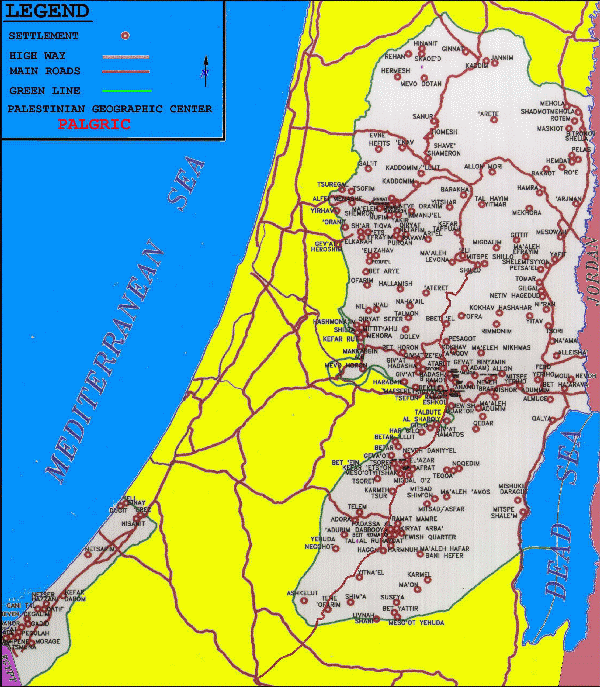
A Map of the Current Israeli Settlements Activities- 1997
Front Page Back to Index