
| Palestinian National Authority Official Website Building the State of Palestine |
PALESTINIAN NATIONAL AUTHORITY
Higher National Committee for Institutional Development (HNCID)
Coordination office
Position Paper
A PROPOSED SHORT TERM ACTION PLAN FOR THE
DEVELOPMENT OF THE PALESTINIAN PUBLIC INSTITUTIONS
presented at the joint meeting of
The Council on Foreign Relations Independent Task Force (ITF) and
The Palestinian Higher National Committee for Institutional Development.
Brussels, Nov. 3rd ,1999
On August 11, 1999 President Yasser Arafat issued decree regarding the formation of the Higher National Committee for Institutional Development (thereafter of the National Committee). According to this Presidential decree, the National Committee was mandated with:
While we were able, over the past five years, and under a very difficult political and economic setting, to set up new public institutions in the areas under our control, and to upgrade those that existed before the establishment of our National Authority, we are still faced with daunting problems with respect to achieving high standards of professional institutional management, and of assuring the quality of the public services delivered so as to meet our people’s own expectations for effective and substantial institutional reform and development.
Therefore, and based on our own needs to start the immediate and imperative process of a comprehensive review of the Palestinian experience in building our public institutions, and the necessity to develop and modernize these institutions as a part of the overall efforts needed to strengthen the internal structure of the Palestinian National Authority, and in order to be able to cope with the expected future challenges pertaining to the final status negotiations leading to the fulfillment of our people’s legitimate national aspirations in self determination and independence, this paper outlines our vision as to the nature of the tasks and responsibilities of the National Committee in accordance with the Presidential mandate.
The vision outlined in this paper is based on the discussions and deliberations that took place in the first four meetings of the National Committee on August 21 and 28, on September 15, and on Oct. 28, 1999. In those meetings, valuable thoughts and ideas were raised as to where to start (the question of priorities) and how to start (the question of mechanism), in addition to a whole host of other issues pertaining to the National Committee’s mandate and the scope of its future work. It is also based on the work done by the Technical Supporting Committee (TSC) which was established within the Ministry of Planning and International Cooperation (MOPIC) to help give advice in all related matters discussed in the National Committee meetings.
In addition to the thoughts and suggestions emerging from the National Committee’s own meetings, this paper has also benefited from many other domestic as well as international studies which came out in recent months, focusing on the present state of the Palestinian institutions and the need for institutional development and reform. Reference is especially made here to the work done by our Palestinian Legislative Council (PLC), and the Palestinian General Comptroller Office as well as to the solid work by Council on Foreign Relations (CFR) entitled “Strengthening the Palestinian Public Institutions”, the World Bank study on “Public Expenditure Review”, and other work on the subject by the European Union and USAID.
Concerns of the Palestinian public as it was evident from the letters sent to the National Committee, and the positive public reaction to its formation and its mandate which appeared in the local media, were also taken into consideration.
The report of the Council on Foreign Relations (CFR) on “Strengthening the Palestinian Public Institutions” has presented a solid diagnostic as well as a prescriptive in – depth analysis of the current state of our “political” and “operational” public institutions. In so doing, the report presents the Palestinian side with a valuable opportunity to take stock of our institutions and their ability to deliver public services to the community at large, and to start the process of undertaking the needed measures for institutional restructuring, development, and reform.
In this respect, the National Committee will work closely with the task force of the CFR in order to examine the ways and means of how the report’s recommendations can be best implemented.
Based on all of the above, and in order for the National Committee to be able to achieve its goals and objectives, the future work of the National Committee is planned to proceed in accordance with the following general guidelines and mechanism:
The proposed time period for each sector based sub-committee for designing its own action plan is two months. It is envisaged at this stage that four months will be enough for implementing the first phase of this short term action plan.
During the meeting, National Committee members raised many questions regarding the present conditions of the Palestinian public institutions especially in the fiscal and administrative areas. In spite of all the positive efforts exerted over the past five years, there still exist unclear regulations, inadequate standards, and insufficient organizational structures in most of the PNA institutions that said to have caused both inefficiencies and waste in the use of public sector limited resources, and unsatisfactory service delivery to the public. Other concerns were also voiced with respect to the serious present conditions in the Judiciary sector and in the Health sector, both of which are of enormous importance to the physical well being of the Palestinian population and to the future development of the Palestinian society. Many examples of deficiencies and sub-optimal performances in the above areas were cited. Finally, and still in the area of issues of immediate concern to the public, there is the question of Retirement and Pensions of the civil servants. Here a near unanimity existed between National Committee members as to the urgent need to deal with this question in a way that can revitalize the Palestinian public sector.
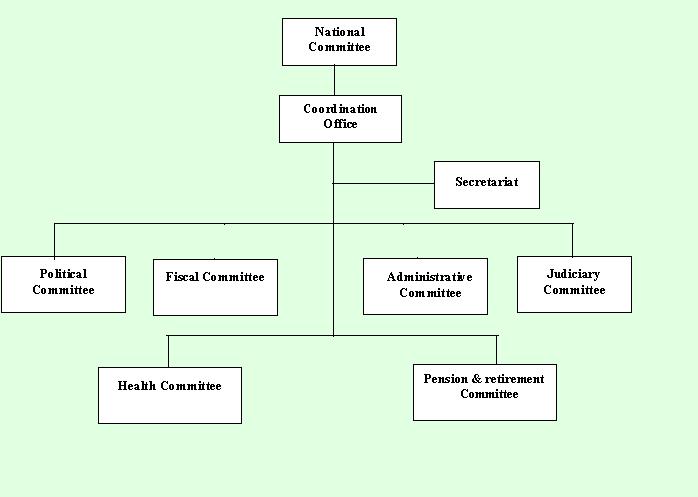
In order to initiate institutional development and reform, and to upgrade the performance of the public institutions in the above areas in a way that could produce a tangible positive impact on the daily life of the citizens and public servants alike, the National Committee has agreed to establish the following six sector-based sub-committees as the first step in the long process of achieving comprehensive institutional reform and development. These sub-committees are:
One. Political and strategic committee
Two. Fiscal reform committee
Three. Administrative reform committee
Four. Judiciary sector committee
Five. Health sector committee
Six. Early Retirement and Pensions committee
The first committee is of a special nature to be explained below. The second and the third committees on fiscal and administrative issues are more of a general type, which cut across the board of all Palestinian public institutions (horizontal reform), while the forth and fifth committees are squarely focused on the sectoral levels (vertical reform) where the need for development and reform is urgent and badly needed. The sixth committee deals with the issue of decommissioning of ex combatants, and is tailored to deal with one of the most delicate issues currently occupying the minds of almost all civil servants, and the aging ones in particular.
We have studied at length these areas, and the list above is by no means an exhaustive one. The choices were made to produce impact and, in some cases, visibility. This is very clear in the case of fiscal and judiciary committee which are intended to produce results that affect all other sectors in the economy, and positively affect both the public and the international community. Judiciary reform will produce results in that it will pre-empt corruption, protect the private sector, and it will help the private sector to conduct its business and to deal with government with certainty. Judiciary reform will also prevent measures taken by security forces to intervene in civilian cases using the pretext of the lengthy time it usually takes to resolve disputes.
Fiscal reform will produce the desired results of accountability and transparency which will have a positive visible impact on both local and expatriate Palestinian. The fiscal reform has the support of both the World Bank and the IMF. The recently appointed committee by the president on fiscal reform will try to draw and make use of all current studies in the field. The committee will use its influence to get presidential and legislative support for its action.
The choice of the early retirement issue was made so as to increase the efficiency of the public sector. The aim here is to provide early retirement to 15000 to 20000 public servants most of them were misfitted in the civil service because their experience is mainly in the military service. Allowing these people decent livelihood outside the system will have a pervasive impact on the public service system. It will reduce cost, and make the PNA able to restructure its salary scale so as to attract better and more qualified staff.
The health system was chosen because it affect a larg portion of the population, and it currently has serious administrative and financial problems. We did not feel the education system has the same problem as it is well managed in comparison. We will carefully look into all current international work in the health sector and cooperate closely with all those in the field.
In what follows, a general description of the nature of work and mandate of each committee will be stated briefly, while the more detailed analysis will be done by the committees themselves once established and start functioning.
A committee will be formed to deal with a variety of interrelated issues at the macro level, and to follow up on the currently on-going work of defining the nature and characteristics of the Palestinian political system to be adopted once a Palestinian state is declared. Here, the committee will be guided by our own national experiences, along with other countries, past and present experiences on such issues as legislative and municipal elections, multi parties-based political system and political dialogue, the formation of the constitution committee, democracy, and human rights.
The work of the committee here will focus on completing the on going efforts of consolidating financial accounts, unifying fiscal regulations across all public institutions, straightening the relation between the Ministry of Finance and all other ministries and governmental institutions, and finding solutions for outstanding fiscal difficulties facing both the Authority and the public. On the whole the objective here is to build a system that is based on transparency and accountability as well as fiscal sanity and prudence along with solid financial management principles.
The work of the committee here involves the completion of the organizational structure of ministries and public institutions, clarifying and specifying their mandate so as to prevent duplication of work, and finalizing job description of staff at all levels of seniority. The work of the committee will also involve supervising the internal efforts in each ministry to ensure a close implementation of the committee work. Again, the objective here is to achieve a level of performance in the public institutions based on effective, efficient, and smooth running administrative system.
This involves working on issues related to the police forces, interior, human rights and the independence of the judicial system. It also deals with rebuilding and rehabilitating the structure of the judiciary, mainly to meet the urgent needs of courts in terms of new recruitment of qualified staff, training of the existing staff to enable the judiciary system to deal with the huge number of outstanding cases. It is estimated that there is about 200,000 backlog cases still unresolved, out of which 65,000 cases related to land disputes. The work of the committee will adopt a systemic approach to judiciary reform, and will attempt tp present legislation on the judiciary arbitration system, and will be closely coordinated with the Ministry of Justice, Diwan El-Fatwa, and other related institutions in the sector.
This sector has a direct impact on daily living of a wide sector of the Palestinian population in the West Bank and Gaza Strip. Of utmost importance will be the state of primary and secondary health services, as well as health care centers across the Palestinian areas, especially those in the heavily populated areas in the Gaza Strip, and remote areas in the West Bank. The work of the committee will aim at adopting administrative, financial, and social measures, and open the door for private enterprise so as to achieve cost recovery, increase efficiency and effectiveness. Be closely coordinated with the Ministry of Health in order to design programs aiming to upgrade the performance of the health sector to make it more capable of serving all citizen.
This issue has a direct impact on the over effectiveness of public sector institutions and the provision of quality and high standard public service. The work of the committee aims to unify the pension and retirement system in the West Bank and Gaza Strip. The objective here is to:
Sector oriented sub-committees have already been established, and committee heads were designated. Members of these committees are currently in the process of being selected from within the PNA institutions closely associated with the above mentioned fields, and will have the qualifications and expertise needed to proceed with the diagnoses and analyses of the most problematic issues. Work in each sub committee will soon start to handle all related questions of development and reform in each of the above six areas, suggest certain reform measures (along the three criteria specified earlier), and put down a clear mechanism for implementation and monitoring. National teams will be aided by part-time and full-time domestic consultants as well as advisors to national teams. The final output of the work of these teams will be developed into specific “projects” that help bring about development and reform in the Palestinian public institutions.
Progress reports will be submitted on a weekly basis by the National Committee Coordination Office (located in the Ministry of Planning and International Cooperation) to National Committee members to update them on the work of all committees and get their feed back and instructions. The Coordination Office will have a small focused working team of domestic and international professionals. The Coordination office will play a crucial role as a link between all teams working in the field and the National Committee members.
Financial resources are needed to cover the expenses of the following items:
Expenses of the National Committee’s work including those of sub-committees and all future activities related to institutional development and reform will be covered partially from the PNA’s own public resource, especially those related to providing office space, running costs, etc. Other expenses related to salaries of full-time and part-time local as well as foreign consultants will be covered from the resources to be sought from the international community for that purpose.
ORGANIZATION OF THE
HIGHER NATIONAL COMMITTEE OF
INSTITUTIONAL DEVELOPMENT (HNCID)
| Front Page | Back to Index |