Arab opposition to an Israeli state began after the Balfour Declaration
1917, which supported the idea of a Jewish national homeland. In the 1920s
there were anti-Zionist riots in Palestine, after the British mandate
government allowed thousands of Jews to immigrate to Palestine from all
over the world.
In 1936 an Arab revolt led to a British royal commission that recommended
partition (approved by United Nations 1947), but rejected by the Arabs.
When it became clear that the British intended to leave by May 15, leaders
of the Yishuv decided (as they claim) to implement that part of the
partition plan calling for establishment of a Jewish state. In Tel Aviv on
May 14 the Provisional State Council, formerly the National Council,
"representing the Jewish people in Palestine and the World Zionist
Movement," proclaimed the "establishment of the Jewish State in Palestine,
to be called Medinat Israel (the State of Israel) … open to the immigration
of Jews from all the countries of their dispersion."
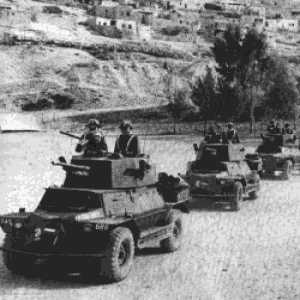
On May 15 the armies of Egypt, Transjordan (now Jordan), Syria,
Lebanon, and Iraq joined Palestinian and other Arab guerrillas
who had been fighting Jewish forces since November 1947. The
war now became an international conflict, the first
Arab-Israeli War.
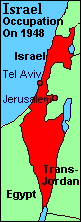
The Arabs failed to prevent establishment of a Jewish state,
and the war ended with four UN-arranged armistice agreements
between Israel and Egypt, Lebanon, Jordan, and Syria. The
frontiers defined in the armistice agreements remained until
they were altered by Israel's conquests during the Six-Day War
in 1967.

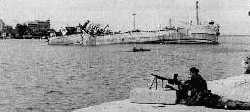
During the 1950s there was considerable tension between Israel and Egypt, which, under President Nasser, had become a leader in the Arab world. His nationalization of the Suez Canal 1956 provided an opportunity for Israel with Britain and France, to attack Egypt and occupy a part of Palestine that Egypt had controlled since 1949, the Gaza Strip , from which Israel was forced by UN and US pressure to withdraw 1957 .
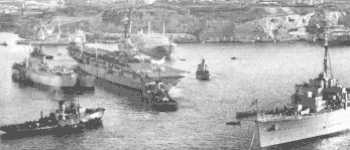
Great Britain and France ostensibly joined the attack because of their
dispute with Egypt's president Gamal Abdel Nasser, who had just
nationalized the Suez Canal. Nasser took over the canal after Great Britain
and France withdrew offers to finance the construction of the Aswân High
Dam. Israel scored a quick victory, seizing the Gaza Strip and the Sinai
Peninsula within a few days. As Israeli forces reached the banks of the
Suez Canal, the British and French started their attack.
The fighting was halted by the UN after a few days, and a UN Emergency
Force (UNEF) was sent to supervise the cease-fire in the Canal zone. In a
rare instance of cooperation, the United States and the Soviet Union
supported the UN resolution forcing the three invading countries to leave
Egypt and Gaza. By the end of the year their forces withdrew from Egypt,
but Israel refused to leave Gaza until early 1957, and only after the
United States had promised to help resolve the conflict and keep the
Straits of Tiran open.
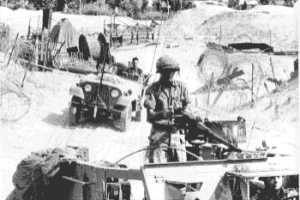
After the Suez-Sinai war Arab nationalism increased dramatically, as did
demands for revenge led by Egypt's president Nasser.
The formation of a united Arab military command
that massed troops along the borders, together
with Egypt's closing of the Straits of Tiran and
Nasser's insistence in 1967 that the UNEF leave
Egypt, led Israel to attack Egypt, Jordan, and
Syria simultaneously on June 5 of that year. The
war ended six days later with an Israeli victory.
Israel's French-equipped air force wiped out the
air power of its antagonists and was the chief
instrument in the destruction of the Arab armies.
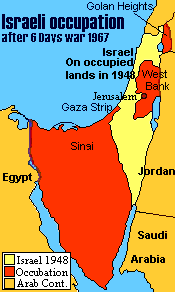
The Six-Day War left Israel in possession of Gaza
and the Sinai Peninsula, which it took from
Egypt; Arab East Jerusalem and the West Bank,
which it took from Jordan; and the Golan Heights,
taken from Syria. Land under Israel's
jurisdiction after the 1967 war was about four
times the size of the area within its 1949
armistice frontiers. The occupied territories
included an Arab population of about 1.5 million.
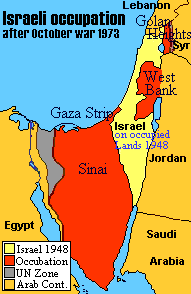
In 1973 Egypt joined Syria in a war on Israel
to regain the territories lost in 1967. The two
Arab states struck unexpectedly on October 6,
which fell on Yom Kippur , Israel's holiest
fast day .
After crossing the swise channel the Arab
forces gain a lot of advanced positions in
Sinai Peninsula and Golan Heights and manage to
defeat the Israeli forces for more then three
weeks.
Israeli forces with a massive U.S. economic and
military assistance managed to stop the arab
forces after a three-week struggle and defeat
with the cost of many casualties,and the Arabs
strong showing won them support from the Union
of Soviet Socialist Republics (USSR) and most
of the world's developing countries.
Israel, forced to compete with the nearly unlimited Arab resources, was
faced with a serious financial setback. Only massive U.S. economic and
military assistance enabled it to redress the balance, but even American
aid was unable to prevent a downward spiral of the economy.
In an effort to encourage a peace settlement, U.S. President Richard M.
Nixon charged his secretary of state, Henry Kissinger, with the task of
negotiating agreements between Israel and Egypt and Syria. Kissinger
managed to work out military disengagements between Israel and Egypt in the
Sinai and between Israel and Syria in the Golan Heights during 1974.
From 1978 the presence of Palestinian guerrillas in Lebanon led to Arab
raids on Israel and Israeli retaliatory incursions.
On 6 June 1982 Israel launched a full-scale invasion. By 14 June Beirut was
encircled, Palestine Liberation Organization (PLO) and Syrian forces were
evacuated mainly to Syria 21-31 Aug.
In Feb 1985 there was a unilateral Israeli withdrawal from the country
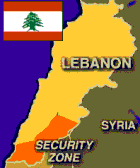
without any gain or losses incurred. Israel maintains an occupied area called as a 'security zone' in
South Lebanon and supports the South Lebanese Army Militia of Lahad, both were occupying the south of Lebanon to defend israelis from
palestinian attacks, and both carried out number of massacres against Lebanese and Palestinian people.
Israel's alleged complicity in massacres in two Palestinian refugee camps
increased Arab hostility and many other massacres like
Beirut, Nabattiyeh, Abbasiyeh, Qana with hundreds of lebanese
civilians killed by Israelis. Talks between Israel and Lebanon , between Dec
1982 and May 1983, resulted in an agreement, drawn up by US secretary of
state George Shultz, calling for the withdrawal of all foreign forces from
Lebanon within three months. Syria refused to acknowledge the agreement,
and left some 30,000 troops, with about 7,000 PLO members, in northeast,
Israel retaliated by refusing to withdraw its forces from the south.
Meanwhile the problems in Lebanon continued. In 1984, under pressure from
Syria, President Gemayel of Lebanon abrogated the 1983 treaty with Israel ,
but the government of national unity in Tel Aviv continued to plan the
withdrawal of its forces. Guerrilla groups of the lebanese resistant on south of Lebanon started their resistant against the Israeli occupation since 1985 when the main important resistant group in
Lebanon which is Hizbollah was founded. Most of the withdrawal
was complete by June 1985 except the south of Lebanon of what so called the 'security zone'.
The south of Lebanon was liberated by resistant operations when Israel withdraw in 25/5/2000.
Israel still occupying Shebaa farms and other small areas until today.
Prime Minister Peres met King Hussein of Jordan secretly in the south of
France 1985, later, in a speech to the UN , Peres said he would not rule
out the possibility of an international conference on the Middle East . PLO
leader Yasser Arafat also had talks with Hussein and later,in Cairo,
renounced PLO guerrilla activity outside Israeli-occupied territory . In
Israel , government of national unity was having some success with its
economic policies , inflation falling in 1986 to manageable levels, but
from 1987 it was faced with an organized Palestinian uprising in the
occupied territories, the Intifada.
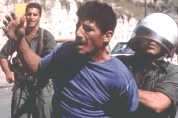
Relations between Israel and the Palestinians entered a new phase in the
late 1987 with the intifada, a series of uprisings in the occupied
territories that included demonstrations, strikes, and rock-throwing
attacks on Israeli soldiers . The harsh response by the Israeli government
drew criticism from both the United States and the UN.
The uprising began Dec 1987 in the Gaza Strip. Rumours that a fatal traffic
collision had been caused by Israeli security service agents in retaliation
for the stabbing of an Israeli the previous week led to demonstrations by
teenagers armed with slingshots. It subsequently spread, despite attempts
at repression. Some 1,300 Palestinians and 80 Israelis were killed in the
uprising up to the end of 1991. Many Palestinian private homes were
dynamited by military order.
