

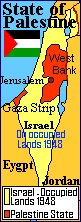

On 15.11.1988, The PNC meeting in Algiers declared the State of Palestine
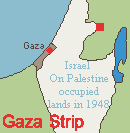
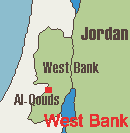
as outlined in the UN Partition Plan 181, which includes Gaza Strip and
West Bank currently under the Israeli occupation since 1967.
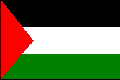
And a flag and the National Anthem for the new state presented.
On 13.09.1993, Chairman Arafat of PLO signed the Declaration of Principles
agreement in Washington with the Israeli Prime Minister, Yitzhak Rabin for
a limited self-rule in Gaza Strip and West Bank based on UN resolution 242
and other UN resolution related to the Arab-Israeli conflict, to start with
Israeli withdraw from Gaza Strip and West Bank city of Jerico which took
place in 1994 .
On July 1994, Chairman Arafat entered Gaza as a president for the new
founded Palestinian National Authority , a political body responsible for
governing the self-rule Palestinian areas.
Interim governing body appointed July 1994 to take over the management of Palestinian affairs from Israel in newly liberated Gaza Strip and Jericho . It is headed by Yasser Arafat, chairman of the PLO. The PNA has jurisdiction over the whole of the formerly occupied areas, except Israeli settlers and nationals, Israel retains responsibility for external defence and foreign affairs.
In 1958, he left Egypt to Kuwait where he worked as an engineer and met
with Abu Jihad. In Kuwait, he discussed the idea of establishing “Fatah”
the Palestinian National Liberation Movement. After that he, returned to
Palestine where he met with a group of Palestinian activists and founded
Fatah Movement on the 1st of January 1965.
He stayed in Jerusalem until 1967, then he left to Jordan. He secretly
returned to Palestine 3 times.
He led Al-Karamah battle in 1968 with his Palestinian colleagues in Fatah
where the Palestinian resistance won the battle against the Israelis.
He was elected as Chairman for the Executive Committee of the PLO in 1969
to be the 3rd chairman after Ash-Shuqiri and Yahya Hamoda. He is still the
chairman of the committee until the present time.
In the aftermath of September war 1969 in Jordan, he moved to Lebanon and
remained there until 1982 when Beirut was under siege for three months by
the Israeli army who failed to conquer the PLO. After that he left Beirut
to Tunisia.
In 1987, the Palestinian Intifada erupted in the occupied Palestinian
territories and lasted until 13 September 1993 when President Arafat signed
the Declaration of Principles agreement in Washington with the Israeli
Prime Minister, Yitzhak Rabin.
On 4 May 1994 President Arafat signed the Cairo agreement with Rabin.
On July 1994, he entered Gaza after 27 years .
In 1994, President Arafat was awarded the Nobel peace prize which he shared
with the late PM Rabin and Mr. Shimon Peres.
In 1995 he signed the Taba agreement.
On 20 January, he was elected President of the Palestinian National
Authority in the first general free elections for the Palestinian people on
its land where he took 83% of the votes.
The first elected Palestinian Legislative Council (PLC) was initially
conceptualized with the Declaration of Principles (DOP). The idea was
further developed in the Israel-Palestinian Interim Agreement (Oslo II) in
which the structure, jurisdiction, functions, size, and responsibilities of
the Council were determined.
The PLC, is to replace the Palestinian Authority upon it inauguration. As
such, the Council is expected to act as the highest authority in the
interim phase. The PLC is the body responsible for legislation and from it
the majority (80% of the cabinet) of the Executive Authority is appointed.
The Council established eleven permanent committees at its second meeting on April 4, 1996. Under Title III of the Standing Rules, the committees review and propose amendments to legislation, report to the Council, receive constituent complaints, and study and review plans, programs, agreements, and treaties submitted to the Council by the Executive Authority. The committees discuss and report to the Council on any proposals referred by the Council or by the Speaker. The committees usually meet twice a week and may hold additional meetings at the call of the chairman, or by request of the Speaker or a majority of the members of the committee, with at least 24 hours notice. The committees meet in secret but can decide to hold public meetings. The quorum for a committee meeting is a majority of its members and decisions of the committees require a simple majority. Each committee has a chairman and a secretary elected from among its members. A committee may request, through the Speaker, that any relevant Minister or responsible person within the Palestinian National Authority give information or clarify any issue within the committee’s mandate. A committee may also ask the Speaker to request, through the President of the Authority, the attendance of any relevant Minister at a committee meeting.
