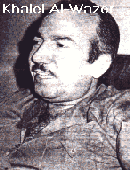
By name ABU JIHAD (born Oct. 10, 1935, Ramla, Palestine -d. April 16, 1988,
Tunis, Tunisia), Palestinian leader who was believed to be the military
strategist and second in command of the Palestine Liberation Organization
(PLO).
Palestine's most loyal sons and one of the Palestinian Revolution's
historical leaders, Khalil al-Wazir (Abu Jihad), He was assassinated by
Zionist commandos, in Tunis, Tunisia. At the time of his assassination Abu
Jihad was working late in his office. He refused to surrender to his
assassins. After a brief exchange of fire Abu Jihad, the mastermind behind
the Savoy Operation in 1975 and Dalal al-Mughrabi's operation on the raod
between Tel Aviv and Haifa in March of 1978, fell with his gun in his hand.
It was reported later that his body was riddled with 77 bullets.
Abu Jihad was born in Ramla in 1935. He was displaced in 1948 when Zionist
forces evicted Palestinians from that region. He settled in the Burayj
refugee camp in the Gaza Strip, where he completed his secondary education.
He planned and executed military acts against Israeli targets and in 1954
was punished by the Egyptian authorities for such activities. Al-Wazir
received his military traning in Cairo while attending classes at the
University of Alexandria in 1956 but never completed college education Abu
Jihad found work in Kuwait in 1959 and remained there, working as a
teacher, until 1963. His stay in Kuwait put him in touch with his comrades
with whom he founded the FATEH movement. Al-Wazir was one of the early
full-time (mutafarrigh) members of Fatah after the Fatah Central Committee
instructed him to open an office for the movement in Algeria. He was also
one of the founding editors of Filastinuna, the official organ of Fatah. He
was in charge of the recruitment and training of Fatah fighters, creating
the nucleus of the fighting force of Fatah, later known as AL-ASIFA, The
Storm. Al-Wazir settled in Algeria in 1963 and cultivated ties with
military leaders in socialist countries. He opened the first office for
Fatah in an Arab country and started the first military training camp for
his movement. He visited China in 1964 and later preached "a people's
liberation war," although he never supported communism as an ideology .He
also visited North Vietnam and North Korea, here he received advanced
military education.
In 1965, Abu Jihad settled in Damascus, taking advantage of the Syrian
Ba'thist regime's support of the doctrine of people's liberation war. He
became the major link between underground activist cells inside Occupied
Palestine and the Palestinian national movement. The 1967 defeat propelled
him into a key leadership position with the PLO, made possible by his
reputation as an expert on people's liberation war, considered the only
solution at the time. He assumed major responsibilities in the Central
Committee of Fatah, in the command of the forces of al-Asifa, on the
PALESTINE NATIONAL COUNCIL, and on the Supreme Military Council of the PLO.
He was also put in charge of commando operations in the Occupied
Territories and inside Israel. Abu Jihad played an important military role
in JORDAN in 1970-71 during the BLACK SEPTEMBER clashes, He also supplied
the encircled Palestinian forces in Jarash and Ajlun. Then, like other PLO
leaders, he relocated to Beirut, where he kept a low profile until the
eruption of the Lebanese civil war. He advocated a policy of full support
for the Lebanese national movement and helped build up the forces of the
PLO's Lebanese allies. Meanwhile, his main interest remained with the
Occupied Territories; more than any other person inside the PLO and Fatah,
Abu Jihad is credited with the development of underground cells in the WEST
BANK and Gaza despite Israeli attempts to eradicate all vestiges of
opposition to the occupation. Abu Jihad used his contacts with communist
countries to augment the military power of the PLO. The resulting arms
acquisition changed the PLO's fighting forces into a conventional army,
rather than the "people's liberation forces" on which he had earlier
insisted. Nevertheless, Abu Jihad remained close to his fighters; avoiding
the lure of Beirut, he established his headquarters in Kayfun, near Alayh
in Mount Lebanon.
Unlike other PLO leaders, Abu Jihad did not allow the Lebanese environment
to discredit his role within the movement; he was never tainted by the
massive corruption and thuggery that swept the ranks of PLO officials.
Although he was less visible than most of his comrades, he commanded the
respect and loyalty of most Palestinians, including members of rival
organizations. His close relationship with Yasir Arafat was greatly to
Arafat's benefit, since Arafat was being constantly challenged from within
over his search for a diplomatic solution to the Palestinian problem.
The 1982 invasion of Lebanon by the Zionist forces forced Abu Jihad, along
with other PLO leaders, to relocate farther away from Palestine, this time
in Tunisia.
The 1982 invasion of Lebanon seemed to have changed Abu Jihad's political
and military philosophy; apparently, he lost faith in the PLO's ability to
deliver a solution to the Palestinians from outside the Occupied
Territories. Instead, he believed in the power of the masses in the West
Bank and Gaza. In 1982, he began to sponsor youth committees in the
Occupied Territories, committees that became the embryonic organization
that later ignited the INTIFADA. However, Abu Jihad did not live long
enough to see that uprising; he was assassinated by Israeli commandos in
April 1988.