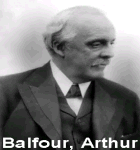
British Conservative politician, prime minister 1902-05 and foreign
secretary 1916-19, when he issued the Balfour Declaration 1917 and was
involved in peace negotiations after World War I, signing the Treaty of
Versailles.
Son of a Scottish landowner, Balfour was elected a Conservative member of
Parliament 1874. In Lord Salisbury’s ministry he was secretary for Ireland
1887, and for his ruthless vigour was called ‘Bloody Balfour’ by Irish
nationalists. In 1891 and again in 1895 he became First Lord of the
Treasury and leader of the Commons, and in 1902 he succeeded Salisbury as
prime minister. His cabinet was divided over Joseph Chamberlain’s
tariff-reform proposals, and in the 1905 elections suffered a crushing
defeat.
Balfour retired from the party leadership 1911. In 1915 he joined the
Asquith coalition as First Lord of the Admiralty. As foreign secretary
1916-19 he issued the Balfour Declaration in favour of a national home in
Palestine for the Jews. He was Lord President of the Council 1919-22 and
1925-29. Created 1st Earl of Balfour 1922. He also wrote books on
philosophy.