
|

ARCHEOLOGICAL SITES
Maqam Al-Nabi Musa
Tomb of Prophet Moses
Location
Maqam al-Nabi Musa, or the Tomb of Prophet Moses,
is a splendid example of early Islamic architecture set in an awe-inspiring
landscape. 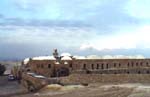 It
lies 30 km east of Jerusalem in an area called Bariyet al-Quds or
the Wilderness of Jerusalem. A narrow road to the right of the main Jerusalem-Jericho
road, about 2 km beyond the sign indicating sea level, leads to a grand
domed building which is held to be the burial place of Moses. The Wilderness
of Jerusalem, also known as the Judaean Desert, is a semi-desert. In ancient
times, monks and hermits came to meditate and pray in its silence. For
generations, Bedouins have been migrating here in search of winter pasture
for their flocks. Today, several Israeli military settlements have sprung
up in the region. It
lies 30 km east of Jerusalem in an area called Bariyet al-Quds or
the Wilderness of Jerusalem. A narrow road to the right of the main Jerusalem-Jericho
road, about 2 km beyond the sign indicating sea level, leads to a grand
domed building which is held to be the burial place of Moses. The Wilderness
of Jerusalem, also known as the Judaean Desert, is a semi-desert. In ancient
times, monks and hermits came to meditate and pray in its silence. For
generations, Bedouins have been migrating here in search of winter pasture
for their flocks. Today, several Israeli military settlements have sprung
up in the region.
History of the Site
The maqam of Nabi Musa is considered a holy place
because it houses the grave of prophet Moses according to local tradition.
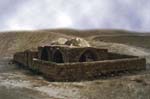 Moses
is recognized by Moslems as one of the great prophets of Islam. The bituminous
rocks around the shrine add to its mystique and sanctity since they are
flammable. This remarkable property is due to their mineral content of
qatraan or tar, and it has a distinctive smell. Pilgrims use the
stones as fuel for warmth and cooking. Moses
is recognized by Moslems as one of the great prophets of Islam. The bituminous
rocks around the shrine add to its mystique and sanctity since they are
flammable. This remarkable property is due to their mineral content of
qatraan or tar, and it has a distinctive smell. Pilgrims use the
stones as fuel for warmth and cooking.
The tomb has been the site of an annual pilgrimage festival
or mawsim at least since the time of the great Muslim leader Salah
al-Din (Saladin) who liberated Jerusalem from the Crusaders in the twelfth
century AD. Muslims believe that Moses is buried here; although, according
to the Old Testament (Deuteronomy 34), Moses never entered Palestine, the
"Promised Land", but rather died at Mount Nebo in present day
Jordan.
The main body of the present shrine-the mosque, minaret,
and some of the rooms-was completed in 1269 AD during the reign of the
Mamluk Sultan, al-Dhaher Baybars who reigned from 1260 AD to 1277 AD. Baybars
bequeathed a huge religious endowment-waqf-of agricultural land
and villages to support the maqam, including Turmus Aiya, al-Mazra'a,
Khirbet Abu Falah, Sur Baher, and the lands and waters of Wadi Qilt, and
Jericho. In later periods, more lands and villages from the Nablus region
and Ajlun were added to the waqf, making it the largest in the whole
of Palestine.
Successive additions of rooms for visitors and pilgrims
brought the maqam to its present shape and size in 1475 AD. Further
major maintenance and restorations were undertaken by the Ottoman rulers
in 1820, this is documented by an inscription above the main western entrance
of the maqam.
The mawsim of Nabi Musa
The growth of the annual pilgrimage and festival of Nabi
Musa (and other local religious festivals like Nabi Saleh, Nabi Rubin,
and Sa'idna Hussein) was, at least in part, a response to the atmosphere
of religious fundamentalism engendered during the Crusader period. At that
time, Muslims were banned from visiting Jerusalem. 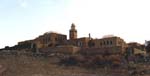 Thus,
the Nabi Musa festival was both a Muslim alternative and response to the
crusaders occupation of Jerusalem. Pilgrimage to the maqam was encouraged
by successive Muslim rulers to counterbalance the influx of Christian pilgrims
to Jerusalem during the Holy Easter Week in April. From that time on, thousands
of Muslims from all over Palestine made it their habit to come to Jerusalem
on Good Friday. They prayed in al-Aqsa Mosque and then marched in grand
procession, singing religious songs, dancing the traditional dabkeh,
and playing flutes and drums until they reached the maqam. Prayers,
celebrations, horse racing and games continued for five days around the
shrine. This has developed over the years to became one of the most attractive
and popular festivals in Palestine. Thus,
the Nabi Musa festival was both a Muslim alternative and response to the
crusaders occupation of Jerusalem. Pilgrimage to the maqam was encouraged
by successive Muslim rulers to counterbalance the influx of Christian pilgrims
to Jerusalem during the Holy Easter Week in April. From that time on, thousands
of Muslims from all over Palestine made it their habit to come to Jerusalem
on Good Friday. They prayed in al-Aqsa Mosque and then marched in grand
procession, singing religious songs, dancing the traditional dabkeh,
and playing flutes and drums until they reached the maqam. Prayers,
celebrations, horse racing and games continued for five days around the
shrine. This has developed over the years to became one of the most attractive
and popular festivals in Palestine.
The mawsim is a religious occasion but it is also
a time for celebration and relaxation. It was an important social event
too, since it brought together Palestinians from all parts of the country
who met, discussed their affairs, forged links with one another, and planned
joint activities. Delegations came from as far away as Haifa, Nablus, Jaffa,
Hebron, Jerusalem, and other towns and villages in Palestine. The political
significance of such a huge gathering was demonstrated during the 1920s
and 1930s. Tens of thousands of Palestinians at Nabi Musa demonstrated
against Zionist immigration and settlement in Palestine, and against the
British Mandate authorities who supported it. In 1930, the British army
was called in to quell demonstrations at the site; and in 1937, the British
banned celebrations at the maqam completely. Annual pilgrimage was
resumed only in 1987, when 50,000 Palestinians attended a mawsim
organized by the Muslim Waqf in Jerusalem after a break of 50 years.
Description of the Site
The maqam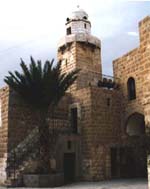 represents Islamic architecture in its simplest and best form. It is a
huge two story building topped by a complex of domes. The building consists
of a large central open courtyard surrounded by over 120 rooms, usually
reserved for rich families; poorer people slept in tents or out in the
open.
represents Islamic architecture in its simplest and best form. It is a
huge two story building topped by a complex of domes. The building consists
of a large central open courtyard surrounded by over 120 rooms, usually
reserved for rich families; poorer people slept in tents or out in the
open.
The main mosque, with a minaret, lies against the western
wall of the courtyard. Inside, there is a mihrab or prayer niche
pointing in the direction of Mecca, and beside it is a minbar or
pulpit from which the Imam traditionally leads the prayers. A wall with
a large opening divides the mosque into two parts: the large eastern section
is designated for men, while the smaller western part is for women-it is
also at a lower level so as to prevent eye-contact between the sexes during
prayer. 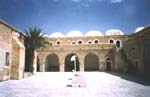 To
the right of the main entrance of the mosque, another door leads to a small
chamber in the center of which is a tomb covered with a green cloth, that
is the burial place of the Prophet Moses. On the wall, a Mamluk inscription
reads: "The construction of this maqam over the grave of the
Prophet who spoke with God, Moses, is ordered by his majesty, Sultan Dhaher
Abu al-Fatah Baybars, in the year 668 hijra" (AD 1269\70).
The title, Abu al-Fatah, meaning 'The Conqueror', was given to Baybars
since he liberated Palestine from the Crusaders. To
the right of the main entrance of the mosque, another door leads to a small
chamber in the center of which is a tomb covered with a green cloth, that
is the burial place of the Prophet Moses. On the wall, a Mamluk inscription
reads: "The construction of this maqam over the grave of the
Prophet who spoke with God, Moses, is ordered by his majesty, Sultan Dhaher
Abu al-Fatah Baybars, in the year 668 hijra" (AD 1269\70).
The title, Abu al-Fatah, meaning 'The Conqueror', was given to Baybars
since he liberated Palestine from the Crusaders.
Outside the mosque, the fine minaret affords a wonderful
panoramic view of the shrine, the Jordan Valley and the desert hills beyond.
On a clear day, one can also catch sight of the Hills of Moab on the eastern
bank of the Jordan River and Mount Nebo which biblical tradition associates
with Moses.
The huge cemetery outside the walls of the shrine is for
Muslims who either died during the festivals or who asked to be buried
here because of the sanctity of the site. According to local tradition,
the cemetery includes two important tombs over which two small maqams
have been built: the larger one, about one kilometer west of Nabi Musa,
is held by local tradition to be that of Hassan al-Ra'i, the shepherd of
the Prophet Moses, although records show him to have been a guardian of
the maqam in the nineteenth century. Unfortunately, this maqam
has been vandalized in recent years. The second tomb, to the southeast,
is held to be that of A'isha, the favorite wife of the Prophet Mohammed.
Again, A'isha is known to have died in Syria--this tomb is perhaps that
of a righteous local woman of the same name.
The maqam today
The 1937 ban on the mawsim of Nabi Musa continued
and the shrine was used as a military base under Jordanian rule and by
the Israelis until 1973 when it was handed back to the Islamic Waqf in
Jerusalem. It resumed once in 1987 but was halted by the outbreak of the
Palestinian Intifada against the occupation which started in December
of that year. The Oslo Accord of 1992 between Israel and the PLO placed
the sanctuary under the jurisdiction of the Palestinian Ministry of the
Islamic Waqf. Although major reconstruction and restoration works
need to be carried out, there are plans to celebrate the Nabi Musa festival
as from April 1997.
A Palestinian family from Jericho lives on the site and
looks after it; they are happy to show visitors around. They run a small
shop selling interesting and unusual gifts, such as pure olive-oil soap,
honey, and locally-produced olive oil, the proceeds of which go towards
maintaining the site. Soft drinks and snacks are also available. The sanctuary
is open daily from 8 am until sunset; no entrance fee is required, but
donations towards its upkeep are welcome.
|